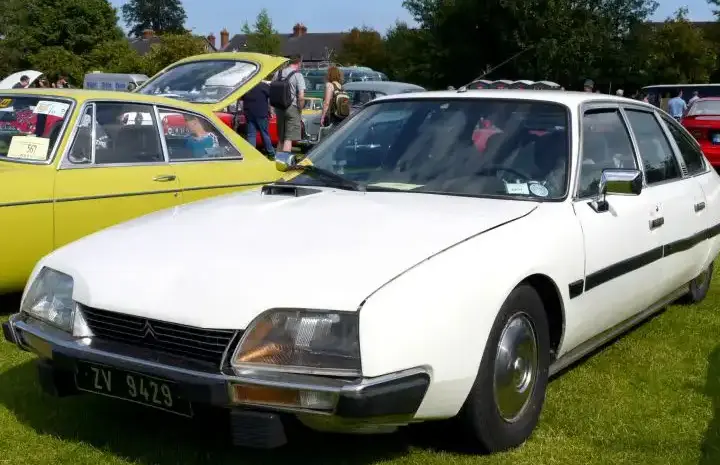
The Citroën CX I Break Super 2400, produced between 1980 and 1982, represents a distinctive iteration of Citroën’s innovative CX series. Positioned as a premium variant within the CX I Break (estate/station wagon) lineup, the Super 2400 offered a blend of comfort, performance, and practicality. It was built upon the foundation of the CX platform, internally designated as the G series, and shared its advanced hydropneumatic suspension with the rest of the range. This model aimed to provide a more refined experience than the base CX models, appealing to buyers seeking a spacious and comfortable family vehicle with a touch of luxury. The CX series as a whole was Citroën’s replacement for the venerable DS, continuing the company’s tradition of engineering innovation.
Technical Specifications
| Brand | Citroen |
| Model | CX |
| Generation | CX I Break |
| Type (Engine) | Super 2400 (120 Hp) |
| Start of production | 1980 year |
| End of production | 1982 year |
| Powertrain Architecture | Internal Combustion engine |
| Body type | Station wagon (estate) |
| Seats | 5 |
| Doors | 5 |
| Fuel Type | Petrol (Gasoline) |
| Maximum speed | 180 km/h (111.85 mph) |
| Weight-to-power ratio | 11.8 kg/Hp, 84.5 Hp/tonne |
| Weight-to-torque ratio | 7.2 kg/Nm, 138 Nm/tonne |
| Power | 120 Hp @ 5500 rpm |
| Power per litre | 51.1 Hp/l |
| Torque | 196 Nm @ 2750 rpm (144.56 lb.-ft. @ 2750 rpm) |
| Engine layout | Front, Transverse |
| Engine Model/Code | M23.639 |
| Engine displacement | 2347 cm3 (143.22 cu. in.) |
| Number of cylinders | 4 |
| Engine configuration | Inline |
| Cylinder Bore | 93.5 mm (3.68 in.) |
| Piston Stroke | 85.5 mm (3.37 in.) |
| Compression ratio | 8.75:1 |
| Number of valves per cylinder | 2 |
| Fuel injection system | Carburettor |
| Engine aspiration | Naturally aspirated engine |
| Engine oil capacity | 5.3 l (5.6 US qt | 4.66 UK qt) |
| Coolant | 11 l (11.62 US qt | 9.68 UK qt) |
| Kerb Weight | 1420 kg (3130.56 lbs) |
| Max. weight | 2130 kg (4695.85 lbs) |
| Max load | 710 kg (1565.28 lbs) |
| Trunk (boot) space – minimum | 110 l (3.88 cu. ft.) |
| Trunk (boot) space – maximum | 2030 l (71.69 cu. ft.) |
| Fuel tank capacity | 68 l (17.96 US gal | 14.96 UK gal) |
| Permitted trailer load with brakes (12%) | 1300 kg (2866.01 lbs) |
| Length | 4952 mm (194.96 in.) |
| Width | 1734 mm (68.27 in.) |
| Height | 1456 mm (57.32 in.) |
| Wheelbase | 3095 mm (121.85 in.) |
| Front track | 1474 mm (58.03 in.) |
| Rear (Back) track | 1390 mm (54.72 in.) |
| Front overhang | 1050 mm (41.34 in.) |
| Rear overhang | 807 mm (31.77 in.) |
| Drag coefficient (Cd) | 0.43 |
| Minimum turning circle (turning diameter) | 12.70 m (41.67 ft.) |
| Drivetrain Architecture | The Internal combustion engine (ICE) drives the front wheels of the vehicle. |
| Drive wheel | Front wheel drive |
| Number of gears and type of gearbox | 5 gears, manual transmission |
| Front brakes | Ventilated discs |
| Rear brakes | Disc |
| Steering type | Steering rack and pinion |
| Wheel rims size | 5.5J x 14 |
The Citroën CX I Break Super 2400 was powered by the M23.639 engine, a 2.4-liter inline-four cylinder petrol engine. This engine was a mainstay of Citroën and Peugeot vehicles during the late 1970s and early 1980s. It featured a cast iron block and an aluminum cylinder head, with two valves per cylinder operated by a single overhead camshaft. The Super 2400 utilized a Solex C35 PHH carburetor for fuel delivery, a relatively common setup for the period, though less sophisticated than fuel injection systems. The engine produced 120 horsepower at 5500 rpm and 196 Nm (144.56 lb-ft) of torque at 2750 rpm. The engine was transversely mounted, contributing to the CX’s front-wheel-drive configuration. The transmission was a five-speed manual gearbox, providing a reasonable balance between performance and fuel economy. The engine’s design prioritized smoothness and refinement over outright power, aligning with Citroën’s reputation for comfortable and sophisticated vehicles.
Driving Characteristics
The CX I Break Super 2400 offered a unique driving experience largely defined by its hydropneumatic suspension. This system, a Citroën hallmark, provided an exceptionally smooth and comfortable ride, absorbing bumps and imperfections in the road with remarkable effectiveness. The 120 hp engine, coupled with the five-speed manual transmission, provided adequate performance for cruising and everyday driving. However, it wasn’t a particularly sporty vehicle. Acceleration was respectable, but not brisk, and the engine felt somewhat strained at higher speeds, especially when fully loaded. The gear ratios were tuned for relaxed cruising rather than aggressive acceleration. Compared to the more powerful CX 2500 GTI, the Super 2400 felt noticeably slower. The steering was light and precise, thanks to the rack-and-pinion system, but lacked significant feedback. The front-wheel-drive layout provided good traction in most conditions, but could exhibit some understeer when pushed hard.
Equipment & Trim Levels
The Super 2400 trim level represented a step up in terms of equipment compared to the base CX I Break models. Standard features typically included comfortable cloth upholstery, a wood-trimmed dashboard, and power-assisted steering. Additional features often included a radio, heated rear window, and a trip computer. Optional extras could include air conditioning, leather upholstery, and a sunroof. The interior design was typically understated and functional, prioritizing comfort and ergonomics. The CX I Break’s spacious interior and large cargo area made it a practical choice for families and those needing to transport large items. The estate body style offered a significant advantage in terms of versatility compared to the saloon version.
Chassis & Braking
The CX I Break Super 2400 utilized an independent suspension system on all four wheels, with the aforementioned hydropneumatic technology providing self-leveling and adjustable ride height. The front suspension featured MacPherson struts, while the rear suspension employed trailing arms. The braking system consisted of ventilated disc brakes at the front and solid disc brakes at the rear. The brakes were effective, providing good stopping power, but lacked the sophistication of more modern anti-lock braking systems. The steering was a rack-and-pinion system, offering precise and responsive control. The chassis was designed to prioritize ride comfort and stability, rather than outright handling performance.
Market Reception & Comparison
The Citroën CX I Break Super 2400 was generally well-received by critics, who praised its comfortable ride, spacious interior, and innovative technology. However, some critics noted the engine’s lack of outright power and the car’s relatively high price. Compared to other estate cars of the time, such as the Volvo 240 or Ford Estate, the CX offered a more sophisticated and luxurious experience, but at a higher cost. Fuel economy was reasonable for the period, but not exceptional. Reliability was a mixed bag, with the hydropneumatic suspension system requiring regular maintenance and occasional repairs. The Super 2400 offered a compelling alternative to more conventional estate cars, appealing to buyers who valued comfort and innovation above all else.
Legacy
The Citroën CX I Break Super 2400, while not a high-volume seller, remains a fondly remembered vehicle among Citroën enthusiasts. The M23 engine, while not known for its longevity, is generally reliable when properly maintained. The hydropneumatic suspension system, while complex, is capable of providing years of comfortable service with regular attention. Today, the CX I Break Super 2400 is a relatively rare sight on the road, and well-maintained examples are becoming increasingly collectible. Its unique blend of comfort, innovation, and practicality continues to appeal to those seeking a classic French automobile with a distinctive character. Parts availability can be a challenge, but a dedicated network of specialists and enthusiasts helps to keep these cars running.