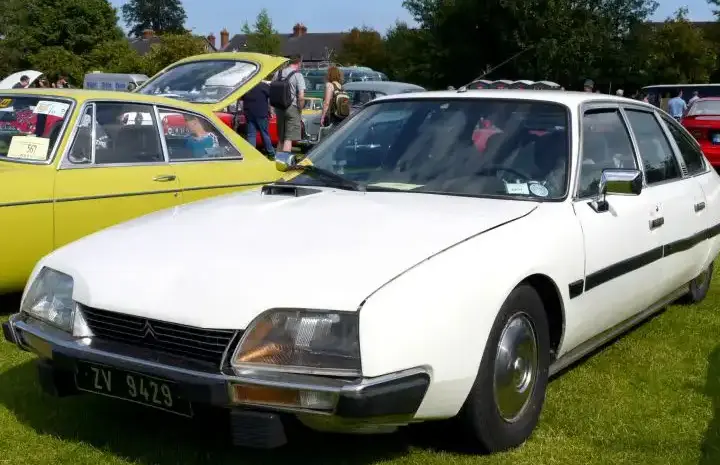
The Citroën CX I Break Super 2500 D was a variant of the groundbreaking CX series, produced between 1978 and 1980. Positioned as a practical, diesel-powered estate car, it offered a blend of Citroën’s innovative hydropneumatic suspension with the spaciousness expected of a family wagon. This model occupied a specific niche within the CX lineup, appealing to buyers prioritizing fuel economy and load-carrying capacity over outright performance. It was built on the CX I platform, known for its aerodynamic design and advanced engineering, and represented Citroën’s continued commitment to distinctive automotive solutions.
Technical Specifications
| Brand | Citroen |
| Model | CX |
| Generation | CX I Break |
| Type (Engine) | Super 2500 D (75 Hp) |
| Start of production | 1978 year |
| End of production | 1980 year |
| Powertrain Architecture | Internal Combustion engine |
| Body type | Station wagon (estate) |
| Seats | 5 |
| Doors | 5 |
| Fuel Type | Diesel |
| Acceleration 0 – 100 km/h | 19.8 sec |
| Acceleration 0 – 62 mph | 19.8 sec |
| Acceleration 0 – 60 mph | 18.8 sec |
| Maximum speed | 145 km/h (90.1 mph) |
| Weight-to-power ratio | 19.5 kg/Hp, 51.2 Hp/tonne |
| Weight-to-torque ratio | 9.8 kg/Nm, 102.4 Nm/tonne |
| Power | 75 Hp @ 4250 rpm |
| Power per litre | 30 Hp/l |
| Torque | 150 Nm @ 2000 rpm (110.63 lb.-ft. @ 2000 rpm) |
| Engine layout | Front, Transverse |
| Engine Model/Code | M25-629 |
| Engine displacement | 2499 cm3 (152.5 cu. in.) |
| Number of cylinders | 4 |
| Engine configuration | Inline |
| Cylinder Bore | 93 mm (3.66 in.) |
| Piston Stroke | 92 mm (3.62 in.) |
| Compression ratio | 22.25:1 |
| Number of valves per cylinder | 2 |
| Fuel injection system | Precombustion chamber injection |
| Engine aspiration | Naturally aspirated engine |
| Engine oil capacity | 5.3 l (5.6 US qt | 4.66 UK qt) |
| Coolant | 12.3 l (13 US qt | 10.82 UK qt) |
| Kerb Weight | 1465 kg (3229.77 lbs.) |
| Max. weight | 2110 kg (4651.75 lbs.) |
| Max load | 645 kg (1421.98 lbs.) |
| Trunk (boot) space – minimum | 1100 l (38.85 cu. ft.) |
| Trunk (boot) space – maximum | 2030 l (71.69 cu. ft.) |
| Fuel tank capacity | 68 l (17.96 US gal | 14.96 UK gal) |
| Length | 4952 mm (194.96 in.) |
| Width | 1734 mm (68.27 in.) |
| Height | 1456 mm (57.32 in.) |
| Wheelbase | 3095 mm (121.85 in.) |
| Front track | 1474 mm (58.03 in.) |
| Rear (Back) track | 1390 mm (54.72 in.) |
| Front overhang | 1050 mm (41.34 in.) |
| Rear overhang | 807 mm (31.77 in.) |
| Ride height (ground clearance) | 155 mm (6.1 in.) |
| Drag coefficient (Cd) | 0.43 |
| Minimum turning circle | 12.70 m (41.67 ft.) |
| Drivetrain Architecture | The Internal combustion engine (ICE) drives the front wheels of the vehicle. |
| Drive wheel | Front wheel drive |
| Number of gears and type of gearbox | 4 gears, manual transmission |
| Front brakes | Ventilated discs |
| Rear brakes | Disc |
| Steering type | Steering rack and pinion |
| Wheel rims size | 5.5J x 14 |
Powertrain & Engine Architecture
The Super 2500 D variant of the CX I Break was powered by the M25-629 engine, a 2.5-liter inline-four diesel. This engine was a naturally aspirated design, utilizing precombustion chamber injection – a system common in European diesel engines of the era. This system involved small precombustion chambers within the cylinder head, aiding in cold starting and smoother combustion. The engine produced 75 horsepower at 4250 rpm and 150 Nm (110.63 lb-ft) of torque at 2000 rpm. The engine’s relatively high compression ratio of 22.25:1 was typical for diesel engines, contributing to its fuel efficiency. The engine was transversely mounted, a layout that maximized interior space and contributed to the CX’s front-wheel-drive configuration. The vehicle was equipped with a four-speed manual transmission, chosen for its simplicity and durability.
Driving Characteristics
The CX I Break Super 2500 D offered a distinctly different driving experience compared to its gasoline-powered siblings. The diesel engine’s torque delivery was concentrated at lower engine speeds, making it suitable for hauling loads and providing reasonable acceleration in everyday driving. However, its 0-60 mph time of around 18.8 seconds and top speed of 90.1 mph were considerably slower than the more powerful gasoline versions. The four-speed manual transmission, while robust, had relatively widely spaced gear ratios, requiring drivers to carefully select gears to maintain optimal engine speed. The CX’s signature hydropneumatic suspension, however, remained a highlight, providing an exceptionally smooth and comfortable ride, even with a full load. The suspension automatically adjusted to road conditions, maintaining a level ride height and absorbing bumps effectively.
Equipment & Trim Levels
The Super 2500 D trim level represented a mid-range offering within the CX I Break lineup. Standard equipment included comfortable cloth upholstery, a basic instrument panel, and the aforementioned hydropneumatic suspension. While not as lavishly equipped as the higher-end versions, it provided essential features for family transportation. Optional extras included upgraded upholstery, a sunroof, and more advanced audio systems. The interior design was functional and focused on practicality, with a large cargo area accessible through the rear tailgate. The dashboard layout was typical of Citroëns of the period, featuring a combination of analog gauges and switches.
Chassis & Braking
The CX I Break’s chassis was designed to maximize comfort and handling. The front suspension utilized independent double wishbones, while the rear suspension relied on the innovative hydropneumatic system. The braking system featured ventilated discs on the front wheels and solid discs on the rear, providing adequate stopping power for the vehicle’s weight. The steering was rack and pinion, offering precise control. The CX’s relatively long wheelbase (3095 mm / 121.85 in.) contributed to its stability, while its aerodynamic body shape helped to reduce drag and improve fuel efficiency.
Market Reception & Comparison
The CX I Break Super 2500 D was generally well-received by critics for its fuel economy, spaciousness, and comfortable ride. However, its relatively slow performance was a common criticism. Compared to the gasoline-powered CX models, the diesel variant offered significantly better fuel economy but lacked the same level of performance. Against competitors like the Volvo 240 estate and the Ford Taunus Turnier, the CX I Break stood out for its unique hydropneumatic suspension and distinctive styling. The diesel engine’s durability and relatively low maintenance costs were also seen as advantages.
Legacy
The Citroën CX I Break Super 2500 D, while not the most powerful or fastest version of the CX, remains a significant example of Citroën’s engineering prowess. The M25-629 diesel engine proved to be a reliable and long-lasting unit, and many examples are still on the road today. The CX’s hydropneumatic suspension continues to be admired for its exceptional ride quality. In the used car market, the Super 2500 D is often sought after by enthusiasts who appreciate its practicality, fuel efficiency, and unique character. Its status as a classic Citroën ensures its continued appeal to collectors and drivers alike.