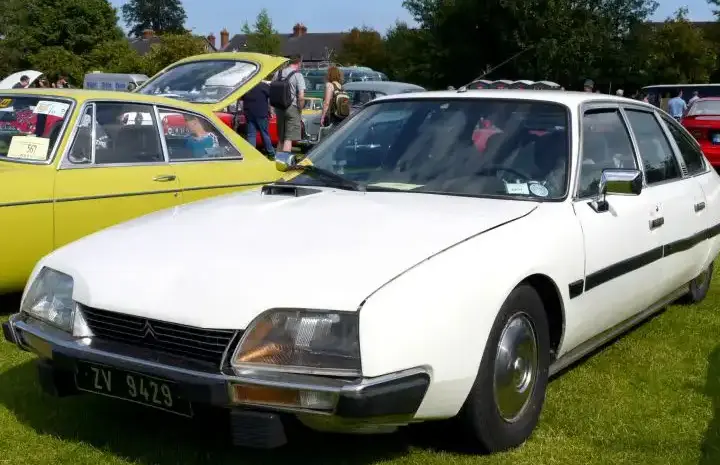
The Citroën CX 2400 Injection Automatic, produced between 1982 and 1983, represents a refined iteration of the groundbreaking CX series. Positioned as a mid-range offering within the CX I (Phase I) lineup, it aimed to provide a blend of luxury, performance, and the advanced hydropneumatic suspension system for which Citroën was renowned. This variant utilized a 2.4-liter inline-four engine coupled with a three-speed automatic transmission, catering to buyers seeking a comfortable and effortless driving experience. The CX, as a whole, was Citroën’s replacement for the iconic DS, continuing the tradition of innovative engineering and distinctive styling.
Technical Specifications
| Brand | Citroën |
| Model | CX |
| Generation | CX I (Phase I, 1982) |
| Type (Engine) | 2400 (128 Hp) Injection Automatic |
| Start of production | 1982 |
| End of production | 1983 |
| Powertrain Architecture | Internal Combustion engine |
| Body type | Hatchback |
| Seats | 5 |
| Doors | 5 |
| Fuel Type | Petrol (Gasoline) |
| Acceleration 0 – 100 km/h | 12 sec |
| Acceleration 0 – 62 mph | 12 sec |
| Acceleration 0 – 60 mph | 11.4 sec |
| Maximum speed | 185 km/h (114.95 mph) |
| Weight-to-power ratio | 10.7 kg/Hp, 93.4 Hp/tonne |
| Weight-to-torque ratio | 6.8 kg/Nm, 146.7 Nm/tonne |
| Power | 128 Hp @ 4800 rpm |
| Power per litre | 54.5 Hp/l |
| Torque | 201 Nm @ 3750 rpm (148.25 lb.-ft. @ 3750 rpm) |
| Engine layout | Front, Transverse |
| Engine Model/Code | M23.622 |
| Engine displacement | 2347 cm3 (143.22 cu. in.) |
| Number of cylinders | 4 |
| Engine configuration | Inline |
| Cylinder Bore | 93.5 mm (3.68 in.) |
| Piston Stroke | 85.5 mm (3.37 in.) |
| Compression ratio | 9:1 |
| Number of valves per cylinder | 2 |
| Fuel injection system | Multi-port manifold injection |
| Engine aspiration | Naturally aspirated engine |
| Engine oil capacity | 5.3 l (5.6 US qt | 4.66 UK qt) |
| Coolant | 11 l (11.62 US qt | 9.68 UK qt) |
| Kerb Weight | 1370 kg (3020.33 lbs) |
| Max. weight | 1880 kg (4144.69 lbs) |
| Max load | 510 kg (1124.36 lbs) |
| Trunk (boot) space – minimum | 325 l (11.48 cu. ft.) |
| Fuel tank capacity | 68 l (17.96 US gal | 14.96 UK gal) |
| Permitted trailer load with brakes (12%) | 1300 kg (2866.01 lbs) |
| Length | 4659 mm (183.43 in.) |
| Width | 1755 mm (69.09 in.) |
| Height | 1360 mm (53.54 in.) |
| Wheelbase | 2845 mm (112.01 in.) |
| Front track | 1474 mm (58.03 in.) |
| Rear (Back) track | 1360 mm (53.54 in.) |
| Front overhang | 1050 mm (41.34 in.) |
| Rear overhang | 764 mm (30.08 in.) |
| Drag coefficient (Cd) | 0.40 |
| Minimum turning circle (turning diameter) | 11.80 m (38.71 ft) |
| Drivetrain Architecture | The Internal combustion engine (ICE) drives the front wheels of the vehicle. |
| Drive wheel | Front wheel drive |
| Number of gears and type of gearbox | 3 gears, automatic transmission |
| Front brakes | Ventilated discs |
| Rear brakes | Disc |
| Steering type | Steering rack and pinion |
Introduction
The Citroën CX 2400 Injection Automatic, launched in 1982, was a key variant within the first phase of the CX model range. Building upon the innovative foundation laid by the DS, the CX aimed to modernize Citroën’s flagship while retaining the comfort and advanced technology its customers expected. The 2400 Injection Automatic occupied a middle ground in the CX lineup, offering a step up in performance and refinement from the base 2200 models, but without the added expense of the top-of-the-line 2500 GTI. It was designed to appeal to drivers who prioritized a smooth, comfortable ride and effortless cruising, particularly on long journeys.
Powertrain & Engine Architecture
At the heart of the CX 2400 Automatic lies the M23.622 engine, a 2.4-liter (2347 cc) inline-four cylinder powerplant. This engine featured a cast iron block and an aluminum cylinder head, employing a belt-driven single overhead camshaft (SOHC) valvetrain with two valves per cylinder. The “Injection” designation refers to the Bosch K-Jetronic multi-port fuel injection system, a significant upgrade over the carburetors used in earlier Citroën models. This system provided more precise fuel delivery, contributing to improved performance and fuel efficiency. The engine produced 128 horsepower at 4800 rpm and 201 Nm (148.25 lb-ft) of torque at 3750 rpm. The three-speed automatic transmission, while providing convenience, was not known for its sportiness. It was a traditional hydraulic automatic, offering smooth but relatively slow shifts.
Driving Characteristics
The CX 2400 Automatic offered a distinctly comfortable driving experience, largely due to Citroën’s renowned hydropneumatic suspension. This system utilized self-leveling spheres filled with nitrogen and hydraulic fluid to provide a remarkably smooth ride, absorbing bumps and imperfections in the road with ease. However, the combination of the 2.4-liter engine and the three-speed automatic transmission resulted in performance that was adequate rather than exhilarating. Acceleration to 60 mph took around 11.4 seconds, and top speed was approximately 115 mph. The automatic transmission’s gear ratios were geared towards comfort and fuel economy, meaning the engine often felt strained during hard acceleration. Compared to the manual transmission versions of the 2400, or the more powerful 2500 GTI, the automatic felt noticeably slower and less responsive.
Equipment & Trim Levels
The CX 2400 Injection Automatic came reasonably well-equipped for its time. Standard features typically included power steering, central locking, electric windows, and a comfortable cloth interior. The dashboard layout was characteristically Citroën, featuring a unique combination of analog gauges and toggle switches. Optional extras included leather upholstery, air conditioning, and a sunroof. The interior trim was generally well-appointed, although the materials used were not as luxurious as those found in some of its German competitors. The CX’s steering wheel, with its distinctive single-spoke design, was a defining feature of the interior.
Chassis & Braking
The CX featured a monocoque chassis with independent suspension on all four wheels, utilizing the hydropneumatic system. The front suspension employed double wishbones, while the rear used trailing arms. Braking was provided by ventilated discs at the front and solid discs at the rear. The CX’s braking performance was generally good, although the system lacked the anti-lock braking system (ABS) that was becoming increasingly common on other vehicles of the era. Stabilizer bars were fitted to both the front and rear axles to reduce body roll during cornering.
Market Reception & Comparison
The CX 2400 Injection Automatic was generally well-received by automotive critics, who praised its ride comfort and innovative technology. However, some reviewers criticized its performance, particularly the sluggishness of the automatic transmission. Compared to the manual transmission versions of the 2400, the automatic offered less engaging driving experience. Fuel economy was reasonable for the time, but not exceptional. The CX faced competition from other luxury hatchbacks, such as the Peugeot 505 and the Rover SD1, but it distinguished itself with its unique hydropneumatic suspension and distinctive styling.
Legacy
The Citroën CX, while not a massive sales success, remains a beloved classic among enthusiasts. The 2400 Injection Automatic, while not the most sought-after variant, offers a good balance of comfort, refinement, and affordability. The M23 engine, when properly maintained, is known to be relatively reliable, although the hydropneumatic suspension system requires regular attention to prevent leaks and ensure optimal performance. Today, well-maintained examples of the CX 2400 Automatic are becoming increasingly collectible, appealing to those who appreciate its unique character and innovative engineering. Finding parts can be challenging, but a dedicated network of Citroën specialists and enthusiasts continues to support the preservation of these iconic vehicles.