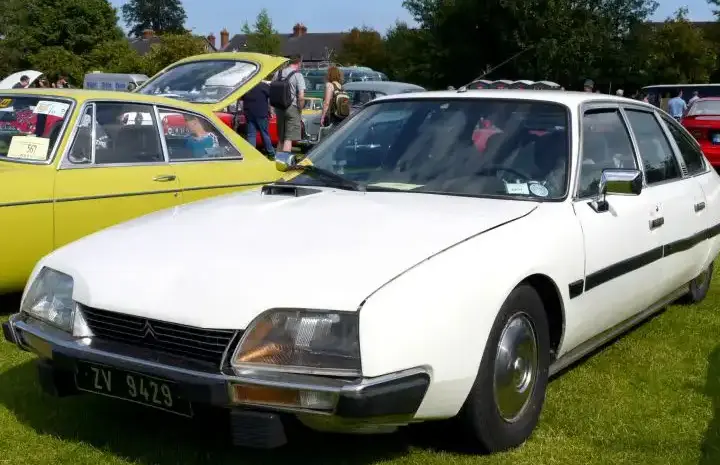
The Citroën CX 25 IE, produced between 1983 and 1985, represented a significant evolution in Citroën’s long history of innovative automotive engineering. Falling within the first phase (CX I) of the CX model range, the 25 IE was positioned as a premium offering, boasting a larger displacement engine and improved performance compared to the base models. It was a flagship vehicle for Citroën, embodying the company’s commitment to comfort, advanced technology, and distinctive styling. The CX, as a whole, replaced the venerable Citroën DS, continuing the tradition of hydropneumatic suspension and sophisticated design. This particular variant, the 25 IE, aimed to provide a blend of luxury and performance for discerning buyers in the European market.
Technical Specifications
| Brand | Citroën |
| Model | CX |
| Generation | CX I (Phase I, 1982) |
| Type (Engine) | 25 (138 Hp) IE |
| Start of production | 1983 |
| End of production | 1985 |
| Powertrain Architecture | Internal Combustion engine |
| Body type | Hatchback |
| Seats | 5 |
| Doors | 5 |
| Fuel Type | Petrol (Gasoline) |
| Acceleration 0 – 100 km/h | 9.7 sec |
| Acceleration 0 – 62 mph | 9.7 sec |
| Acceleration 0 – 60 mph | 9.2 sec |
| Maximum speed | 200 km/h (124.27 mph) |
| Weight-to-power ratio | 9.9 kg/Hp, 100.7 Hp/tonne |
| Weight-to-torque ratio | 6.5 kg/Nm, 154 Nm/tonne |
| Power | 138 Hp @ 5000 rpm |
| Power per litre | 55.2 Hp/l |
| Torque | 211 Nm @ 4000 rpm (155.63 lb.-ft. @ 4000 rpm) |
| Maximum engine speed | 6000 rpm |
| Engine layout | Front, Transverse |
| Engine Model/Code | M25.659 |
| Engine displacement | 2499 cm3 (152.5 cu. in.) |
| Number of cylinders | 4 |
| Engine configuration | Inline |
| Cylinder Bore | 93 mm (3.66 in.) |
| Piston Stroke | 92 mm (3.62 in.) |
| Compression ratio | 8.75:1 |
| Number of valves per cylinder | 2 |
| Fuel injection system | Multi-port manifold injection |
| Engine aspiration | Naturally aspirated engine |
| Engine oil capacity | 5 l (5.28 US qt | 4.4 UK qt) |
| Coolant | 12.3 l (13 US qt | 10.82 UK qt) |
| Kerb Weight | 1370 kg (3020.33 lbs) |
| Max. weight | 1885 kg (4155.71 lbs) |
| Max load | 515 kg (1135.38 lbs) |
| Trunk (boot) space – minimum | 325 l (11.48 cu. ft.) |
| Fuel tank capacity | 68 l (17.96 US gal | 14.96 UK gal) |
| Length | 4659 mm (183.43 in.) |
| Width | 1770 mm (69.69 in.) |
| Height | 1360 mm (53.54 in.) |
| Wheelbase | 2845 mm (112.01 in.) |
| Front track | 1522 mm (59.92 in.) |
| Rear (Back) track | 1368 mm (53.86 in.) |
| Front overhang | 1050 mm (41.34 in.) |
| Rear overhang | 764 mm (30.08 in.) |
| Drag coefficient (Cd) | 0.36 |
| Minimum turning circle | 11.7 m (38.39 ft.) |
| Drivetrain Architecture | The Internal combustion engine (ICE) drives the front wheels of the vehicle. |
| Drive wheel | Front wheel drive |
| Number of gears and type of gearbox | 5 gears, manual transmission |
| Front brakes | Ventilated discs |
| Rear brakes | Disc |
| Steering type | Steering rack and pinion |
Powertrain & Engine Architecture
The Citroën CX 25 IE was powered by the M25.659 engine, a 2.5-liter inline-four cylinder gasoline engine. This engine was a significant upgrade from the smaller engines offered in other CX variants. It featured a cast iron block and an aluminum cylinder head, a common configuration for engines of this era. The engine utilized Bosch multi-port fuel injection, contributing to improved fuel efficiency and smoother power delivery compared to carbureted engines. The valvetrain employed a single overhead camshaft (SOHC) design with two valves per cylinder. The engine produced 138 horsepower at 5000 rpm and 211 Nm (155.63 lb-ft) of torque at 4000 rpm. The engine was transversely mounted, a layout that maximized interior space and contributed to the CX’s front-wheel-drive configuration. The 25 IE was exclusively offered with a five-speed manual transmission, providing drivers with precise control over the engine’s power band.
Driving Characteristics
The CX 25 IE offered a unique driving experience, largely defined by Citroën’s renowned hydropneumatic suspension system. This system provided an exceptionally smooth and comfortable ride, absorbing bumps and imperfections in the road with remarkable effectiveness. The 2.5-liter engine, coupled with the five-speed manual transmission, delivered respectable performance. Acceleration from 0 to 60 mph was achieved in approximately 9.2 seconds, and the car had a top speed of 200 km/h (124 mph). While not a sports car, the CX 25 IE offered sufficient power for comfortable highway cruising and overtaking. The manual transmission allowed drivers to fully exploit the engine’s torque, providing responsive acceleration. Compared to the lower-powered CX models, the 25 IE felt noticeably more capable, particularly when fully loaded or tackling inclines. The steering, while precise, was power-assisted and could feel somewhat detached due to the suspension system.
Equipment & Trim Levels
The CX 25 IE was positioned as a well-equipped vehicle. Standard features typically included power steering, central locking, electric windows, and a high-quality stereo system. The interior was characterized by comfortable seating upholstered in premium cloth or leather (optional). The dashboard featured a distinctive design with a combination of analog gauges and warning lights. Optional extras included air conditioning, a sunroof, and upgraded audio systems. The CX 25 IE’s interior was designed to provide a luxurious and refined experience, reflecting its status as a premium model.
Chassis & Braking
The CX featured a monocoque chassis construction, providing a strong and rigid platform. The hydropneumatic suspension system, utilizing spheres filled with nitrogen gas and hydraulic fluid, was the defining characteristic of the chassis. This system allowed the car to maintain a constant ride height regardless of load, and it automatically adjusted damping rates to optimize ride comfort. The front suspension utilized independent double wishbones, while the rear suspension employed a trailing arm design. Braking was provided by ventilated discs on the front wheels and solid discs on the rear. The braking system was effective, providing ample stopping power for the car’s weight and performance.
Market Reception & Comparison
The Citroën CX 25 IE was generally well-received by automotive critics. It was praised for its exceptional ride comfort, innovative technology, and distinctive styling. However, some critics noted that the car’s complex hydropneumatic suspension system could be expensive to maintain. Compared to other vehicles in its class, such as the Peugeot 505 and the BMW 5 Series, the CX offered a unique blend of comfort and technology. The 25 IE’s fuel economy was reasonable for a 2.5-liter engine, but it was not as fuel-efficient as some of its competitors. Reliability was a mixed bag, with some owners reporting issues with the hydropneumatic suspension and electrical systems.
Legacy
The Citroën CX 25 IE remains a highly regarded classic car among enthusiasts. Its innovative technology, distinctive styling, and exceptional ride comfort continue to impress. While the hydropneumatic suspension system can be challenging to maintain, it is also a defining feature of the car’s character. The CX 25 IE is becoming increasingly collectible, and well-maintained examples command premium prices in the used car market. The engine, while not known for being exceptionally durable, is generally considered reliable if properly maintained. The CX’s legacy lies in its pioneering use of advanced automotive technology and its commitment to providing a uniquely comfortable and refined driving experience.