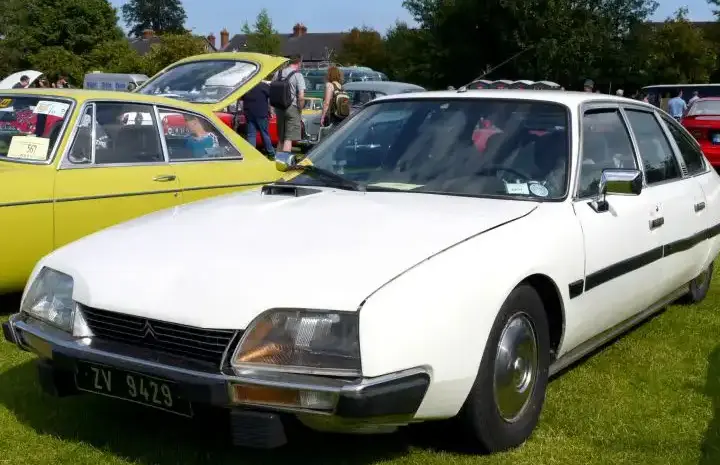
The Citroën CX I Prestige 2400, produced between 1982 and 1983, represented a significant evolution in Citroën’s long history of innovative automotive engineering. Positioned as a premium variant within the CX Series I (Phase I) lineup – internally designated 1HX0 – the 2400 offered a blend of comfort, performance, and advanced technology for its time. It served as a flagship model, appealing to buyers seeking a sophisticated and uniquely styled large family car. The CX, as a whole, was intended to replace the aging Citroën DS, carrying forward the torch of hydropneumatic suspension and distinctive design while incorporating more modern mechanicals.
Technical Specifications
| Brand | Citroën |
| Model | CX |
| Generation | CX I (Phase I, 1982) |
| Type (Engine) | Prestige 2400 (130 Hp) |
| Start of production | 1982 |
| End of production | 1983 |
| Powertrain Architecture | Internal Combustion engine |
| Body type | Hatchback |
| Seats | 5 |
| Doors | 5 |
| Fuel Type | Petrol (Gasoline) |
| Acceleration 0 – 100 km/h | 10.9 sec |
| Acceleration 0 – 62 mph | 10.9 sec |
| Acceleration 0 – 60 mph | 10.4 sec |
| Maximum speed | 192 km/h (119.3 mph) |
| Weight-to-power ratio | 11.2 kg/Hp, 89.3 Hp/tonne |
| Weight-to-torque ratio | 7.2 kg/Nm, 138.1 Nm/tonne |
| Power | 130 Hp @ 5000 rpm |
| Power per litre | 55.4 Hp/l |
| Torque | 201 Nm @ 3750 rpm (148.25 lb.-ft. @ 3750 rpm) |
| Engine layout | Front, Transverse |
| Engine Model/Code | M23.622 |
| Engine displacement | 2347 cm3 (143.22 cu. in.) |
| Number of cylinders | 4 |
| Engine configuration | Inline |
| Cylinder Bore | 93.5 mm (3.68 in.) |
| Piston Stroke | 85.5 mm (3.37 in.) |
| Compression ratio | 9:1 |
| Number of valves per cylinder | 2 |
| Fuel injection system | Multi-port manifold injection |
| Engine aspiration | Naturally aspirated engine |
| Engine oil capacity | 5.3 l (5.6 US qt | 4.66 UK qt) |
| Kerb Weight | 1455 kg (3207.73 lbs.) |
| Max. weight | 1925 kg (4243.9 lbs.) |
| Max load | 470 kg (1036.17 lbs.) |
| Trunk (boot) space – minimum | 325 l (11.48 cu. ft.) |
| Fuel tank capacity | 68 l (17.96 US gal | 14.96 UK gal) |
| Permitted trailer load with brakes (12%) | 1300 kg (2866.01 lbs.) |
| Length | 4916 mm (193.54 in.) |
| Width | 1755 mm (69.09 in.) |
| Height | 1375 mm (54.13 in.) |
| Wheelbase | 3095 mm (121.85 in.) |
| Front track | 1474 mm (58.03 in.) |
| Rear (Back) track | 1360 mm (53.54 in.) |
| Front overhang | 1057 mm (41.61 in.) |
| Rear overhang | 764 mm (30.08 in.) |
| Drag coefficient (Cd) | 0.40 |
| Minimum turning circle | 11.80 m (38.71 ft.) |
| Drivetrain Architecture | The Internal combustion engine (ICE) drives the front wheels of the vehicle. |
| Drive wheel | Front wheel drive |
| Number of gears and type of gearbox | 5 gears, manual transmission |
| Front brakes | Ventilated discs |
| Rear brakes | Disc |
| Steering type | Steering rack and pinion |
| Wheel rims size | 5.5J x 14 |
Powertrain & Engine Architecture
The Prestige 2400 was powered by the M23.622, a 2.4-liter inline-four cylinder engine. This engine, a development of earlier Peugeot-Renault-Volvo (PRV) designs, featured a cast iron block and an aluminum cylinder head. It utilized a Bosch multi-port fuel injection system, a significant upgrade over the carburetors found on earlier Citroëns, contributing to improved fuel efficiency and smoother operation. The engine produced 130 horsepower at 5000 rpm and 201 Nm (148 lb-ft) of torque at 3750 rpm. The engine’s relatively high compression ratio of 9:1 demanded premium fuel for optimal performance. The engine was transversely mounted, a common layout for front-wheel-drive vehicles, and paired with a five-speed manual transmission. While an automatic transmission was offered on other CX variants, the 2400 was exclusively available with the manual gearbox.
Driving Characteristics
The CX 2400, with its 130 hp and five-speed manual, offered a respectable, though not overtly sporty, driving experience. Acceleration to 60 mph took approximately 10.4 seconds, and it could achieve a top speed of around 119 mph. The five-speed gearbox allowed for efficient cruising at highway speeds, while providing adequate gearing for acceleration. Compared to the lower-powered CX 2000, the 2400 offered noticeably more punch, particularly during overtaking maneuvers. However, it lacked the outright performance of the later CX 25 GTI Turbo models. The defining characteristic of the CX, regardless of engine, was its hydropneumatic suspension. This system provided an exceptionally smooth and comfortable ride, absorbing bumps and imperfections in the road with remarkable ease. The steering, also hydraulically assisted, was light and precise.
Equipment & Trim Levels
The Prestige trim level, as the name suggests, included a generous array of standard features. Interior appointments included comfortable cloth upholstery, a wood-trimmed dashboard, and power-assisted steering. Other standard equipment included central locking, electric windows, and a high-quality radio. Optional extras included leather upholstery, air conditioning, and a sunroof. The CX’s interior was known for its ergonomic design and spaciousness, offering ample room for five passengers and a reasonably sized trunk (325 liters/11.48 cu. ft.).
Chassis & Braking
The CX I utilized a monocoque chassis construction, providing a strong and rigid platform. The front suspension employed independent double wishbones with hydropneumatic springs and dampers, while the rear suspension featured an independent trailing arm setup, also with hydropneumatic components. Braking duties were handled by ventilated discs at the front and solid discs at the rear. The braking system was hydraulically assisted, providing ample stopping power. The CX’s low center of gravity, thanks to its engine layout and hydropneumatic suspension, contributed to stable handling.
Market Reception & Comparison
The Citroën CX was generally well-received by automotive critics, praised for its innovative technology, comfortable ride, and distinctive styling. The 2400 model, in particular, was seen as a capable and refined grand tourer. However, some critics noted the relatively high cost of maintenance and repairs, particularly related to the complex hydropneumatic suspension system. Compared to its contemporaries, such as the Peugeot 505 and the Ford Granada, the CX offered a more unique and technologically advanced package, but at a higher price point. Fuel economy was reasonable for the time, averaging around 22-26 mpg in mixed driving.
Legacy
The Citroën CX, and the 2400 variant specifically, remains a beloved classic among Citroën enthusiasts. While the hydropneumatic suspension system can require specialized maintenance, the engine itself is generally considered reliable if properly maintained. Today, well-preserved examples of the CX 2400 are sought after by collectors and enthusiasts who appreciate its unique character and engineering ingenuity. The CX’s influence can be seen in subsequent Citroën models, and its innovative suspension technology continues to inspire automotive engineers today. The car represents a high point in Citroën’s history, embodying the company’s commitment to pushing the boundaries of automotive design and technology.