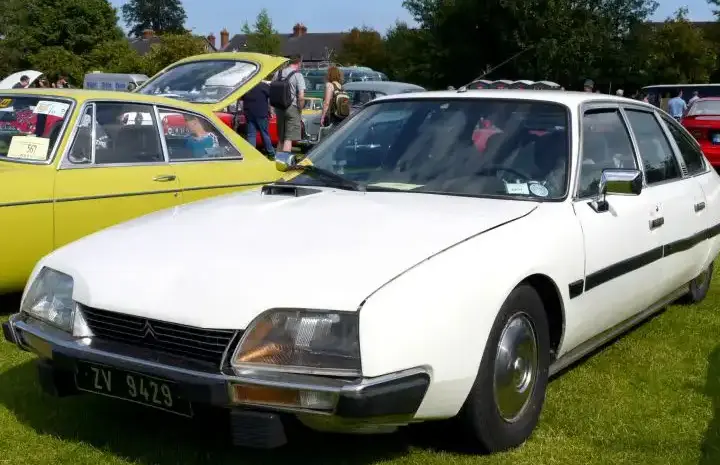
The Citroën CX I Prestige 2400 Automatic, produced between 1982 and 1983, represents a significant iteration of Citroën’s innovative CX series. Positioned as a luxury variant within the initial CX I (Phase I) range, the 2400 Automatic offered a blend of advanced hydropneumatic suspension, comfortable interior appointments, and a relatively powerful engine for its time. It was built upon the platform designated 1HX0, and served as a flagship model for Citroën, embodying the company’s commitment to technological sophistication and ride quality. This particular configuration, combining the 2.4-liter engine with a three-speed automatic transmission, aimed to provide a more accessible entry point into the CX range for buyers prioritizing ease of driving over outright performance.
Technical Specifications
| Brand | Citroen |
| Model | CX |
| Generation | CX I (Phase I, 1982) |
| Type (Engine) | Prestige 2400 (130 Hp) Automatic |
| Start of production | 1982 |
| End of production | 1983 |
| Powertrain Architecture | Internal Combustion engine |
| Body type | Hatchback |
| Seats | 5 |
| Doors | 5 |
| Fuel Type | Petrol (Gasoline) |
| Acceleration 0 – 100 km/h | 12.8 sec |
| Acceleration 0 – 62 mph | 12.8 sec |
| Acceleration 0 – 60 mph | 12.2 sec |
| Maximum speed | 180 km/h (111.85 mph) |
| Weight-to-power ratio | 11.3 kg/Hp, 88.4 Hp/tonne |
| Weight-to-torque ratio | 7.3 kg/Nm, 136.7 Nm/tonne |
| Power | 130 Hp @ 5000 rpm |
| Power per litre | 55.4 Hp/l |
| Torque | 201 Nm @ 3750 rpm (148.25 lb.-ft. @ 3750 rpm) |
| Engine layout | Front, Transverse |
| Engine Model/Code | M23.622 |
| Engine displacement | 2347 cm3 (143.22 cu. in.) |
| Number of cylinders | 4 |
| Engine configuration | Inline |
| Cylinder Bore | 93.5 mm (3.68 in.) |
| Piston Stroke | 85.5 mm (3.37 in.) |
| Compression ratio | 9:1 |
| Number of valves per cylinder | 2 |
| Fuel injection system | Multi-port manifold injection |
| Engine aspiration | Naturally aspirated engine |
| Engine oil capacity | 5.3 l (5.6 US qt | 4.66 UK qt) |
| Kerb Weight | 1470 kg (3240.8 lbs.) |
| Max. weight | 1925 kg (4243.9 lbs.) |
| Max load | 455 kg (1003.1 lbs.) |
| Trunk (boot) space – minimum | 325 l (11.48 cu. ft.) |
| Fuel tank capacity | 68 l (17.96 US gal | 14.96 UK gal) |
| Permitted trailer load with brakes (12%) | 1300 kg (2866.01 lbs.) |
| Length | 4916 mm (193.54 in.) |
| Width | 1755 mm (69.09 in.) |
| Height | 1375 mm (54.13 in.) |
| Wheelbase | 3095 mm (121.85 in.) |
| Front track | 1474 mm (58.03 in.) |
| Rear (Back) track | 1360 mm (53.54 in.) |
| Front overhang | 1057 mm (41.61 in.) |
| Rear overhang | 764 mm (30.08 in.) |
| Drag coefficient (Cd) | 0.40 |
| Minimum turning circle (turning diameter) | 11.80 m (38.71 ft.) |
| Drivetrain Architecture | The Internal combustion engine (ICE) drives the front wheels of the vehicle. |
| Drive wheel | Front wheel drive |
| Number of gears and type of gearbox | 3 gears, automatic transmission |
| Front brakes | Ventilated discs |
| Rear brakes | Disc |
| Steering type | Steering rack and pinion |
| Wheel rims size | 5.5J x 14 |
Powertrain & Engine Architecture
The heart of the CX 2400 Prestige Automatic is the M23.622 engine, a 2.4-liter (2347 cc) inline-four cylinder gasoline engine. This engine featured a cast iron block and an aluminum cylinder head, employing a dual overhead camshaft (DOHC) design with two valves per cylinder. Fuel delivery was managed by a Bosch multi-port fuel injection system, a significant advancement over the carburetors used in earlier Citroën models. This system contributed to improved fuel efficiency and smoother power delivery. The engine produced 130 horsepower at 5000 rpm and 201 Nm (148.25 lb-ft) of torque at 3750 rpm. The engine’s relatively high compression ratio of 9:1 was typical for the era, requiring the use of premium gasoline for optimal performance.
The engine was mated to a three-speed automatic transmission. While not known for its sporting character, this transmission provided a comfortable and convenient driving experience, particularly well-suited to the CX’s focus on ride quality. The automatic gearbox was designed to prioritize smooth shifts and ease of use, rather than aggressive acceleration.
Driving Characteristics
The CX 2400 Automatic offered a distinctly different driving experience compared to its manual transmission counterparts or higher-performance variants like the CX 2500. The automatic transmission, while providing convenience, resulted in slightly slower acceleration – approximately 12.8 seconds to 62 mph. The three-speed gearbox meant that the engine often operated at higher revs during highway cruising, potentially impacting fuel economy. However, the hydropneumatic suspension system, a hallmark of Citroën engineering, largely compensated for any performance shortcomings. This system provided an exceptionally smooth and comfortable ride, absorbing bumps and imperfections in the road with remarkable effectiveness. The steering, also hydraulically assisted, was light and precise, contributing to the car’s overall ease of driving.
Equipment & Trim Levels
The Prestige trim level, as indicated in the model name, signified a higher level of equipment and refinement. Standard features included comfortable cloth upholstery, power steering, central locking, and electric windows. The dashboard layout was characteristically Citroën, featuring a unique combination of analog gauges and switches. Optional extras available for the CX 2400 Automatic included leather upholstery, air conditioning, and a more advanced radio system. The interior was designed to provide a luxurious and comfortable environment for both driver and passengers.
Chassis & Braking
The CX I utilized a monocoque chassis construction, providing a strong and rigid platform. The front suspension employed independent double wishbones, while the rear suspension featured Citroën’s innovative hydropneumatic system. This system not only provided exceptional ride comfort but also allowed for self-leveling, maintaining a consistent ride height regardless of load. Braking duties were handled by ventilated discs at the front and solid discs at the rear. The braking system was hydraulically assisted, providing ample stopping power for the vehicle’s weight and performance.
Market Reception & Comparison
The CX 2400 Automatic was generally well-received by automotive critics, who praised its ride quality, innovative technology, and comfortable interior. However, some reviewers noted that the automatic transmission detracted from the car’s overall performance. Compared to the manual transmission versions, the automatic was noticeably slower. Against competitors like the Peugeot 505 and the Rover SD1, the CX offered a unique blend of sophistication and comfort, but its unconventional design and complex technology sometimes proved a barrier to wider acceptance. Fuel economy was reasonable for the time, but not exceptional.
Legacy
The Citroën CX, and specifically the 2400 Automatic variant, remains a beloved classic among Citroën enthusiasts. The M23 engine, while not known for being particularly robust, is generally reliable with proper maintenance. The hydropneumatic suspension system, however, requires specialized knowledge and care, and can be expensive to repair. Today, well-maintained examples of the CX 2400 Automatic are sought after by collectors and enthusiasts who appreciate its unique character and technological innovation. The car represents a high point in Citroën’s engineering history, and a testament to the company’s commitment to pushing the boundaries of automotive design and technology.