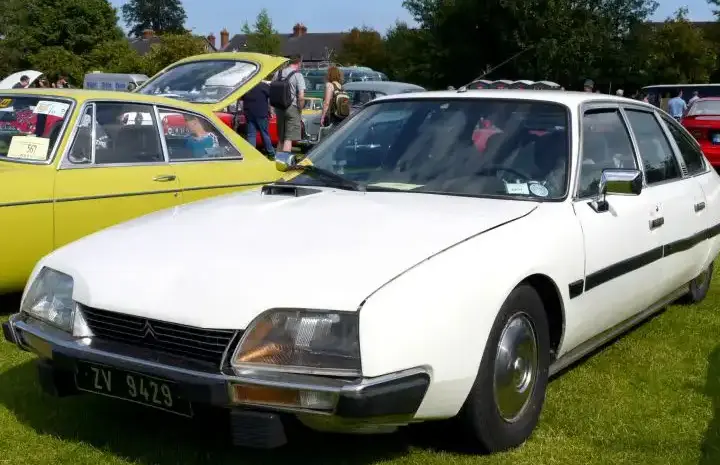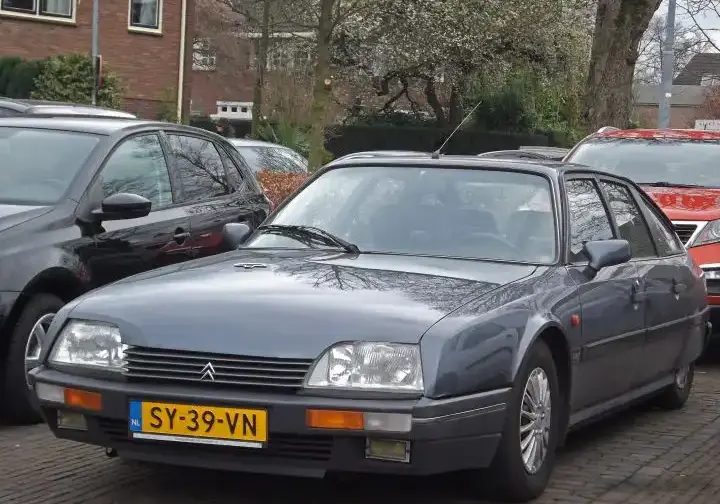
The Citroen CX II 22 TRS, produced between 1985 and 1989, represented a mid-range offering within the second generation (CX II) of Citroen’s innovative CX line. Positioned above the base models but below the more powerful and luxurious trims, the 22 TRS aimed to balance performance, comfort, and affordability for the European market. It continued the CX’s legacy of hydropneumatic suspension and aerodynamic styling, offering a distinctive driving experience. This variant utilized a 2.2-liter inline-four engine producing 115 horsepower, paired with a five-speed manual transmission. The CX II series, built upon the platform of the original CX, refined the design and addressed some of the earlier model’s shortcomings while retaining its core technological advancements.
Technical Specifications
| Brand | Citroen |
| Model | CX |
| Generation | CX II |
| Type (Engine) | 22 TRS (115 Hp) |
| Start of production | 1985 |
| End of production | 1989 |
| Powertrain Architecture | Internal Combustion engine |
| Body type | Hatchback |
| Seats | 5 |
| Doors | 5 |
| Fuel consumption (urban) | 12 l/100 km (19.6 US mpg, 23.5 UK mpg, 8.3 km/l) |
| Fuel consumption (combined) | 9 l/100 km (26.1 US mpg, 31.4 UK mpg, 11.1 km/l) |
| Fuel Type | Petrol (Gasoline) |
| Acceleration 0 – 100 km/h | 10.6 sec |
| Acceleration 0 – 62 mph | 10.6 sec |
| Acceleration 0 – 60 mph | 10.1 sec |
| Maximum speed | 186 km/h (115.58 mph) |
| Weight-to-power ratio | 11.1 kg/Hp, 90.2 Hp/tonne |
| Weight-to-torque ratio | 7.3 kg/Nm, 136.5 Nm/tonne |
| Power | 115 Hp @ 5600 rpm |
| Power per litre | 53.1 Hp/l |
| Torque | 174 Nm @ 3250 rpm (128.34 lb.-ft. @ 3250 rpm) |
| Engine layout | Front, Transverse |
| Engine Model/Code | J6T.A500 |
| Engine displacement | 2165 cm3 (132.12 cu. in.) |
| Number of cylinders | 4 |
| Engine configuration | Inline |
| Cylinder Bore | 88 mm (3.46 in.) |
| Piston Stroke | 89 mm (3.5 in.) |
| Compression ratio | 9.8:1 |
| Number of valves per cylinder | 2 |
| Fuel injection system | Carburettor |
| Engine aspiration | Naturally aspirated engine |
| Valvetrain | OHV |
| Engine oil capacity | 5.5 l (5.81 US qt | 4.84 UK qt) |
| Coolant | 12 l (12.68 US qt | 10.56 UK qt) |
| Kerb Weight | 1275 kg (2810.89 lbs.) |
| Max. weight | 1780 kg (3924.23 lbs.) |
| Max load | 505 kg (1113.33 lbs.) |
| Trunk (boot) space – minimum | 485 l (17.13 cu. ft.) |
| Trunk (boot) space – maximum | 507 l (17.9 cu. ft.) |
| Fuel tank capacity | 68 l (17.96 US gal | 14.96 UK gal) |
| Max. roof load | 80 kg (176.37 lbs.) |
| Permitted trailer load with brakes (12%) | 1300 kg (2866.01 lbs.) |
| Permitted trailer load without brakes | 635 kg (1399.94 lbs.) |
| Permitted towbar download | 100 kg (220.46 lbs.) |
| Length | 4650 mm (183.07 in.) |
| Width | 1770 mm (69.69 in.) |
| Height | 1360 mm (53.54 in.) |
| Wheelbase | 2845 mm (112.01 in.) |
| Front track | 1520 mm (59.84 in.) |
| Rear (Back) track | 1370 mm (53.94 in.) |
| Ride height (ground clearance) | 157 mm (6.18 in.) |
| Drag coefficient (Cd) | 0.35 |
| Minimum turning circle (turning diameter) | 12.5 m (41.01 ft.) |
| Drivetrain Architecture | The Internal combustion engine (ICE) drives the front wheels of the vehicle. |
| Drive wheel | Front wheel drive |
| Number of gears and type of gearbox | 5 gears, manual transmission |
| Front suspension | Hydro-pneumatic element |
| Rear suspension | Hydro-pneumatic element |
| Front brakes | Ventilated discs |
| Rear brakes | Disc |
| Assisting systems | ABS (Anti-lock braking system) |
| Steering type | Steering rack and pinion |
| Power steering | Hydraulic Steering |
| Tires size | 195/70 R14; 185/70 R14 |
| Wheel rims size | 5.5J x 14 |
Powertrain & Engine Architecture
The heart of the CX II 22 TRS was the J6T.A500 engine, a 2.2-liter (2165 cc) inline-four cylinder petrol engine. This engine featured a relatively simple overhead valve (OHV) valvetrain with two valves per cylinder. Unlike many contemporary engines, the 22 TRS utilized a carburetor for fuel delivery, a cost-saving measure compared to fuel injection systems. The carburetor, while less precise than injection, provided adequate performance for the intended market segment. The engine produced 115 horsepower at 5600 rpm and 174 Nm (128.34 lb-ft) of torque at 3250 rpm. The five-speed manual transmission allowed for reasonably efficient cruising and provided some flexibility in gearing. The engine’s transverse mounting contributed to the CX’s front-wheel-drive layout.
Driving Characteristics
The CX II 22 TRS offered a unique driving experience largely defined by its hydropneumatic suspension. This system provided an exceptionally smooth and comfortable ride, absorbing bumps and imperfections in the road with remarkable effectiveness. However, the 115 hp engine and the car’s relatively substantial weight (1275 kg / 2810.89 lbs) meant that acceleration was not particularly brisk. 0-60 mph took around 10.1 seconds, and top speed was 186 km/h (115.58 mph). Compared to the more powerful CX 25 GTI Turbo, the 22 TRS felt noticeably slower. The five-speed manual transmission helped to keep the engine in its optimal power band, but it still required careful gear selection for overtaking maneuvers. The steering, while hydraulic, lacked the directness of some competitors.
Equipment & Trim Levels
The 22 TRS trim level offered a good balance of comfort and features. Standard equipment typically included cloth upholstery, a basic radio, and power steering. Optional extras could include upgraded audio systems, sunroofs, and more luxurious interior trim options. The dashboard layout was typical of Citroens of the era, featuring a combination of analog gauges and switches. The CX II’s interior was known for its spaciousness and comfortable seating, although the materials used were not always of the highest quality.
Chassis & Braking
The CX II’s chassis was notable for its hydropneumatic suspension, which allowed the ride height to be adjusted and maintained a level ride even with varying loads. The front suspension utilized independent hydropneumatic elements, while the rear suspension also employed a hydropneumatic system. Braking was provided by ventilated discs at the front and solid discs at the rear. An anti-lock braking system (ABS) was included as standard, enhancing safety. The steering system was a rack and pinion type with hydraulic assistance.
Market Reception & Comparison
The CX II 22 TRS was generally well-received by automotive critics as a comfortable and refined touring car. However, its performance was often criticized as being somewhat underwhelming, particularly when compared to more powerful alternatives. Fuel economy was reasonable for the time, averaging around 26.1 US mpg (9 l/100 km). Compared to the CX 25 GTI Turbo, the 22 TRS offered a more affordable entry point into the CX range, but at the expense of performance. The 22 TRS also competed with other European hatchbacks such as the Peugeot 505 and the Ford Sierra.
Legacy
The Citroen CX II 22 TRS, while not the most powerful or sought-after variant of the CX, remains a significant vehicle in automotive history. Its innovative hydropneumatic suspension and aerodynamic design set it apart from its contemporaries. The J6T.A500 engine, while relatively simple, proved to be reasonably reliable with proper maintenance. Today, the CX II 22 TRS is a popular choice among classic car enthusiasts who appreciate its unique character and comfortable ride. Parts availability can be a challenge, but a dedicated community of owners and specialists helps to keep these cars on the road. The 22 TRS represents a high point in Citroen’s engineering prowess and a testament to the company’s commitment to innovation.