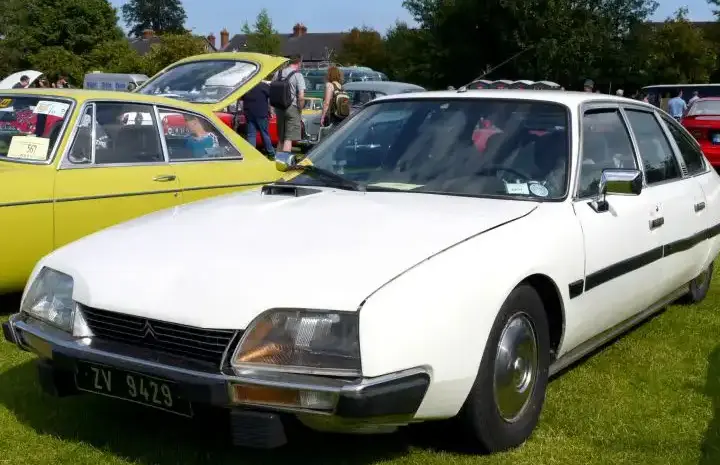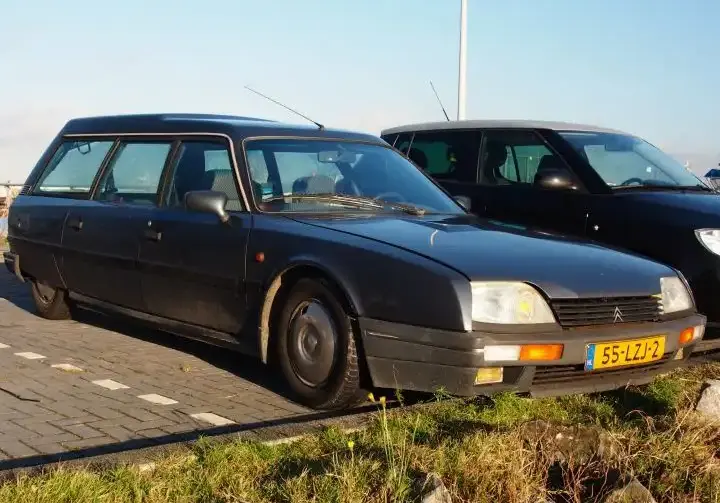
The Citroen CX II Break 20 RE, produced between 1985 and 1991, represents a unique blend of Citroen’s innovative hydropneumatic suspension technology and a relatively accessible engine option within the CX range. Positioned as a mid-range variant of the CX II Break (estate) body style, the 20 RE offered a balance between performance, comfort, and practicality for family buyers. It was part of the second series of the CX, denoted by the “II” designation, which brought refinements to the original CX design launched in 1974. The CX II Break, in general, was Citroen’s answer to the growing demand for versatile, spacious wagons, and the 20 RE trim aimed to provide a comfortable and reasonably powerful option for those needing extra cargo capacity.
Technical Specifications
| Brand | Citroen |
| Model | CX |
| Generation | CX II Break |
| Type (Engine) | 20 RE (106 Hp) |
| Start of production | 1985 |
| End of production | 1991 |
| Powertrain Architecture | Internal Combustion engine |
| Body type | Station wagon (estate) |
| Seats | 5 |
| Doors | 5 |
| Fuel consumption (urban) | 12 l/100 km (19.6 US mpg, 23.5 UK mpg, 8.3 km/l) |
| Fuel consumption (extra urban) | 8 l/100 km (29.4 US mpg, 35.3 UK mpg, 12.5 km/l) |
| Fuel consumption (combined) | 10.2 l/100 km (23.1 US mpg, 27.7 UK mpg, 9.8 km/l) |
| Fuel Type | Petrol (Gasoline) |
| Acceleration 0 – 100 km/h | 14.9 sec |
| Acceleration 0 – 62 mph | 14.9 sec |
| Acceleration 0 – 60 mph | 14.2 sec |
| Maximum speed | 168 km/h (104.39 mph) |
| Weight-to-power ratio | 13.1 kg/Hp, 76.3 Hp/tonne |
| Weight-to-torque ratio | 8.4 kg/Nm, 119.4 Nm/tonne |
| Power | 106 Hp @ 5500 rpm |
| Power per litre | 53.1 Hp/l |
| Torque | 166 Nm @ 3250 rpm (122.44 lb.-ft. @ 3250 rpm) |
| Engine layout | Front, Transverse |
| Engine Model/Code | 829.A5 |
| Engine displacement | 1995 cm3 (121.74 cu. in.) |
| Number of cylinders | 4 |
| Engine configuration | Inline |
| Cylinder Bore | 88 mm (3.46 in.) |
| Piston Stroke | 82 mm (3.23 in.) |
| Compression ratio | 9.2:1 |
| Number of valves per cylinder | 2 |
| Fuel injection system | Carburettor |
| Engine aspiration | Naturally aspirated engine |
| Valvetrain | OHV |
| Engine oil capacity | 5.5 l (5.81 US qt | 4.84 UK qt) |
| Coolant | 9.5 l (10.04 US qt | 8.36 UK qt) |
| Kerb Weight | 1390 kg (3064.43 lbs.) |
| Max. weight | 2080 kg (4585.62 lbs.) |
| Max load | 690 kg (1521.19 lbs.) |
| Trunk (boot) space – minimum | 485 l (17.13 cu. ft.) |
| Trunk (boot) space – maximum | 1163 l (41.07 cu. ft.) |
| Fuel tank capacity | 68 l (17.96 US gal | 14.96 UK gal) |
| Max. roof load | 80 kg (176.37 lbs.) |
| Permitted trailer load with brakes (12%) | 1300 kg (2866.01 lbs.) |
| Permitted trailer load without brakes | 695 kg (1532.21 lbs.) |
| Permitted towbar download | 100 kg (220.46 lbs.) |
| Length | 4929 mm (194.06 in.) |
| Width | 1770 mm (69.69 in.) |
| Height | 1475 mm (58.07 in.) |
| Wheelbase | 3095 mm (121.85 in.) |
| Front track | 1522 mm (59.92 in.) |
| Rear (Back) track | 1398 mm (55.04 in.) |
| Drag coefficient (Cd) | 0.37 |
| Minimum turning circle | 13.40 m (43.96 ft.) |
| Drivetrain Architecture | The Internal combustion engine (ICE) drives the front wheels of the vehicle. |
| Drive wheel | Front wheel drive |
| Number of gears and type of gearbox | 4 gears, manual transmission |
| Front suspension | Hydro-pneumatic element |
| Rear suspension | Hydro-pneumatic element |
| Front brakes | Ventilated discs |
| Rear brakes | Disc |
| Steering type | Steering rack and pinion |
| Power steering | Hydraulic Steering |
| Tires size | 195/70 R14 |
| Wheel rims size | 5.5J x 14 |
Powertrain & Engine Architecture
The Citroen CX II Break 20 RE was powered by the 829.A5 engine, a 1995cc inline-four cylinder petrol engine. This engine, while not the most powerful in the CX lineup (the 25 GTI Turbo offered significantly more performance), was known for its smoothness and relative reliability. It utilized a single overhead valve (OHV) valvetrain and a carburetor fuel injection system – a somewhat dated technology by the mid-1980s, but one that contributed to the engine’s simplicity. The engine produced 106 horsepower at 5500 rpm and 166 Nm (122.44 lb-ft) of torque at 3250 rpm. The engine was transversely mounted, driving the front wheels. The 20 RE was typically equipped with a four-speed manual transmission, although a three-speed automatic transmission was also available, albeit less common. The automatic transmission, while offering convenience, did noticeably impact acceleration and fuel economy.
Driving Characteristics
The CX II Break 20 RE offered a unique driving experience largely defined by its hydropneumatic suspension. This system provided an exceptionally smooth and comfortable ride, absorbing bumps and imperfections in the road with remarkable ease. However, the 106 hp engine and the weight of the vehicle (approximately 1390 kg or 3064 lbs) meant that performance was modest. Acceleration from 0-60 mph took around 14.2 seconds, and top speed was around 104 mph. Compared to the more powerful CX variants, the 20 RE felt noticeably slower, particularly when fully loaded. The four-speed manual transmission helped to keep the engine in its optimal power band, but the automatic version resulted in a more sluggish feel. Steering was light and precise thanks to the hydraulic power steering system.
Equipment & Trim Levels
The 20 RE trim level generally included features such as cloth upholstery, a basic stereo system, and power-assisted steering. Optional extras included air conditioning, electric windows, and a sunroof. The interior design was typical of Citroen in the 1980s – functional and comfortable, but not overly luxurious. The dashboard featured a combination of analog gauges and warning lights. The Break (estate) body style offered a generous amount of cargo space, with 485 liters (17.13 cu ft) with the rear seats up and 1163 liters (41.07 cu ft) with the seats folded down.
Chassis & Braking
The CX II Break featured independent suspension on all four wheels, utilizing Citroen’s signature hydropneumatic system. This system allowed the ride height to be adjusted, providing excellent ride quality and handling. The front brakes were ventilated discs, while the rear brakes were solid discs. The steering was a rack and pinion system with hydraulic power assistance. The tires were typically 195/70 R14 size, mounted on 5.5J x 14 inch steel wheels.
Market Reception & Comparison
The CX II Break 20 RE was generally well-received as a practical and comfortable family car. Critics praised the ride quality and spaciousness, but noted the modest performance. Compared to other CX variants, such as the 25 GTI Turbo, the 20 RE was significantly less expensive and more fuel-efficient. However, it lacked the performance and prestige of its more powerful siblings. Against competitors like the Volvo 240 estate or the Ford Sierra estate, the CX offered a unique driving experience thanks to its hydropneumatic suspension, but its reliability record was sometimes questioned.
Legacy
The Citroen CX II Break 20 RE, while not the most iconic version of the CX, remains a popular choice among Citroen enthusiasts. The 829.A5 engine is generally considered to be relatively reliable, although maintenance can be complex due to the hydropneumatic suspension system. Finding parts can be challenging, but a dedicated network of Citroen specialists and suppliers exists. Today, well-maintained examples of the CX II Break 20 RE are sought after by collectors and those who appreciate its unique blend of comfort, style, and engineering innovation. The car represents a high point in Citroen’s history, showcasing the company’s commitment to pushing the boundaries of automotive technology.