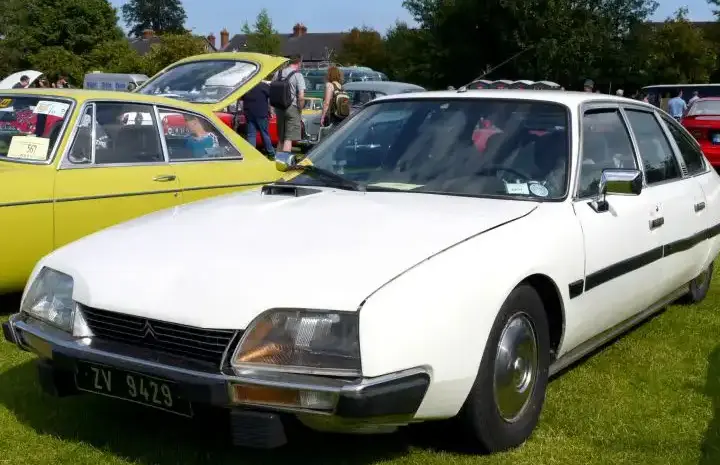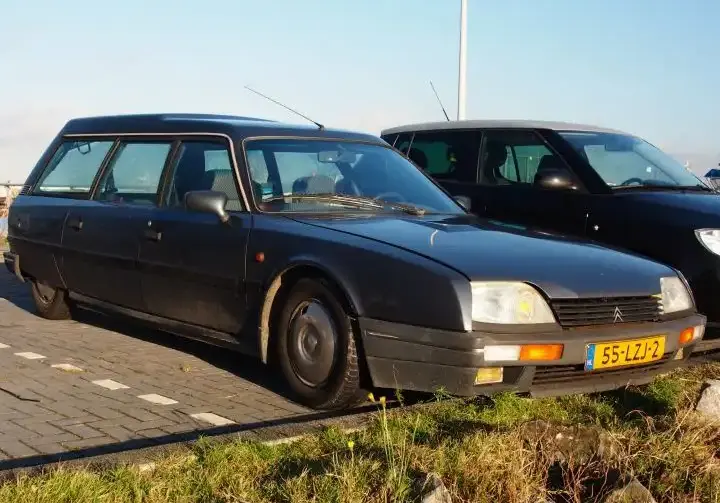
The Citroën CX II Break 22 RS, produced between 1987 and 1989, represents a compelling blend of practicality and the innovative engineering for which Citroën was renowned. Positioned as a mid-range offering within the CX II Break (estate) lineup, the 22 RS provided a balance between performance and economy, appealing to families and drivers seeking a comfortable and capable long-distance vehicle. It built upon the foundation of the CX series, known for its distinctive wedge shape and advanced hydropneumatic suspension, offering a spacious interior and a relatively powerful engine for its time. The CX II Break, in general, served as Citroën’s flagship estate car, competing with models like the Peugeot 505 Break and Volvo 245.
Technical Specifications
| Brand | Citroen |
| Model | CX |
| Generation | CX II Break |
| Type (Engine) | 22 RS (115 Hp) |
| Start of production | 1987 |
| End of production | 1989 |
| Powertrain Architecture | Internal Combustion engine |
| Body type | Station wagon (estate) |
| Seats | 5 |
| Doors | 5 |
| Fuel consumption (urban) | 12 l/100 km (19.6 US mpg, 23.5 UK mpg, 8.3 km/l) |
| Fuel consumption (extra urban) | 7.1 l/100 km (33.1 US mpg, 39.8 UK mpg, 14.1 km/l) |
| Fuel consumption (combined) | 9.4 l/100 km (25 US mpg, 30.1 UK mpg, 10.6 km/l) |
| Fuel Type | Petrol (Gasoline) |
| Maximum speed | 180 km/h (111.85 mph) |
| Weight-to-power ratio | 12.1 kg/Hp, 82.7 Hp/tonne |
| Weight-to-torque ratio | 7.8 kg/Nm, 128.1 Nm/tonne |
| Power | 115 Hp @ 5600 rpm |
| Power per litre | 53.1 Hp/l |
| Torque | 178 Nm @ 3250 rpm (131.29 lb.-ft. @ 3250 rpm) |
| Engine layout | Front, Transverse |
| Engine Model/Code | J6T.A500 |
| Engine displacement | 2165 cm3 (132.12 cu. in.) |
| Number of cylinders | 4 |
| Engine configuration | Inline |
| Cylinder Bore | 88 mm (3.46 in.) |
| Piston Stroke | 89 mm (3.5 in.) |
| Compression ratio | 9.8:1 |
| Number of valves per cylinder | 2 |
| Fuel injection system | Carburettor |
| Engine aspiration | Naturally aspirated engine |
| Engine oil capacity | 5.5 l (5.81 US qt | 4.84 UK qt) |
| Coolant | 12 l (12.68 US qt | 10.56 UK qt) |
| Kerb Weight | 1390 kg (3064.43 lbs.) |
| Max. weight | 2080 kg (4585.62 lbs.) |
| Max load | 690 kg (1521.19 lbs.) |
| Trunk (boot) space – minimum | 485 l (17.13 cu. ft.) |
| Trunk (boot) space – maximum | 1163 l (41.07 cu. ft.) |
| Fuel tank capacity | 68 l (17.96 US gal | 14.96 UK gal) |
| Max. roof load | 80 kg (176.37 lbs.) |
| Permitted trailer load with brakes (12%) | 1300 kg (2866.01 lbs.) |
| Permitted trailer load without brakes | 695 kg (1532.21 lbs.) |
| Permitted towbar download | 100 kg (220.46 lbs.) |
| Length | 4929 mm (194.06 in.) |
| Width | 1770 mm (69.69 in.) |
| Height | 1475 mm (58.07 in.) |
| Wheelbase | 3095 mm (121.85 in.) |
| Front track | 1522 mm (59.92 in.) |
| Rear (Back) track | 1398 mm (55.04 in.) |
| Drag coefficient (Cd) | 0.37 |
| Minimum turning circle (turning diameter) | 13.40 m (43.96 ft.) |
| Drivetrain Architecture | The Internal combustion engine (ICE) drives the front wheels of the vehicle. |
| Drive wheel | Front wheel drive |
| Number of gears and type of gearbox | 5 gears, manual transmission |
| Front suspension | Hydro-pneumatic element |
| Rear suspension | Hydro-pneumatic element |
| Front brakes | Ventilated discs |
| Rear brakes | Disc |
| Steering type | Steering rack and pinion |
| Power steering | Hydraulic Steering |
| Tires size | 195/70 R14 |
| Wheel rims size | 5.5J x 14 |
Powertrain & Engine Architecture
The Citroën CX II Break 22 RS was powered by the J6T.A500 engine, a 2.2-liter inline-four cylinder petrol engine. This engine, while not the most powerful in the CX range (the GTI Turbo offered significantly more performance), was known for its smoothness and relative reliability. The engine utilized a single overhead camshaft (SOHC) valvetrain with two valves per cylinder. Fuel delivery was managed by a Solex C35 PHH carburetor, a common setup for European cars of this era. The carburetor, while simpler than fuel injection, provided adequate fuel atomization for the engine’s output. The engine produced 115 horsepower at 5600 rpm and 178 Nm (131.29 lb-ft) of torque at 3250 rpm. The engine was transversely mounted, contributing to the CX’s front-wheel-drive configuration. The 22 RS was equipped with a five-speed manual transmission, offering a reasonable balance between acceleration and fuel economy.
Driving Characteristics
The CX II Break 22 RS offered a comfortable and refined driving experience, largely thanks to Citroën’s signature hydropneumatic suspension. This system provided a remarkably smooth ride, absorbing bumps and imperfections in the road with ease. However, the 115 hp engine and the weight of the estate body meant that performance was not particularly brisk. Acceleration was adequate for everyday driving, but overtaking required careful planning. The five-speed manual transmission allowed drivers to keep the engine in its optimal power band, but the engine lacked the low-end torque of larger displacement units. Compared to the more powerful CX GTI, the 22 RS felt noticeably slower, but it offered a more relaxed and fuel-efficient driving experience. The steering, while hydraulic, lacked the precision of some contemporary rivals.
Equipment & Trim Levels
The 22 RS trim level offered a good level of standard equipment. Interior appointments typically included cloth upholstery, although optional leather was available. The dashboard featured a comprehensive array of gauges, including a speedometer, tachometer, fuel gauge, and coolant temperature gauge. Power steering was standard, as were front ventilated disc brakes. Other features included central locking, electric windows (often optional), and a radio/cassette player. The CX II Break’s defining feature was its spacious interior and large cargo area, making it a practical choice for families. The rear seats could be folded down to increase cargo capacity further.
Chassis & Braking
The CX II Break utilized a robust chassis with independent suspension on all four wheels, employing Citroën’s innovative hydropneumatic system. This system not only provided a comfortable ride but also allowed the vehicle to maintain a constant ride height regardless of load. The front suspension featured independent double wishbones, while the rear suspension utilized a trailing arm design. Braking was provided by ventilated discs on the front wheels and solid discs on the rear. The braking system was hydraulic, with power assistance. The CX II Break’s tires were typically 195/70 R14, providing a good balance between grip and ride comfort.
Market Reception & Comparison
The Citroën CX II Break 22 RS was generally well-received by automotive critics, who praised its comfortable ride, spacious interior, and distinctive styling. However, some critics noted that the engine lacked the power to fully exploit the chassis’ capabilities. Compared to other CX variants, the 22 RS offered a more affordable entry point into the CX range, appealing to buyers who prioritized comfort and practicality over outright performance. Fuel economy was reasonable for a vehicle of its size and era, although it was not class-leading. Reliability was generally good, although the hydropneumatic suspension system required regular maintenance to prevent issues.
Legacy
The Citroën CX II Break 22 RS remains a popular classic car among enthusiasts. The J6T engine, while not known for its high performance, is generally considered reliable if properly maintained. The hydropneumatic suspension system, however, requires specialized knowledge and can be expensive to repair. Today, the CX II Break 22 RS is valued for its unique styling, comfortable ride, and historical significance. It represents a high point in Citroën’s engineering innovation and continues to attract a dedicated following.