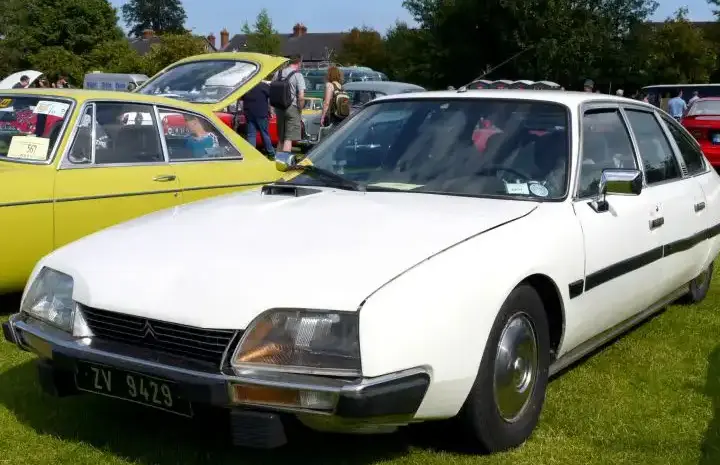
The Citroen CX II Break 25 GTi Automatic, produced between 1987 and 1991, represents a unique blend of Citroen’s innovative hydropneumatic suspension technology with a relatively accessible, albeit sporty, powertrain option. Positioned as a higher-end variant within the CX II Break (estate) range, the 25 GTi Automatic offered a comfortable and capable grand touring experience. It was part of the second series of the CX, denoted by the “II” designation, which brought refinements to the original CX design launched in 1974. The CX, as a whole, was Citroen’s flagship saloon and estate, intended to replace the venerable DS, and continued the company’s tradition of technologically advanced and strikingly styled vehicles.
Technical Specifications
| Brand | Citroen |
| Model | CX |
| Generation | CX II Break |
| Type (Engine) | 25 GTi (123 Hp) Automatic |
| Start of production | 1987 |
| End of production | 1991 |
| Powertrain Architecture | Internal Combustion engine |
| Body type | Station wagon (estate) |
| Seats | 5 |
| Doors | 5 |
| Fuel Type | Petrol (Gasoline) |
| Acceleration 0 – 100 km/h | 16.3 sec |
| Acceleration 0 – 62 mph | 16.3 sec |
| Acceleration 0 – 60 mph | 15.5 sec |
| Maximum speed | 182 km/h (113.09 mph) |
| Weight-to-power ratio | 11.7 kg/Hp, 85.7 Hp/tonne |
| Weight-to-torque ratio | 7.5 kg/Nm, 133.1 Nm/tonne |
| Power | 123 Hp @ 5100 rpm |
| Power per litre | 49.2 Hp/l |
| Torque | 191 Nm @ 4000 rpm (140.87 lb.-ft. @ 4000 rpm) |
| Engine layout | Front, Transverse |
| Engine Model/Code | M25.668 |
| Engine displacement | 2500 cm3 (152.56 cu. in.) |
| Number of cylinders | 4 |
| Engine configuration | Inline |
| Cylinder Bore | 93 mm (3.66 in.) |
| Piston Stroke | 92 mm (3.62 in.) |
| Compression ratio | 8.75:1 |
| Number of valves per cylinder | 2 |
| Fuel injection system | Multi-port manifold injection |
| Engine aspiration | Naturally aspirated engine |
| Engine oil capacity | 5.5 l (5.81 US qt | 4.84 UK qt) |
| Coolant | 12.5 l (13.21 US qt | 11 UK qt) |
| Kerb Weight | 1435 kg (3163.63 lbs.) |
| Max. weight | 2165 kg (4773.01 lbs.) |
| Max load | 730 kg (1609.37 lbs.) |
| Trunk (boot) space – minimum | 485 l (17.13 cu. ft.) |
| Trunk (boot) space – maximum | 1163 l (41.07 cu. ft.) |
| Fuel tank capacity | 68 l (17.96 US gal | 14.96 UK gal) |
| Max. roof load | 80 kg (176.37 lbs.) |
| Permitted towbar download | 100 kg (220.46 lbs.) |
| Length | 4929 mm (194.06 in.) |
| Width | 1770 mm (69.69 in.) |
| Height | 1475 mm (58.07 in.) |
| Wheelbase | 3095 mm (121.85 in.) |
| Front track | 1522 mm (59.92 in.) |
| Rear (Back) track | 1398 mm (55.04 in.) |
| Drag coefficient (Cd) | 0.37 |
| Minimum turning circle | 13.40 m (43.96 ft.) |
| Drivetrain Architecture | The Internal combustion engine (ICE) drives the front wheels of the vehicle. |
| Drive wheel | Front wheel drive |
| Number of gears and type of gearbox | 3 gears, automatic transmission |
| Front suspension | Hydro-pneumatic element |
| Rear suspension | Hydro-pneumatic element |
| Front brakes | Ventilated discs |
| Rear brakes | Disc |
| Steering type | Steering rack and pinion |
| Power steering | Hydraulic Steering |
| Tires size | 195/70 R14 |
| Wheel rims size | 5.5J x 14 |
INTRODUCTION
The Citroen CX II Break 25 GTi Automatic, produced from 1987 to 1991, was a station wagon variant of the CX series, known for its distinctive wedge shape and advanced hydropneumatic suspension. The “Break” designation signified the estate body style. The 25 GTi Automatic trim level represented a step up in performance and equipment compared to the base CX Break models, offering a more refined driving experience. It utilized a 2.5-liter inline-four engine paired with a three-speed automatic transmission, targeting buyers who desired comfort and practicality without sacrificing a degree of sporting character. This model occupied a middle ground within the CX II Break lineup, positioned below the more powerful and expensive 25 Turbo models.
Powertrain & Engine Architecture
The heart of the CX II Break 25 GTi Automatic is the M25.668 engine, a 2.5-liter (2499cc) inline-four cylinder petrol engine. This engine featured a cast iron block and an aluminum cylinder head, employing a single overhead camshaft (SOHC) design with two valves per cylinder. Fuel delivery was managed by a Bosch multi-port fuel injection system, providing improved efficiency and responsiveness compared to earlier carbureted Citroen engines. The engine produced 123 horsepower at 5100 rpm and 191 Nm (140.87 lb-ft) of torque at 4000 rpm. The three-speed automatic transmission, while providing convenience, was a relatively dated design even in the late 1980s. It lacked the sophistication of more modern automatic gearboxes, resulting in noticeable shifts and a less direct connection to the engine. The transmission was designed to prioritize smooth operation over outright performance.
Driving Characteristics
The driving experience in the CX II Break 25 GTi Automatic is heavily influenced by Citroen’s signature hydropneumatic suspension. This system, utilizing self-leveling spheres filled with nitrogen and hydraulic fluid, provides an exceptionally smooth and comfortable ride, absorbing bumps and imperfections in the road with remarkable ease. However, the combination of the 2.5-liter engine and the three-speed automatic transmission results in performance that is best described as adequate rather than exhilarating. Acceleration from 0-60 mph takes around 15.5 seconds, and the top speed is approximately 113 mph. The automatic transmission’s gear ratios are geared towards fuel economy and cruising comfort, rather than rapid acceleration. Compared to the manual transmission versions of the 25 GTi, the automatic suffers a noticeable performance deficit. The higher-output 25 Turbo models, with their turbocharged engines, offer significantly more power and a more engaging driving experience.
Equipment & Trim Levels
The 25 GTi Automatic trim level included a number of standard features designed to enhance comfort and convenience. These typically included power steering, central locking, electric windows, and a high-quality stereo system. Interior upholstery was generally cloth, although leather options were available as an extra cost. The dashboard layout was typical of Citroen designs of the era, featuring a combination of analog gauges and illuminated switches. Optional extras could include air conditioning, a sunroof, and upgraded sound systems. The Break (estate) body style itself offered a significant advantage in terms of practicality, with a generous cargo capacity of 485 liters (17.13 cu. ft.) with the rear seats up, expanding to 1163 liters (41.07 cu. ft.) with the seats folded down.
Chassis & Braking
The CX II Break 25 GTi Automatic utilized a front-wheel-drive layout with independent suspension on all four wheels, courtesy of the hydropneumatic system. The front suspension featured a complex arrangement of spheres, dampers, and linkages, while the rear suspension employed a similar setup. Braking duties were handled by ventilated discs at the front and solid discs at the rear. The hydraulic braking system, integrated with the hydropneumatic suspension, provided effective stopping power, although the system required regular maintenance to ensure optimal performance. The steering was a rack-and-pinion system with hydraulic power assistance, offering light and precise steering feel.
Market Reception & Comparison
The CX II Break 25 GTi Automatic received mixed reviews from automotive critics. While the ride quality and comfort were universally praised, the performance of the 2.5-liter engine and the dated automatic transmission were often criticized. Compared to its rivals, such as the Volvo 240 estate or the BMW 5 Series Touring, the CX offered a unique driving experience thanks to its hydropneumatic suspension, but it lacked the outright performance and refinement of some of its competitors. Fuel economy was reasonable for the time, but not exceptional. Reliability was generally good, although the hydropneumatic suspension system required specialized knowledge and maintenance, which could be costly.
Legacy
The Citroen CX II Break 25 GTi Automatic remains a distinctive and somewhat quirky classic car. The hydropneumatic suspension system, while complex, continues to be admired for its ability to deliver an unparalleled ride quality. The M25.668 engine, while not particularly powerful, is generally considered to be a reliable unit when properly maintained. Today, the CX II Break 25 GTi Automatic is sought after by Citroen enthusiasts and collectors who appreciate its unique character and technological innovation. Finding well-maintained examples can be challenging, as the hydropneumatic system requires regular attention to prevent leaks and maintain optimal performance. However, for those willing to invest the time and effort, the CX II Break 25 GTi Automatic offers a rewarding and unforgettable driving experience.