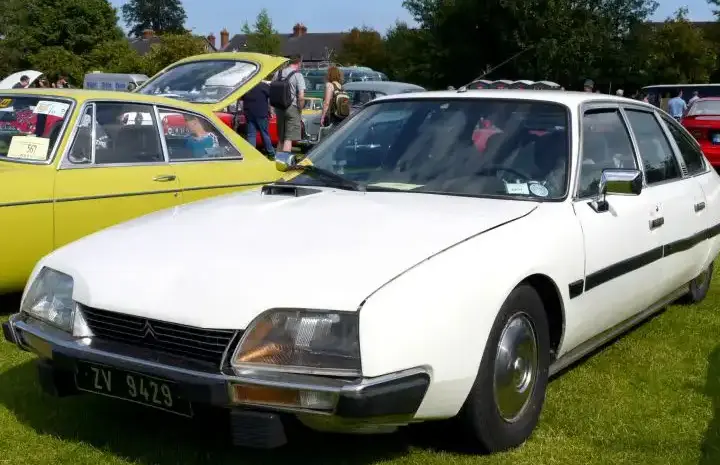
The Citroen CX II Break 25 RD, produced between 1985 and 1991, represents a unique offering within the second generation of the CX series. This variant, characterized by its 2.5-liter diesel engine producing 75 horsepower, coupled with a four-speed manual transmission, served as a practical and economical choice for buyers seeking a spacious station wagon. The CX II Break, meaning “estate” in British English, was Citroen’s answer to the growing demand for versatile family vehicles, offering a blend of comfort, innovative technology, and distinctive styling. It sat within the CX range as an entry-level diesel option, positioned below the more powerful and technologically advanced gasoline-powered models.
Technical Specifications
| Brand | Citroen |
| Model | CX |
| Generation | CX II Break |
| Type (Engine) | 25 RD (75 Hp) Manual 4-speed |
| Start of production | 1985 |
| End of production | 1991 |
| Powertrain Architecture | Internal Combustion engine |
| Body type | Station wagon (estate) |
| Seats | 5 |
| Doors | 5 |
| Fuel consumption (urban) | 8.5 l/100 km (27.7 US mpg, 33.2 UK mpg, 11.8 km/l) |
| Fuel consumption (extra urban) | 6.3 l/100 km (37.3 US mpg, 44.8 UK mpg, 15.9 km/l) |
| Fuel consumption (combined) | 7.8 l/100 km (30.2 US mpg, 36.2 UK mpg, 12.8 km/l) |
| Fuel Type | Diesel |
| Acceleration 0 – 100 km/h | 17.9 sec |
| Acceleration 0 – 62 mph | 17.9 sec |
| Acceleration 0 – 60 mph | 17 sec |
| Maximum speed | 147 km/h (91.34 mph) |
| Weight-to-power ratio | 19.7 kg/Hp, 50.8 Hp/tonne |
| Weight-to-torque ratio | 9.6 kg/Nm, 103.7 Nm/tonne |
| Power | 75 Hp @ 4250 rpm |
| Power per litre | 30 Hp/l |
| Torque | 153 Nm @ 2000 rpm (112.85 lb.-ft. @ 2000 rpm) |
| Engine layout | Front, Transverse |
| Engine Model/Code | M25-660 |
| Engine displacement | 2500 cm3 (152.56 cu. in.) |
| Number of cylinders | 4 |
| Engine configuration | Inline |
| Cylinder Bore | 93 mm (3.66 in.) |
| Piston Stroke | 92 mm (3.62 in.) |
| Compression ratio | 22.25:1 |
| Number of valves per cylinder | 2 |
| Fuel injection system | Precombustion chamber injection |
| Engine aspiration | Naturally aspirated engine |
| Engine oil capacity | 6 l (6.34 US qt | 5.28 UK qt) |
| Coolant | 13 l (13.74 US qt | 11.44 UK qt) |
| Kerb Weight | 1475 kg (3251.82 lbs.) |
| Max. weight | 2190 kg (4828.12 lbs.) |
| Max load | 715 kg (1576.31 lbs.) |
| Trunk (boot) space – minimum | 485 l (17.13 cu. ft.) |
| Trunk (boot) space – maximum | 1163 l (41.07 cu. ft.) |
| Fuel tank capacity | 68 l (17.96 US gal | 14.96 UK gal) |
| Max. roof load | 80 kg (176.37 lbs.) |
| Permitted trailer load with brakes (12%) | 1300 kg (2866.01 lbs.) |
| Permitted trailer load without brakes | 755 kg (1664.49 lbs.) |
| Permitted towbar download | 100 kg (220.46 lbs.) |
| Length | 4929 mm (194.06 in.) |
| Width | 1770 mm (69.69 in.) |
| Height | 1475 mm (58.07 in.) |
| Wheelbase | 3095 mm (121.85 in.) |
| Front track | 1522 mm (59.92 in.) |
| Rear (Back) track | 1398 mm (55.04 in.) |
| Ride height (ground clearance) | 157 mm (6.18 in.) |
| Drag coefficient (Cd) | 0.37 |
| Minimum turning circle (turning diameter) | 13.40 m (43.96 ft.) |
| Drivetrain Architecture | The Internal combustion engine (ICE) drives the front wheels of the vehicle. |
| Drive wheel | Front wheel drive |
| Number of gears and type of gearbox | 4 gears, manual transmission |
| Front suspension | Hydro-pneumatic element |
| Rear suspension | Hydro-pneumatic element |
| Front brakes | Ventilated discs |
| Rear brakes | Disc |
| Steering type | Steering rack and pinion |
| Power steering | Hydraulic Steering |
| Tires size | 195/70 R14 |
| Wheel rims size | 5.5J x 14 |
Powertrain & Engine Architecture
The heart of the CX 25 RD is the M25-660, a 2.5-liter inline-four diesel engine. This engine utilizes precombustion chamber injection, a system common in European diesel engines of the era. This system involves injecting fuel into a small precombustion chamber within the cylinder head, where it ignites and then ignites the main charge in the cylinder. This design aids in smoother combustion and reduced engine noise compared to direct injection systems. The engine produces 75 horsepower at 4250 rpm and 153 Nm (112.85 lb-ft) of torque at 2000 rpm. The four-speed manual transmission was a standard feature, providing drivers with control over gear selection. While not a performance-oriented setup, the powertrain was designed for durability and fuel efficiency.
Driving Characteristics
The CX 25 RD with the manual transmission offered a driving experience focused on practicality and comfort. Acceleration was leisurely, with a 0-60 mph time of around 17 seconds. The engine’s torque delivery was relatively flat, making it suitable for hauling loads and navigating varied terrain. Compared to the gasoline-powered CX models, the 25 RD lacked the outright speed and responsiveness, but it compensated with significantly better fuel economy. The manual transmission allowed for greater driver engagement and control, although the gear ratios were optimized for economy rather than performance. The CX’s renowned hydropneumatic suspension provided a remarkably smooth and comfortable ride, absorbing bumps and imperfections in the road with ease.
Equipment & Trim Levels
The CX II Break 25 RD was generally equipped with a modest level of standard features. Interior upholstery typically consisted of durable cloth materials. The dashboard layout was functional and straightforward, with essential gauges and controls readily accessible. Power steering was standard, making maneuvering the large station wagon easier. Optional extras included features like upgraded audio systems, sunroofs, and more luxurious interior trim options. The 25 RD was positioned as a value-oriented trim, appealing to buyers who prioritized practicality and affordability over luxury.
Chassis & Braking
The CX II Break featured Citroen’s innovative hydropneumatic suspension system, which provided a self-leveling ride and exceptional comfort. The front suspension utilized hydropneumatic spheres, while the rear also employed this technology. Braking duties were handled by ventilated discs at the front and solid discs at the rear. The hydraulic braking system, integrated with the hydropneumatic suspension, offered consistent and reliable stopping power. The steering system was a rack and pinion setup with hydraulic assistance, providing precise and responsive steering feel.
Market Reception & Comparison
The CX 25 RD was well-received in European markets as a practical and economical station wagon. Critics praised its comfortable ride, spacious interior, and fuel efficiency. However, its relatively slow acceleration and modest power output were noted. Compared to the gasoline-powered CX models, the 25 RD offered a more affordable entry point into the CX range, but at the expense of performance. It also competed with other European station wagons, such as the Peugeot 505 Break and the Volvo 240 Estate, offering a unique blend of comfort and practicality.
Legacy
The Citroen CX II Break 25 RD, while not the most powerful or technologically advanced variant of the CX, remains a respected and fondly remembered vehicle. The M25-660 diesel engine, when properly maintained, proved to be remarkably durable and long-lasting. Today, the CX 25 RD is a sought-after classic car, appreciated for its unique styling, comfortable ride, and innovative technology. Finding well-maintained examples can be challenging, but the CX 25 RD continues to offer a distinctive and rewarding driving experience for enthusiasts.