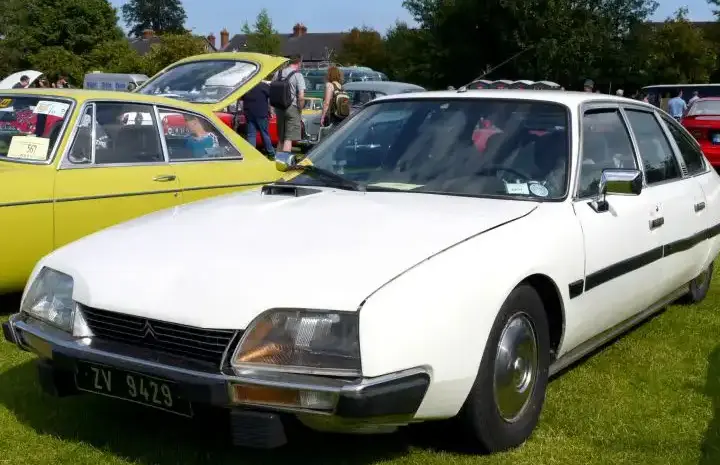
Technical Specifications
| Brand | Citroen |
| Model | CX |
| Generation | CX II Break |
| Type (Engine) | 25 TRi (138 Hp) Automatic |
| Start of production | 1985 |
| End of production | 1990 |
| Powertrain Architecture | Internal Combustion engine |
| Body type | Station wagon (estate) |
| Seats | 5 |
| Doors | 5 |
| Fuel consumption (urban) | 13 l/100 km (18.1 US mpg, 21.7 UK mpg, 7.7 km/l) |
| Fuel consumption (extra urban) | 9.6 l/100 km (24.5 US mpg, 29.4 UK mpg, 10.4 km/l) |
| Fuel consumption (combined) | 11.5 l/100 km (20.5 US mpg, 24.6 UK mpg, 8.7 km/l) |
| Fuel Type | Petrol (Gasoline) |
| Acceleration 0 – 100 km/h | 10.4 sec |
| Acceleration 0 – 62 mph | 10.4 sec |
| Acceleration 0 – 60 mph | 9.9 sec |
| Maximum speed | 191 km/h (118.68 mph) |
| Weight-to-power ratio | 10.6 kg/Hp, 94.2 Hp/tonne |
| Weight-to-torque ratio | 6.9 kg/Nm, 144 Nm/tonne |
| Power | 138 Hp @ 5000 rpm |
| Power per litre | 55.2 Hp/l |
| Torque | 211 Nm @ 4000 rpm (155.63 lb.-ft. @ 4000 rpm) |
| Engine layout | Front, Transverse |
| Engine Model/Code | M25.659 |
| Engine displacement | 2500 cm3 (152.56 cu. in.) |
| Number of cylinders | 4 |
| Engine configuration | Inline |
| Cylinder Bore | 93 mm (3.66 in.) |
| Piston Stroke | 92 mm (3.62 in.) |
| Compression ratio | 8.75:1 |
| Number of valves per cylinder | 2 |
| Fuel injection system | Multi-port manifold injection |
| Engine aspiration | Naturally aspirated engine |
| Engine oil capacity | 5.5 l (5.81 US qt | 4.84 UK qt) |
| Coolant | 12.5 l (13.21 US qt | 11 UK qt) |
| Kerb Weight | 1465 kg (3229.77 lbs.) |
| Max. weight | 2165 kg (4773.01 lbs.) |
| Max load | 700 kg (1543.24 lbs.) |
| Trunk (boot) space – minimum | 485 l (17.13 cu. ft.) |
| Trunk (boot) space – maximum | 1163 l (41.07 cu. ft.) |
| Fuel tank capacity | 68 l (17.96 US gal | 14.96 UK gal) |
| Max. roof load | 80 kg (176.37 lbs.) |
| Permitted trailer load with brakes (12%) | 1300 kg (2866.01 lbs.) |
| Permitted trailer load without brakes | 730 kg (1609.37 lbs.) |
| Permitted towbar download | 100 kg (220.46 lbs.) |
| Length | 4929 mm (194.06 in.) |
| Width | 1770 mm (69.69 in.) |
| Height | 1475 mm (58.07 in.) |
| Wheelbase | 3095 mm (121.85 in.) |
| Front track | 1522 mm (59.92 in.) |
| Rear (Back) track | 1398 mm (55.04 in.) |
| Ride height (ground clearance) | 160 mm (6.3 in.) |
| Drag coefficient (Cd) | 0.37 |
| Minimum turning circle (turning diameter) | 13.40 m (43.96 ft.) |
| Drivetrain Architecture | The Internal combustion engine (ICE) drives the front wheels of the vehicle. |
| Drive wheel | Front wheel drive |
| Number of gears and type of gearbox | 3 gears, automatic transmission |
| Front suspension | Hydro-pneumatic element |
| Rear suspension | Hydro-pneumatic element |
| Front brakes | Ventilated discs |
| Rear brakes | Disc |
| Steering type | Steering rack and pinion |
| Power steering | Hydraulic Steering |
| Tires size | 195/70 R14 |
| Wheel rims size | 5.5J x 14 |
The Citroen CX II Break 25 TRi Automatic, produced between 1985 and 1990, represents a luxurious and technologically advanced iteration of Citroen’s iconic CX estate car. Positioned as a mid-to-high range trim level within the CX II Break lineup, it offered a blend of performance, comfort, and practicality aimed at discerning buyers. The CX, as a whole, was Citroen’s flagship saloon and estate, succeeding the DS and continuing the company’s tradition of innovative hydropneumatic suspension. The “Break” designation signified the estate (station wagon) body style, offering increased cargo capacity compared to the saloon. This particular 25 TRi variant, equipped with a 2.5-liter engine and a three-speed automatic transmission, was designed to provide effortless cruising and a refined driving experience.
Powertrain & Engine Architecture
The heart of the CX 25 TRi Automatic is the M25.659 engine, a 2.5-liter inline-four cylinder petrol engine. This engine featured a cast iron block and an aluminum cylinder head, employing a single overhead camshaft (SOHC) design with two valves per cylinder. Fuel delivery was managed by a Bosch multi-port fuel injection system, contributing to improved efficiency and smoother operation compared to earlier carbureted Citroen engines. The engine produced 138 horsepower at 5000 rpm and 211 Nm (155.63 lb-ft) of torque at 4000 rpm. The engine’s transverse mounting saved space in the engine bay and contributed to the car’s front-wheel-drive configuration. Paired with the engine was a three-speed automatic transmission, designed for comfortable and relaxed driving. While not offering the performance of a manual gearbox, it suited the car’s grand touring character.
Driving Characteristics
The CX 25 TRi Automatic prioritized comfort and ease of driving over outright performance. The three-speed automatic transmission, while smooth, resulted in a slightly less responsive feel compared to the five-speed manual versions. Acceleration from 0 to 60 mph took approximately 9.9 seconds, and the top speed was around 118.68 mph. The automatic gearbox’s gear ratios were optimized for cruising, providing relaxed highway performance. However, it could feel somewhat sluggish during quick overtaking maneuvers. The CX’s signature hydropneumatic suspension, however, provided an exceptionally smooth and comfortable ride, absorbing bumps and imperfections in the road with remarkable effectiveness. This suspension system also allowed for self-leveling, maintaining a consistent ride height regardless of load.
Equipment & Trim Levels
The 25 TRi Automatic trim level was well-equipped for its time. Standard features included power steering, central locking, electric windows, and a high-quality stereo system. The interior typically featured comfortable cloth upholstery, although leather was available as an optional extra. The dashboard layout was characteristically Citroen, with a unique combination of analog gauges and switches. Optional extras included air conditioning, a sunroof, and upgraded sound systems. The “TRi” designation indicated a higher level of trim and equipment compared to the base CX 25 models.
Chassis & Braking
The CX II Break featured a robust chassis designed to handle the weight of the estate body and the hydropneumatic suspension system. The front suspension utilized Citroen’s innovative hydropneumatic technology, providing a remarkably smooth and controlled ride. The rear suspension also employed a hydropneumatic system, further enhancing ride comfort. Braking duties were handled by ventilated discs at the front and solid discs at the rear, providing adequate stopping power for the car’s weight and performance. Hydraulic assistance was standard for the steering, making maneuvering at low speeds easier.
Market Reception & Comparison
The Citroen CX II Break 25 TRi Automatic was generally well-received by automotive critics, who praised its comfortable ride, spacious interior, and innovative technology. However, some critics noted the automatic transmission’s lack of responsiveness compared to the manual gearbox. Compared to other estate cars of the time, the CX offered a unique blend of luxury, practicality, and advanced engineering. The 25 TRi Automatic was positioned above the base CX 25 models in terms of price and equipment, but below the more powerful and expensive CX 25 GTI. Fuel economy, at around 20.5 US mpg combined, was typical for a car of its size and engine displacement in the late 1980s.
Legacy
The Citroen CX, while not a massive sales success, remains a beloved classic among Citroen enthusiasts. The 25 TRi Automatic powertrain, while not the most powerful in the CX lineup, is known for its reliability and relative simplicity. Today, well-maintained examples of the CX II Break 25 TRi Automatic are sought after by collectors and enthusiasts who appreciate its unique character and advanced technology. Parts availability can be a challenge, but a dedicated network of Citroen specialists and suppliers exists to support owners. The CX’s hydropneumatic suspension, while requiring specialized maintenance, continues to provide a ride quality that few modern cars can match.