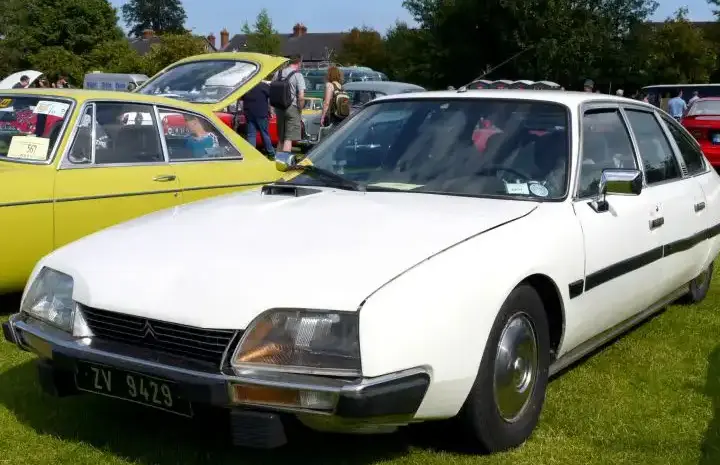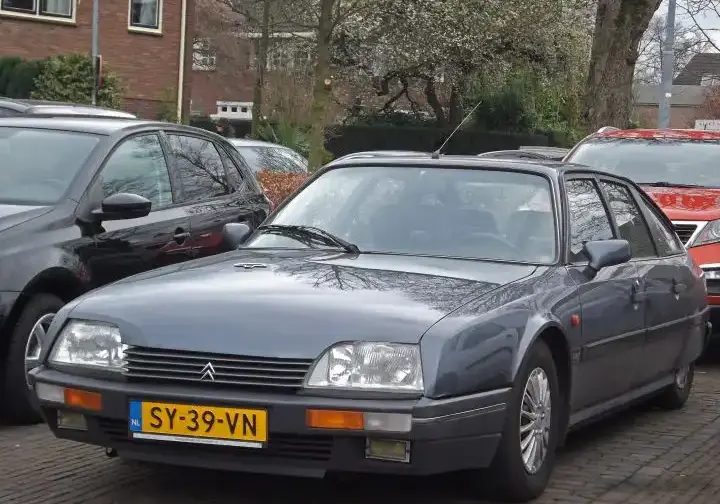
The Citroën CX II Prestige 25 Automatic, produced between 1985 and 1989, represented a luxurious and technologically advanced offering within the second generation (CX II) of the iconic CX line. Positioned as a premium variant, it combined a 2.5-liter inline-four engine with a three-speed automatic transmission, targeting buyers seeking a comfortable and refined grand touring experience. The CX II, building upon the revolutionary hydropneumatic suspension of the original CX, continued Citroën’s tradition of innovation and distinctive styling. This particular model occupied the upper-midrange of the CX lineup, offering more power and features than the base models but remaining below the flagship versions equipped with the more potent turbocharged engines.
Technical Specifications
| Brand | Citroen |
| Model | CX |
| Generation | CX II |
| Type (Engine) | Prestige 25 (138 Hp) Automatic |
| Start of production | 1985 |
| End of production | 1989 |
| Powertrain Architecture | Internal Combustion engine |
| Body type | Hatchback |
| Seats | 5 |
| Doors | 5 |
| Fuel consumption (urban) | 13.6 l/100 km (17.3 US mpg, 20.8 UK mpg) |
| Fuel consumption (extra urban) | 8 l/100 km (29.4 US mpg, 35.3 UK mpg) |
| Fuel Type | Petrol (Gasoline) |
| Acceleration 0 – 100 km/h | 12.3 sec |
| Acceleration 0 – 62 mph | 12.3 sec |
| Acceleration 0 – 60 mph | 11.7 sec |
| Maximum speed | 195 km/h (121.17 mph) |
| Weight-to-power ratio | 10.5 kg/Hp |
| Weight-to-torque ratio | 6.9 kg/Nm |
| Power | 138 Hp @ 5000 rpm |
| Power per litre | 55.2 Hp/l |
| Torque | 211 Nm @ 4000 rpm (155.63 lb.-ft. @ 4000 rpm) |
| Engine layout | Front, Transverse |
| Engine Model/Code | M25.659 |
| Engine displacement | 2500 cm3 (152.56 cu. in.) |
| Number of cylinders | 4 |
| Engine configuration | Inline |
| Cylinder Bore | 93 mm (3.66 in.) |
| Piston Stroke | 92 mm (3.62 in.) |
| Compression ratio | 8.75:1 |
| Number of valves per cylinder | 2 |
| Fuel injection system | Multi-port manifold injection |
| Engine aspiration | Naturally aspirated |
| Engine oil capacity | 5.5 l (5.81 US qt | 4.84 UK qt) |
| Coolant capacity | 12.5 l (13.21 US qt | 11 UK qt) |
| Kerb Weight | 1450 kg (3196.7 lbs.) |
| Max. weight | 1910 kg (4210.83 lbs.) |
| Max load | 460 kg (1014.13 lbs.) |
| Trunk (boot) space – minimum | 485 l (17.13 cu. ft.) |
| Trunk (boot) space – maximum | 507 l (17.9 cu. ft.) |
| Fuel tank capacity | 68 l (17.96 US gal | 14.96 UK gal) |
| Max. roof load | 80 kg (176.37 lbs.) |
| Permitted trailer load with brakes (12%) | 1300 kg (2866.01 lbs.) |
| Permitted trailer load without brakes | 725 kg (1598.35 lbs.) |
| Permitted towbar download | 100 kg (220.46 lbs.) |
| Length | 4900 mm (192.91 in.) |
| Width | 1770 mm (69.69 in.) |
| Height | 1375 mm (54.13 in.) |
| Wheelbase | 3095 mm (121.85 in.) |
| Front track | 1522 mm (59.92 in.) |
| Rear track | 1368 mm (53.86 in.) |
| Ride height (ground clearance) | 160 mm (6.3 in.) |
| Drag coefficient (Cd) | 0.34 |
| Minimum turning circle | 13.40 m (43.96 ft.) |
| Drivetrain Architecture | Front wheel drive |
| Number of gears | 3 |
| Gearbox type | Automatic transmission |
| Front suspension | Hydro-pneumatic |
| Rear suspension | Hydro-pneumatic |
| Front brakes | Ventilated discs |
| Rear brakes | Disc |
| Steering type | Steering rack and pinion |
| Power steering | Hydraulic |
| Tires size | 195/70 R14 |
| Wheel rims size | 5.5J x 14 |
Powertrain & Engine Architecture
The Prestige 25 was powered by the M25.659 engine, a 2.5-liter inline-four cylinder gasoline engine. This engine featured a cast iron block and an aluminum cylinder head, employing a single overhead camshaft (SOHC) design with two valves per cylinder. Fuel delivery was managed by a Bosch multi-port fuel injection system, contributing to improved efficiency and smoother operation compared to earlier carbureted Citroën engines. The engine produced 138 horsepower at 5000 rpm and 211 Nm (155.63 lb-ft) of torque at 4000 rpm. The three-speed automatic transmission, while providing convenience, was a relatively simple unit designed for smooth shifts rather than outright performance. It lacked the sophistication of more modern automatic gearboxes, with wider gear ratios and a tendency to hunt for gears under certain conditions.
Driving Characteristics
The CX II Prestige 25 Automatic offered a distinctly comfortable ride, largely thanks to Citroën’s renowned hydropneumatic suspension. This system provided a remarkably smooth and level ride, even over uneven surfaces. However, the combination of the 2.5-liter engine and the three-speed automatic transmission resulted in performance that was adequate but not particularly spirited. Acceleration from 0 to 60 mph took around 11.7 seconds, and the top speed was approximately 121 mph. Compared to the manual transmission versions of the same engine, the automatic suffered a noticeable performance penalty. The automatic’s gear ratios were geared more towards fuel economy and cruising comfort than rapid acceleration. The CX’s steering, while precise, was power-assisted and could feel somewhat detached, requiring a degree of acclimatization for drivers accustomed to more direct steering systems.
Equipment & Trim Levels
The Prestige trim level denoted a higher level of equipment and refinement. Standard features included comfortable cloth upholstery, power windows, central locking, and a high-quality audio system. The dashboard layout was characteristically Citroën, featuring a unique combination of analog gauges and switches. Optional extras included leather upholstery, air conditioning, and a sunroof. The interior was spacious and well-appointed, reflecting the CX’s positioning as a luxury vehicle. The Prestige trim also included additional sound deadening material, further enhancing the car’s quiet and comfortable cabin environment.
Chassis & Braking
The CX II utilized a monocoque chassis construction, providing a good balance of strength and rigidity. The hydropneumatic suspension system, a defining feature of the CX, allowed for adjustable ride height and self-leveling, maintaining a consistent ride quality regardless of load. The front suspension employed a complex arrangement of hydraulic spheres and dampers, while the rear suspension utilized a similar setup. Braking was provided by ventilated discs at the front and solid discs at the rear. The hydraulic braking system, integrated with the hydropneumatic suspension, offered excellent stopping power and control. Power steering was standard, making maneuvering at low speeds easier.
Market Reception & Comparison
The CX II Prestige 25 Automatic was generally well-received by automotive critics, who praised its comfortable ride, innovative suspension system, and distinctive styling. However, the automatic transmission was often criticized for its lack of responsiveness and its impact on performance. Compared to other vehicles in its class, such as the Peugeot 505 and the Rover SD1, the CX offered a unique driving experience thanks to its hydropneumatic suspension. Fuel economy was reasonable for the time, but not exceptional. Reliability was a mixed bag, with the hydropneumatic suspension requiring regular maintenance and occasional repairs. The 2.5-liter engine proved to be relatively durable, but the automatic transmission could be prone to issues if not properly maintained.
Legacy
The Citroën CX II Prestige 25 Automatic remains a sought-after classic car, particularly among enthusiasts who appreciate its unique engineering and distinctive design. The hydropneumatic suspension system, while complex, continues to be admired for its ability to provide an exceptionally comfortable ride. The 2.5-liter engine, while not a powerhouse, is known for its reliability and relatively straightforward maintenance. Today, finding well-maintained examples can be challenging, as the hydropneumatic system requires specialized knowledge and parts. However, for those willing to invest the time and effort, the CX II Prestige 25 Automatic offers a unique and rewarding driving experience, representing a high point in Citroën’s history of automotive innovation.