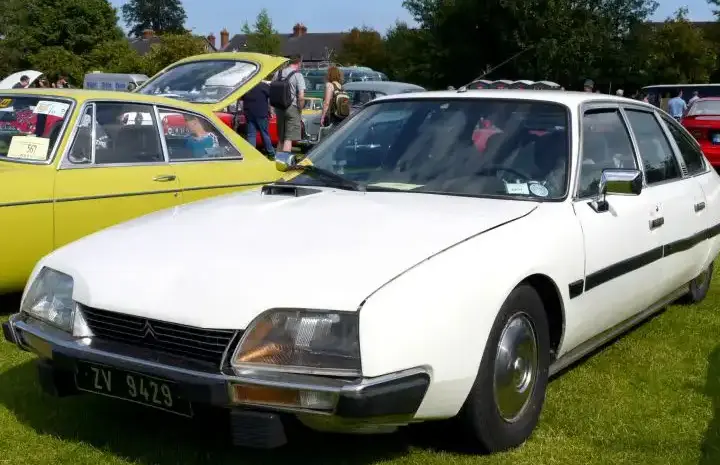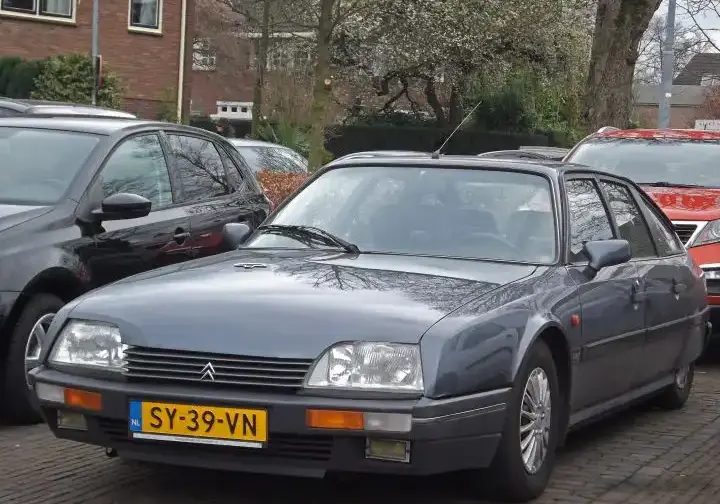
The Citroën CX II Prestige 25 Turbo 2, produced between 1986 and 1989, represented a high-performance variant within the second generation (CX II) of Citroën’s innovative CX line. Building upon the already technologically advanced CX, the 25 Turbo 2 offered a significant power upgrade thanks to its turbocharged 2.5-liter inline-four engine. This model aimed to provide a blend of Citroën’s famed hydropneumatic suspension comfort with genuine sporting performance, appealing to buyers seeking a unique and sophisticated grand touring experience. It occupied a premium position in the CX lineup, positioned above the naturally aspirated versions and serving as a more accessible alternative to the flagship Citroën models.
Technical Specifications
| Brand | Citroen |
| Model | CX |
| Generation | CX II |
| Type (Engine) | Prestige 25 Turbo 2 (160 Hp) |
| Start of production | 1986 |
| End of production | 1989 |
| Body type | Hatchback |
| Seats | 5 |
| Doors | 5 |
| Fuel Type | Petrol (Gasoline) |
| Acceleration 0 – 100 km/h | 9.3 sec |
| Acceleration 0 – 62 mph | 9.3 sec |
| Acceleration 0 – 60 mph | 8.8 sec |
| Maximum speed | 215 km/h (133.59 mph) |
| Weight-to-power ratio | 9.3 kg/Hp, 108.1 Hp/tonne |
| Weight-to-torque ratio | 5.4 kg/Nm, 185.8 Nm/tonne |
| Power | 160 Hp @ 5000 rpm |
| Power per litre | 64 Hp/l |
| Torque | 275 Nm @ 3250 rpm (202.83 lb.-ft. @ 3250 rpm) |
| Engine layout | Front, Transverse |
| Engine Model/Code | M25-667 |
| Engine displacement | 2500 cm3 (152.56 cu. in.) |
| Number of cylinders | 4 |
| Engine configuration | Inline |
| Cylinder Bore | 93 mm (3.66 in.) |
| Piston Stroke | 92 mm (3.62 in.) |
| Compression ratio | 7.75:1 |
| Number of valves per cylinder | 2 |
| Fuel injection system | Multi-port manifold injection |
| Engine aspiration | Turbocharger |
| Engine oil capacity | 5.5 l (5.81 US qt | 4.84 UK qt) |
| Coolant | 12.5 l (13.21 US qt | 11 UK qt) |
| Kerb Weight | 1480 kg (3262.84 lbs.) |
| Max. weight | 1920 kg (4232.88 lbs.) |
| Max load | 440 kg (970.03 lbs.) |
| Trunk (boot) space – minimum | 485 l (17.13 cu. ft.) |
| Trunk (boot) space – maximum | 507 l (17.9 cu. ft.) |
| Fuel tank capacity | 68 l (17.96 US gal | 14.96 UK gal) |
| Max. roof load | 80 kg (176.37 lbs.) |
| Permitted towbar download | 100 kg (220.46 lbs.) |
| Length | 4900 mm (192.91 in.) |
| Width | 1770 mm (69.69 in.) |
| Height | 1375 mm (54.13 in.) |
| Wheelbase | 3095 mm (121.85 in.) |
| Front track | 1522 mm (59.92 in.) |
| Rear (Back) track | 1368 mm (53.86 in.) |
| Ride height (ground clearance) | 160 mm (6.3 in.) |
| Drag coefficient (Cd) | 0.34 |
| Minimum turning circle | 13.40 m (43.96 ft.) |
| Drivetrain Architecture | Internal Combustion Engine (ICE) |
| Drive wheel | Front wheel drive |
| Number of gears and type of gearbox | 5 gears, manual transmission |
| Front suspension | Hydro-pneumatic element |
| Rear suspension | Hydro-pneumatic element |
| Front brakes | Ventilated discs |
| Rear brakes | Disc |
| Steering type | Steering rack and pinion |
| Power steering | Hydraulic |
Powertrain & Engine Architecture
The heart of the CX II Prestige 25 Turbo 2 is the M25-667 engine, a 2.5-liter inline-four cylinder powerplant. This engine is distinguished by its single overhead camshaft (SOHC) valvetrain, operating two valves per cylinder. The key feature, of course, is the turbocharger, which significantly boosts power output. The engine utilizes Bosch multi-port fuel injection, providing precise fuel delivery for optimal combustion. The turbocharger itself is a Garrett unit, carefully matched to the engine’s characteristics to minimize turbo lag and deliver a broad torque curve. The engine’s 7.75:1 compression ratio is a compromise between performance and reliability when used with a turbocharger. The five-speed manual transmission was the only gearbox option for this variant, chosen to maximize the engine’s potential and provide a more engaging driving experience.
Driving Characteristics
The CX II Prestige 25 Turbo 2 offered a markedly different driving experience compared to the naturally aspirated CX models. The turbocharger delivers a noticeable surge of power, allowing for brisk acceleration. The 0-60 mph time of around 8.8 seconds was competitive for its era. While not a sports car in the modern sense, the CX Turbo 2 provided a confident and relaxed cruising ability, with ample power for overtaking. The hydropneumatic suspension continued to provide the CX’s signature ride quality, absorbing bumps and imperfections in the road with remarkable ease. The five-speed manual transmission allowed drivers to fully exploit the engine’s torque, while the gear ratios were well-chosen for both acceleration and highway cruising. Compared to the later 25 TDI diesel variant, the Turbo 2 offered significantly more power and a more responsive feel, but at the cost of fuel economy.
Equipment & Trim Levels
The “Prestige” designation indicated a high level of equipment. Standard features included comfortable cloth upholstery, power windows, central locking, and a high-quality stereo system. The dashboard layout was typical of the CX II, featuring a distinctive array of switches and gauges. Optional extras included leather upholstery, air conditioning, and a sunroof. The interior was designed to be both comfortable and functional, reflecting Citroën’s commitment to driver ergonomics. The CX II Prestige 25 Turbo 2 was positioned as a luxurious and well-equipped grand tourer.
Chassis & Braking
The CX II continued to utilize Citroën’s innovative hydropneumatic suspension system, providing a self-leveling ride and exceptional comfort. The front suspension featured independent hydropneumatic elements, while the rear suspension also employed hydropneumatic spheres. The CX II Prestige 25 Turbo 2 was equipped with ventilated disc brakes at the front and solid disc brakes at the rear, providing adequate stopping power for its performance level. Power-assisted steering was standard, making the car relatively easy to maneuver despite its size. Stabilizer bars were fitted to both the front and rear axles to reduce body roll during cornering.
Market Reception & Comparison
The CX II Prestige 25 Turbo 2 was generally well-received by automotive critics. It was praised for its comfortable ride, strong performance, and distinctive styling. However, some critics noted that the turbocharger could exhibit a degree of lag, and the car’s complexity could lead to higher maintenance costs. Compared to the naturally aspirated CX 25, the Turbo 2 offered a significant performance upgrade, but at a higher price point. The diesel-powered CX 25 TDI, introduced later, offered better fuel economy but lacked the Turbo 2’s outright power. The CX competed with other luxury hatchbacks and sedans of the era, such as the Peugeot 505 and the BMW 5 Series.
Legacy
The Citroën CX II Prestige 25 Turbo 2 remains a sought-after classic car, appreciated for its unique blend of comfort, performance, and technological innovation. The M25-667 engine, while complex, is generally considered to be reliable if properly maintained. However, the hydropneumatic suspension system requires specialized knowledge and can be expensive to repair. Today, the CX Turbo 2 is a relatively rare sight on the road, and well-maintained examples command a premium in the used car market. It represents a high point in Citroën’s engineering history and a testament to the company’s willingness to push the boundaries of automotive technology.