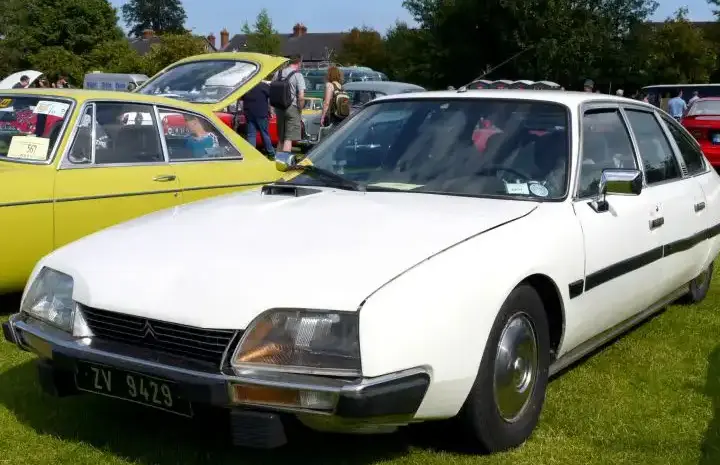
The Citroën CX II Prestige 25 Turbo 2, produced between 1985 and 1986, represented a high-performance variant within the second generation (CX II) of the innovative Citroën CX line. Building upon the already technologically advanced CX, the 25 Turbo 2 aimed to deliver a more engaging driving experience with increased power and refined features. It occupied a premium position in the CX lineup, positioned above the naturally aspirated models and serving as a flagship for performance enthusiasts. The CX II, launched in 1985, featured subtle styling updates and improvements to the already sophisticated hydropneumatic suspension system. This model continued Citroën’s tradition of offering unique and technologically advanced vehicles, though production numbers were relatively limited compared to more mainstream offerings.
Technical Specifications
| Brand | Citroen |
| Model | CX |
| Generation | CX II |
| Type (Engine) | Prestige 25 Turbo 2 (168 Hp) |
| Start of production | 1985 |
| End of production | 1986 |
| Powertrain Architecture | Internal Combustion engine |
| Body type | Hatchback |
| Seats | 5 |
| Doors | 5 |
| Fuel consumption (urban) | 14.1 l/100 km (16.7 US mpg, 20 UK mpg, 7.1 km/l) |
| Fuel consumption (extra urban) | 8 l/100 km (29.4 US mpg, 35.3 UK mpg, 12.5 km/l) |
| Fuel Type | Petrol (Gasoline) |
| Weight-to-power ratio | 8.8 kg/Hp, 113.5 Hp/tonne |
| Weight-to-torque ratio | 5 kg/Nm, 198.6 Nm/tonne |
| Power | 168 Hp @ 5000 rpm |
| Power per litre | 67.2 Hp/l |
| Torque | 294 Nm @ 3250 rpm (216.84 lb.-ft. @ 3250 rpm) |
| Engine layout | Front, Transverse |
| Engine Model/Code | M25.662 |
| Engine displacement | 2500 cm3 (152.56 cu. in.) |
| Number of cylinders | 4 |
| Engine configuration | Inline |
| Cylinder Bore | 93 mm (3.66 in.) |
| Piston Stroke | 92 mm (3.62 in.) |
| Compression ratio | 7.75:1 |
| Number of valves per cylinder | 2 |
| Fuel injection system | Multi-port manifold injection |
| Engine aspiration | Turbocharger |
| Engine oil capacity | 5.5 l (5.81 US qt, 4.84 UK qt) |
| Coolant capacity | 12.5 l (13.21 US qt, 11 UK qt) |
| Kerb Weight | 1480 kg (3262.84 lbs.) |
| Max. weight | 1920 kg (4232.88 lbs.) |
| Max load | 440 kg (970.03 lbs.) |
| Trunk (boot) space – minimum | 485 l (17.13 cu. ft.) |
| Trunk (boot) space – maximum | 507 l (17.9 cu. ft.) |
| Fuel tank capacity | 68 l (17.96 US gal, 14.96 UK gal) |
| Max. roof load | 80 kg (176.37 lbs.) |
| Permitted trailer load with brakes (12%) | 1300 kg (2866.01 lbs.) |
| Permitted trailer load without brakes | 740 kg (1631.42 lbs.) |
| Permitted towbar download | 100 kg (220.46 lbs.) |
| Length | 4900 mm (192.91 in.) |
| Width | 1770 mm (69.69 in.) |
| Height | 1375 mm (54.13 in.) |
| Wheelbase | 3095 mm (121.85 in.) |
| Front track | 1522 mm (59.92 in.) |
| Rear track | 1368 mm (53.86 in.) |
| Ride height (ground clearance) | 160 mm (6.3 in.) |
| Drag coefficient (Cd) | 0.34 |
| Minimum turning circle | 13.40 m (43.96 ft.) |
| Drivetrain Architecture | Front wheel drive |
| Number of gears and type of gearbox | 5 gears, manual transmission |
| Front suspension | Hydro-pneumatic element |
| Rear suspension | Hydro-pneumatic element |
| Front brakes | Ventilated discs |
| Rear brakes | Disc |
| Steering type | Steering rack and pinion |
| Power steering | Hydraulic Steering |
Powertrain & Engine Architecture
The heart of the CX II Prestige 25 Turbo 2 was the M25.662 engine, a 2.5-liter inline-four cylinder gasoline engine equipped with a turbocharger and multi-port fuel injection. This engine produced 168 horsepower at 5000 rpm and 294 Nm (216.84 lb-ft) of torque at 3250 rpm. The turbocharger significantly boosted power output compared to the naturally aspirated 2.5-liter engine found in other CX models. The engine featured a relatively low 7.75:1 compression ratio, typical for turbocharged engines of the era, to mitigate the risk of detonation. The multi-port fuel injection system, a sophisticated feature for the time, ensured precise fuel delivery for optimal performance and efficiency. The engine was transversely mounted in the front of the vehicle, driving the front wheels. The five-speed manual transmission was the only gearbox option available with this engine, providing drivers with full control over the power delivery.
Driving Characteristics
The CX II Prestige 25 Turbo 2 offered a noticeably more spirited driving experience than its naturally aspirated counterparts. The turbocharger provided a surge of power in the mid-range, making overtaking and highway cruising effortless. While not a sports car, the CX II Turbo 2 delivered a refined and comfortable ride thanks to Citroën’s renowned hydropneumatic suspension. This suspension system automatically adjusted ride height and damping to maintain a level ride regardless of load or road conditions. The five-speed manual transmission allowed drivers to keep the engine in its optimal power band. Compared to the standard CX, the Turbo 2 felt more responsive and capable, though the added power didn’t dramatically alter the car’s inherent front-wheel-drive handling characteristics.
Equipment & Trim Levels
The Prestige trim level denoted a high level of equipment. Standard features included comfortable cloth upholstery, power windows, central locking, and a high-quality audio system. The dashboard featured a comprehensive array of gauges, including a boost gauge to monitor turbocharger performance. Optional extras included leather upholstery, air conditioning, and a sunroof. The interior design prioritized comfort and functionality, reflecting Citroën’s commitment to providing a luxurious and user-friendly driving experience.
Chassis & Braking
The CX II utilized Citroën’s innovative hydropneumatic suspension system on both the front and rear axles. This system provided a remarkably smooth and comfortable ride, as well as self-leveling capabilities. The front suspension featured independent hydropneumatic elements, while the rear suspension also employed hydropneumatic spheres. Braking duties were handled by ventilated discs on the front wheels and solid discs on the rear. The hydraulic braking system, integrated with the hydropneumatic suspension, provided excellent stopping power and control. Power steering was standard, making the CX II relatively easy to maneuver despite its size.
Market Reception & Comparison
The CX II Prestige 25 Turbo 2 was generally well-received by automotive critics, who praised its performance, ride quality, and innovative technology. However, some critics noted the car’s relatively high price and complex maintenance requirements. Compared to other turbocharged cars of the era, the CX II Turbo 2 offered a unique blend of comfort and performance. It was often compared to the Peugeot 505 Turbo, offering a similar level of refinement but with Citroën’s distinctive hydropneumatic suspension. Fuel economy was reasonable for a turbocharged vehicle of its size, averaging around 16.7 mpg in urban driving and 29.4 mpg on the highway.
Legacy
The Citroën CX II Prestige 25 Turbo 2 remains a sought-after classic car among enthusiasts. The M25.662 engine, while complex, is generally considered reliable when properly maintained. However, the hydropneumatic suspension system requires specialized knowledge and can be expensive to repair. Today, the CX II Turbo 2 is valued for its unique design, innovative technology, and engaging driving experience. It represents a high point in Citroën’s history, showcasing the company’s commitment to pushing the boundaries of automotive engineering. Finding well-maintained examples is becoming increasingly difficult, making them a prized possession for collectors and enthusiasts alike.