
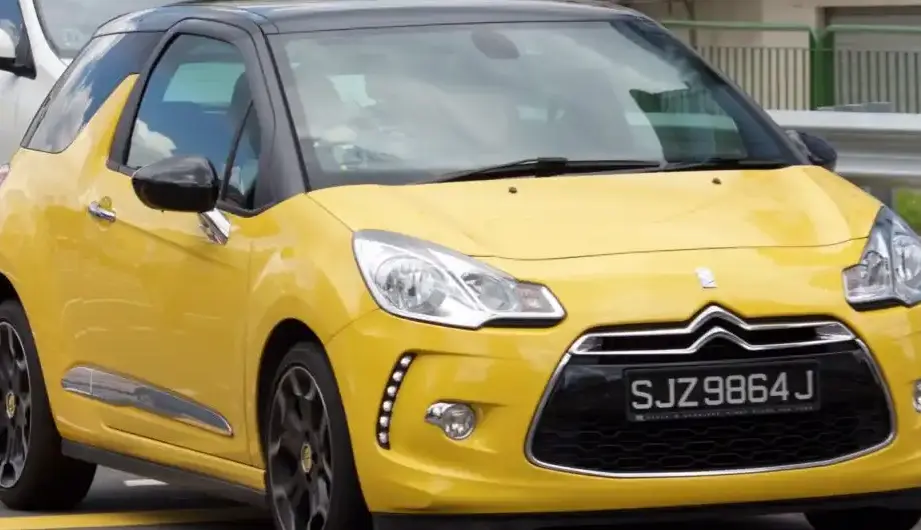
The Citroen DS 3 1.4 e-HDi Airdream (70 hp) FAP ETG, produced between 2011 and 2014, represents an entry-level diesel variant within the first generation (Phase I) of Citroen’s stylish subcompact hatchback. Positioned as a fuel-efficient and relatively affordable option, it aimed to broaden the DS 3’s appeal, particularly in European markets where diesel engines held significant popularity. This model utilized Citroen’s e-HDi technology, combining a diesel engine with stop-start functionality and an automated manual transmission to maximize fuel economy and reduce emissions. It was built on the PF1 platform, shared with the Peugeot 207 and Citroen C2.
Technical Specifications
| Brand | Citroen |
| Model | DS3 |
| Generation | DS 3 (Phase I) |
| Type (Engine) | 1.4 e-HDi Airdream (70 Hp) FAP ETG |
| Start of production | 2011 |
| End of production | 2014 |
| Powertrain Architecture | Internal Combustion engine |
| Body type | Hatchback |
| Seats | 5 |
| Doors | 3 |
| Fuel consumption (urban) | 3.6 l/100 km (65.3 US mpg, 78.5 UK mpg, 27.8 km/l) |
| Fuel consumption (extra urban) | 3.2 l/100 km (73.5 US mpg, 88.3 UK mpg, 31.3 km/l) |
| Fuel consumption (combined) | 3.4 l/100 km (69.2 US mpg, 83.1 UK mpg, 29.4 km/l) |
| CO2 emissions | 87 g/km |
| Fuel Type | Diesel |
| Acceleration 0 – 100 km/h | 16.2 sec |
| Acceleration 0 – 62 mph | 16.2 sec |
| Acceleration 0 – 60 mph | 15.4 sec |
| Maximum speed | 165 km/h (102.53 mph) |
| Emission standard | Euro 5 |
| Weight-to-power ratio | 15.4 kg/Hp, 64.8 Hp/tonne |
| Weight-to-torque ratio | 6.8 kg/Nm, 148.1 Nm/tonne |
| Power | 70 Hp @ 4000 rpm |
| Power per litre | 50.1 Hp/l |
| Torque | 160 Nm @ 1750 rpm (118.01 lb.-ft. @ 1750 rpm) |
| Engine layout | Front, Transverse |
| Engine Model/Code | 8HR DV4C |
| Engine displacement | 1398 cm3 (85.31 cu. in.) |
| Number of cylinders | 4 |
| Engine configuration | Inline |
| Cylinder Bore | 73.7 mm (2.9 in.) |
| Piston Stroke | 82 mm (3.23 in.) |
| Fuel injection system | Diesel Commonrail |
| Engine aspiration | Turbocharger, Intercooler |
| Engine oil capacity | 3.8 l (4.02 US qt | 3.34 UK qt) |
| Kerb Weight | 1080-1146 kg (2380.99 – 2526.5 lbs.) |
| Max. weight | 1585 kg (3494.33 lbs.) |
| Max load | 439-505 kg (967.83 – 1113.33 lbs.) |
| Trunk (boot) space – minimum | 285 l (10.06 cu. ft.) |
| Trunk (boot) space – maximum | 980 l (34.61 cu. ft.) |
| Fuel tank capacity | 45 l (11.89 US gal | 9.9 UK gal) |
| Max. roof load | 70 kg (154.32 lbs.) |
| Permitted trailer load with brakes (12%) | 900 kg (1984.16 lbs.) |
| Permitted trailer load without brakes | 570 kg (1256.63 lbs.) |
| Permitted towbar download | 46 kg (101.41 lbs.) |
| Length | 3948 mm (155.43 in.) |
| Width | 1715 mm (67.52 in.) |
| Width including mirrors | 1994 mm (78.5 in.) |
| Height | 1458-1483 mm (57.4 – 58.39 in.) |
| Wheelbase | 2464 mm (97.01 in.) |
| Front track | 1465-1468 mm (57.68 – 57.8 in.) |
| Rear (Back) track | 1467-1471 mm (57.76 – 57.91 in.) |
| Front overhang | 824 mm (32.44 in.) |
| Rear overhang | 660 mm (25.98 in.) |
| Minimum turning circle | 10.2-10.4 m (33.46 – 34.12 ft.) |
| Drivetrain Architecture | Front wheel drive |
| Drive wheel | Front wheel drive |
| Number of gears and type of gearbox | 5 gears, automatic transmission |
| Front suspension | Independent, type McPherson with coil spring and anti-roll bar |
| Rear suspension | Independent coil spring, Elastic beam |
| Front brakes | Ventilated discs |
| Rear brakes | Disc |
| Assisting systems | ABS (Anti-lock braking system) |
| Steering type | Steering rack and pinion |
| Power steering | Electric Steering |
| Tires size | 195/55 R16 |
| Wheel rims size | 16 |
INTRODUCTION
The Citroen DS 3 1.4 e-HDi Airdream (70 hp) FAP ETG, launched in 2011, was a key component of Citroen’s strategy to offer a diverse range of options within the DS 3 lineup. This variant was specifically designed for buyers prioritizing fuel efficiency and lower running costs. The “e-HDi” designation signified the inclusion of Citroen’s micro-hybrid technology, featuring a start/stop system to reduce idling emissions and improve fuel economy. The “ETG” denoted the use of an electronically controlled, single-clutch automated manual transmission. This model occupied the entry-level position in the DS 3 diesel range, sitting below the more powerful 1.6 HDi variants.
Powertrain & Engine Architecture
At the heart of the DS 3 1.4 e-HDi was the PSA Group’s 8HR engine, a 1.4-liter inline-four cylinder diesel. This engine, also known as the DV4C, featured a turbocharger with an intercooler to boost power and torque. It employed a common rail direct injection system, delivering fuel at high pressure for optimized combustion. The engine produced 70 horsepower at 4000 rpm and 160 Nm (118 lb-ft) of torque at 1750 rpm. The e-HDi system incorporated a starter-generator, allowing for rapid and seamless engine restarts during the stop-start function. The ETG transmission, a six-speed automated manual, offered a degree of convenience over a traditional manual gearbox, but lacked the smoothness of a conventional automatic. It operated by automatically selecting gears based on throttle input and vehicle speed, with the option for manual gear changes via a sequential shift mode.
Driving Characteristics
The 70 hp output and the ETG transmission resulted in a driving experience focused on economy rather than performance. Acceleration was modest, with a 0-62 mph (0-100 km/h) time of around 16.2 seconds. The ETG transmission, while improving fuel efficiency, could exhibit noticeable gear changes, particularly at lower speeds. Compared to the 1.6 HDi models, the 1.4 e-HDi felt noticeably slower, especially when fully loaded or tackling inclines. However, the engine provided adequate torque for everyday driving, and the stop-start system worked effectively in urban traffic, contributing to significant fuel savings. The gear ratios were optimized for fuel efficiency, meaning the engine often operated at lower revolutions per minute during cruising.
Equipment & Trim Levels
The DS 3 1.4 e-HDi Airdream ETG typically came equipped with a reasonable level of standard features. These included air conditioning, electric front windows, a CD player with auxiliary input, and ABS brakes. Safety features such as driver and passenger airbags were also standard. Higher trim levels, such as Sport or DStyle, offered additional features like alloy wheels, a multi-function steering wheel, and upgraded interior trim. Optional extras included a panoramic sunroof, rear parking sensors, and a navigation system. Interior upholstery was typically cloth, with a choice of color schemes. The dashboard layout was modern and functional, with a focus on ease of use.
Chassis & Braking
The DS 3 1.4 e-HDi utilized a McPherson strut front suspension and an elastic beam rear suspension. This setup provided a good balance between ride comfort and handling. The front brakes were ventilated discs, while the rear brakes were solid discs. ABS (Anti-lock Braking System) was standard, enhancing braking performance and stability. The steering was electric power-assisted, providing light and precise control. The suspension was tuned to prioritize comfort, but the DS 3 still offered a reasonably engaging driving experience, particularly on winding roads.
Market Reception & Comparison
The DS 3 1.4 e-HDi Airdream ETG was generally well-received by critics for its fuel efficiency and low emissions. However, the ETG transmission drew some criticism for its sometimes jerky gear changes. Compared to the 1.6 HDi variants, the 1.4 e-HDi offered lower running costs but sacrificed performance. The 1.6 HDi models, available with higher power outputs, were favored by drivers seeking a more dynamic driving experience. In terms of reliability, the 1.4 e-HDi engine proved to be generally robust, but the ETG transmission was known to be a potential source of issues, with some owners reporting problems with clutch wear and electronic control unit failures.
Legacy
The Citroen DS 3 1.4 e-HDi Airdream ETG remains a relatively common sight on the used car market. Its fuel efficiency and affordability continue to appeal to budget-conscious buyers. However, potential buyers should be aware of the potential issues with the ETG transmission and ensure that any vehicle they consider has been properly maintained. The engine itself is generally considered reliable, but regular servicing is essential. The DS 3, in general, helped to establish Citroen’s DS line as a stylish and distinctive alternative in the subcompact hatchback segment, and the 1.4 e-HDi variant played a role in broadening its appeal to a wider range of customers.
