
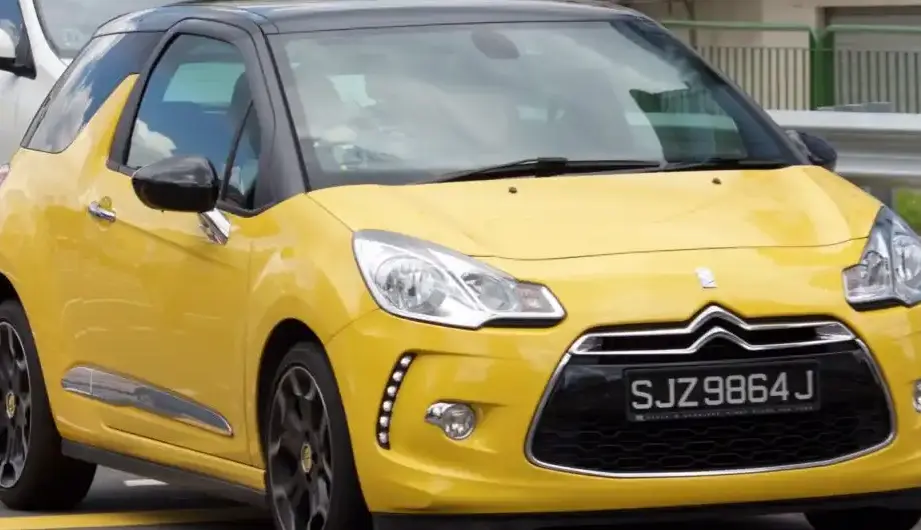
The Citroen DS 3 (Phase I) 1.4 VTi 95 Hp ETG, produced between 2011 and 2013, represents an entry-level offering within the stylish and distinctive DS 3 hatchback range. Positioned as a fashionable and youthful alternative in the supermini segment, the DS 3 aimed to inject personality and a premium feel into the traditionally conservative small car market. This particular variant, equipped with the 1.4-liter VTi engine and the ETG (Efficient Tronic Gearbox) automated manual transmission, served as a more accessible gateway into the DS 3 lineup, prioritizing affordability and fuel efficiency over outright performance. It was built on the PF1 platform, shared with the Peugeot 207 and Citroen C2.
Technical Specifications
| Brand | Citroen |
| Model | DS3 |
| Generation | DS 3 (Phase I) |
| Type (Engine) | 1.4 VTi (95 Hp) ETG |
| Start of production | 2011 |
| End of production | 2013 |
| Powertrain Architecture | Internal Combustion engine |
| Body type | Hatchback |
| Seats | 5 |
| Doors | 3 |
| Fuel consumption (urban) | 7.4 l/100 km (31.8 US mpg) |
| Fuel consumption (extra urban) | 4.4 l/100 km (53.5 US mpg) |
| Fuel consumption (combined) | 5.5 l/100 km (42.8 US mpg) |
| CO2 emissions | 127 g/km |
| Fuel Type | Petrol (Gasoline) |
| Acceleration 0 – 100 km/h | 13.2 sec |
| Acceleration 0 – 62 mph | 13.2 sec |
| Acceleration 0 – 60 mph | 12.5 sec |
| Maximum speed | 184 km/h (114.33 mph) |
| Emission standard | Euro 5 |
| Weight-to-power ratio | 11.4 kg/Hp |
| Weight-to-torque ratio | 7.9 kg/Nm |
| Power | 95 Hp @ 6000 rpm |
| Torque | 136 Nm @ 4000 rpm (100.31 lb.-ft. @ 4000 rpm) |
| Engine layout | Front, Transverse |
| Engine Model/Code | 8FP EP3C |
| Engine displacement | 1397 cm3 (85.25 cu. in.) |
| Number of cylinders | 4 |
| Engine configuration | Inline |
| Cylinder Bore | 77 mm (3.03 in.) |
| Piston Stroke | 75 mm (2.95 in.) |
| Fuel injection system | Multi-port manifold injection |
| Engine aspiration | Naturally aspirated engine |
| Engine oil capacity | 4.25 l (4.49 US qt | 3.74 UK qt) |
| Kerb Weight | 1079 kg (2378.79 lbs.) |
| Max. weight | 1558 kg (3434.8 lbs.) |
| Max load | 479 kg (1056.01 lbs.) |
| Trunk (boot) space – minimum | 285 l (10.06 cu. ft.) |
| Trunk (boot) space – maximum | 980 l (34.61 cu. ft.) |
| Fuel tank capacity | 50 l (13.21 US gal | 11 UK gal) |
| Max. roof load | 70 kg (154.32 lbs.) |
| Permitted trailer load with brakes (12%) | 900 kg (1984.16 lbs.) |
| Permitted trailer load without brakes | 570 kg (1256.63 lbs.) |
| Permitted towbar download | 46 kg (101.41 lbs.) |
| Length | 3948 mm (155.43 in.) |
| Width | 1715 mm (67.52 in.) |
| Width including mirrors | 2004 mm (78.9 in.) |
| Height | 1458-1483 mm (57.4 – 58.39 in.) |
| Wheelbase | 2464 mm (97.01 in.) |
| Front track | 1465-1468 mm (57.68 – 57.8 in.) |
| Rear (Back) track | 1467-1471 mm (57.76 – 57.91 in.) |
| Front overhang | 824 mm (32.44 in.) |
| Rear overhang | 660 mm (25.98 in.) |
| Minimum turning circle (turning diameter) | 10.2 m (33.46 ft.) |
| Drivetrain Architecture | Front wheel drive |
| Number of gears and type of gearbox | 5 gears, automatic transmission |
| Front suspension | Independent, type McPherson with coil spring and anti-roll bar |
| Rear suspension | Independent coil spring, Elastic beam |
| Front brakes | Ventilated discs |
| Rear brakes | Drum |
| Assisting systems | ABS (Anti-lock braking system) |
| Steering type | Steering rack and pinion |
| Tires size | 195/55 R16 |
| Wheel rims size | 16 |
Powertrain & Engine Architecture
The heart of the DS 3 1.4 VTi ETG is the 8FP (EP3C) engine, a 1.4-liter inline-four cylinder petrol engine. This engine belongs to the Prince engine family, co-developed by PSA Peugeot Citroen and BMW. It features multi-point fuel injection and a naturally aspirated configuration, producing 95 horsepower at 6000 rpm and 136 Nm (100 lb-ft) of torque at 4000 rpm. The engine utilizes a timing chain, contributing to its longevity and reduced maintenance compared to timing belts. The ETG (Efficient Tronic Gearbox) is a five-speed automated manual transmission. It’s essentially a conventional manual gearbox with robotic actuators controlling the clutch and gear changes. While marketed as an automatic, it lacks the smoothness of a traditional torque-converter automatic and can exhibit noticeable shifts, particularly at lower speeds.
Driving Characteristics
The 1.4 VTi ETG variant of the DS 3 delivers modest performance. Acceleration from 0 to 60 mph takes around 12.5 seconds, and the top speed is approximately 114 mph. The ETG transmission, while improving fuel economy, doesn’t offer the refined driving experience of a conventional automatic. Gear changes can be jerky, especially during stop-start traffic. The engine feels strained when pushed hard, and the overall driving experience is geared towards efficiency and ease of use rather than spirited performance. Compared to the more powerful 1.6 THP variants, the 1.4 VTi feels significantly slower, but it offers better fuel economy.
Equipment & Trim Levels
The DS 3 1.4 VTi ETG typically came equipped with a reasonable level of standard equipment. This included air conditioning, electric front windows, a CD stereo with USB connectivity, and ABS brakes. Higher trim levels, such as Sport and Chic, added features like alloy wheels, automatic headlights, rain-sensing wipers, and a more premium interior trim. Optional extras included a panoramic sunroof, leather upholstery, and a navigation system. The interior design of the DS 3 is a standout feature, with a distinctive dashboard design and a focus on personalization through color and trim options.
Chassis & Braking
The DS 3 utilizes a McPherson strut front suspension and an elastic beam rear suspension. This setup provides a comfortable ride quality, although it’s not particularly sporty. The front brakes are ventilated discs, while the rear brakes are drums. ABS (Anti-lock Braking System) is standard. The steering is electrically assisted and provides reasonable feedback. The DS 3’s relatively lightweight construction helps to compensate for the modest engine output, contributing to acceptable handling characteristics.
Market Reception & Comparison
The DS 3 1.4 VTi ETG was generally well-received as an affordable and stylish entry point into the DS 3 range. Critics praised its distinctive design and comfortable ride, but the ETG transmission received mixed reviews due to its sometimes jerky shifts. Compared to other superminis with conventional automatic transmissions, the DS 3 1.4 VTi ETG offered competitive fuel economy but a less refined driving experience. The 1.6 VTi manual version offered a more engaging driving experience, while the diesel variants (like the 1.6 HDi) provided superior fuel economy and torque.
Legacy
The 1.4 VTi ETG powertrain has proven to be reasonably reliable, although the ETG transmission can be prone to occasional issues with the robotic actuators. Regular maintenance, including oil changes and transmission servicing, is crucial for ensuring longevity. In the used car market, the DS 3 1.4 VTi ETG represents a relatively affordable option for those seeking a stylish and distinctive supermini. However, potential buyers should be aware of the quirks of the ETG transmission and consider a thorough inspection before purchase. The DS 3, in general, helped to establish Citroen as a brand capable of producing fashionable and desirable small cars, paving the way for future models like the C3 and C4 Cactus.
