
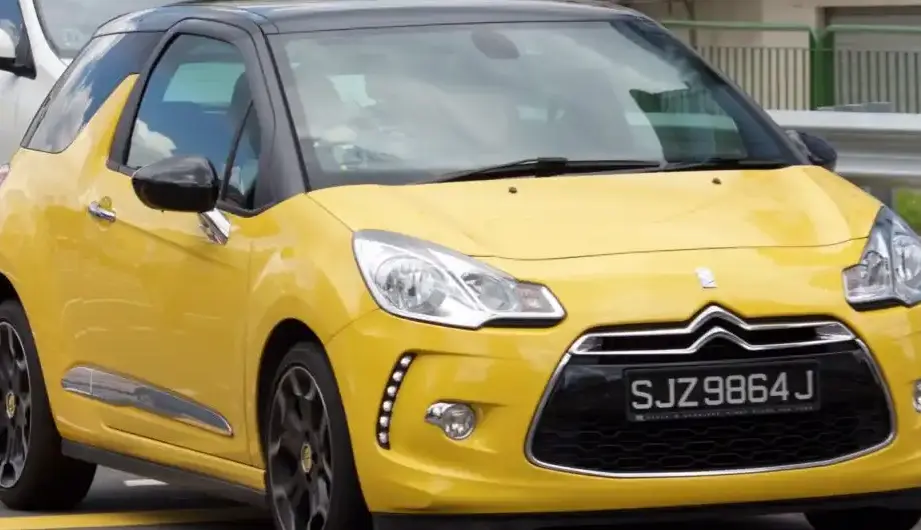
Technical Specifications
| Brand | Citroen |
| Model | DS3 |
| Generation | DS 3 (Phase I) |
| Type (Engine) | 1.6 e-HDi (110 Hp) FAP |
| Start of production | 2011 |
| End of production | 2012 |
| Powertrain Architecture | Internal Combustion engine |
| Body type | Hatchback |
| Seats | 5 |
| Doors | 3 |
| Fuel Type | Diesel |
| Weight-to-power ratio | 9.9 kg/Hp, 100.9 Hp/tonne |
| Weight-to-torque ratio | 4 kg/Nm, 247.7 Nm/tonne |
| Power | 110 Hp @ 3600 rpm |
| Power per litre | 70.5 Hp/l |
| Torque | 270 Nm @ 1750 rpm (199.14 lb.-ft. @ 1750 rpm) |
| Engine layout | Front, Transverse |
| Engine Model/Code | 9HR DV6C |
| Engine displacement | 1560 cm3 (95.2 cu. in.) |
| Number of cylinders | 4 |
| Engine configuration | Inline |
| Cylinder Bore | 75 mm (2.95 in.) |
| Piston Stroke | 88.3 mm (3.48 in.) |
| Fuel injection system | Diesel Commonrail |
| Engine aspiration | Turbocharger, Intercooler |
| Engine oil capacity | 3.75 l (3.96 US qt | 3.3 UK qt) |
| Kerb Weight | 1090 kg (2403.04 lbs.) |
| Max. weight | 1625 kg (3582.51 lbs.) |
| Max load | 535 kg (1179.47 lbs.) |
| Trunk (boot) space – minimum | 285 l (10.06 cu. ft.) |
| Trunk (boot) space – maximum | 980 l (34.61 cu. ft.) |
| Fuel tank capacity | 48 l (12.68 US gal | 10.56 UK gal) |
| Max. roof load | 70 kg (154.32 lbs.) |
| Permitted trailer load with brakes (12%) | 900 kg (1984.16 lbs.) |
| Permitted trailer load without brakes | 570 kg (1256.63 lbs.) |
| Permitted towbar download | 46 kg (101.41 lbs.) |
| Length | 3948 mm (155.43 in.) |
| Width | 1715 mm (67.52 in.) |
| Width including mirrors | 2004 mm (78.9 in.) |
| Height | 1458-1483 mm (57.4 – 58.39 in.) |
| Wheelbase | 2464 mm (97.01 in.) |
| Front track | 1465-1468 mm (57.68 – 57.8 in.) |
| Rear (Back) track | 1467-1471 mm (57.76 – 57.91 in.) |
| Front overhang | 824 mm (32.44 in.) |
| Rear overhang | 660 mm (25.98 in.) |
| Minimum turning circle (turning diameter) | 10.4 m (34.12 ft.) |
| Drivetrain Architecture | The Internal combustion engine (ICE) drives the front wheels of the vehicle. |
| Drive wheel | Front wheel drive |
| Number of gears and type of gearbox | 6 gears, manual transmission |
| Front suspension | Independent, type McPherson with coil spring and anti-roll bar |
| Rear suspension | Independent coil spring, Elastic beam |
| Front brakes | Ventilated discs |
| Rear brakes | Disc |
| Assisting systems | ABS (Anti-lock braking system) |
| Steering type | Steering rack and pinion |
| Power steering | Electric Steering |
| Tires size | 205/45 R17 |
| Wheel rims size | 17 |
The Citroën DS 3 (Phase I) 1.6 e-HDi 110 Hp FAP represents a significant entry in Citroën’s foray into the premium subcompact hatchback segment. Produced from 2011 to 2012, this variant occupied a middle ground within the DS 3 lineup, offering a balance between fuel efficiency, reasonable performance, and a more accessible price point compared to the range-topping models. It was positioned as a stylish and modern alternative to established competitors like the Mini Cooper and Fiat 500, aiming to attract a younger, fashion-conscious demographic. The DS 3 itself was built upon the PF1 platform, shared with the Peugeot 207, but distinguished itself through unique styling cues and a more upscale interior.
Powertrain & Engine Architecture
The heart of the DS 3 1.6 e-HDi 110 is the PSA Group’s DV6C engine, specifically the 9HR variant. This 1.6-liter inline-four diesel engine utilizes common-rail direct injection and a variable geometry turbocharger with an intercooler. The ‘e-HDi’ designation signifies the inclusion of Citroën’s micro-hybrid system, featuring a start/stop system to improve fuel economy. The engine produces 110 horsepower at 3600 rpm and a respectable 270 Nm (199 lb-ft) of torque at just 1750 rpm. This torque output, available from relatively low engine speeds, is a hallmark of modern diesel engines and contributes to the DS 3’s usable performance. The engine is paired with a six-speed manual transmission, which was the standard offering for this variant. The DV6 engine family is known for its durability, but requires regular maintenance, particularly regarding the diesel particulate filter (DPF) due to the ‘FAP’ designation, which stands for ‘Filtre à Particules’.
Driving Characteristics
The 1.6 e-HDi 110 Hp variant of the DS 3 offers a comfortable and efficient driving experience. While not overtly sporty, the engine provides sufficient power for everyday driving and overtaking maneuvers. The six-speed manual transmission allows drivers to keep the engine within its optimal torque band, maximizing fuel economy and responsiveness. Compared to the more powerful 1.6 THP petrol variants, the e-HDi prioritizes fuel efficiency over outright performance. The gear ratios are tuned for economy, meaning the engine doesn’t rev as freely as its petrol counterparts. The DS 3’s relatively lightweight construction (1090 kg / 2403 lbs) helps to mitigate the modest power output, resulting in a reasonably lively feel.
Equipment & Trim Levels
The DS 3 1.6 e-HDi 110 typically came equipped with a decent level of standard features. These included air conditioning, electric front windows, a CD/radio system with USB connectivity, and ABS brakes. Higher trim levels, such as Sport and Chic, added features like alloy wheels, automatic headlights and wipers, rear parking sensors, and upgraded interior trim. Interior upholstery was typically cloth, with options for leather available on higher-spec models. The DS 3 was also notable for its extensive customization options, allowing buyers to personalize their vehicle with a wide range of exterior colors, roof designs, and interior accents.
Chassis & Braking
The DS 3 utilizes a McPherson strut front suspension and an elastic beam rear suspension. This setup provides a good balance between ride comfort and handling. The front suspension incorporates a coil spring and anti-roll bar to reduce body roll during cornering. Braking duties are handled by ventilated discs at the front and solid discs at the rear. ABS (Anti-lock Braking System) is standard, providing enhanced braking performance and stability. The steering is electrically assisted, offering a light and precise feel.
Market Reception & Comparison
The Citroën DS 3 1.6 e-HDi 110 was generally well-received by critics for its stylish design, comfortable ride, and impressive fuel economy. It offered a compelling alternative to more established premium hatchbacks. However, some reviewers noted that the interior, while well-designed, lacked the premium feel of some competitors. Compared to the petrol-powered DS 3 variants, the e-HDi offered significantly better fuel economy, but at the expense of some performance. The 1.6 e-HDi was often compared to the Mini Cooper Diesel and Fiat 500 Diesel, offering a similar blend of style and efficiency at a competitive price point.
Legacy
The 1.6 e-HDi engine, particularly the DV6C variant, proved to be a reliable and durable powertrain when properly maintained. However, the diesel particulate filter (DPF) can be a potential weak point, especially on vehicles that primarily undertake short journeys. In the used car market, the DS 3 1.6 e-HDi 110 remains a popular choice for buyers seeking a stylish, economical, and relatively affordable hatchback. Its combination of fuel efficiency, practicality, and distinctive design continues to appeal to a wide range of drivers. Regular servicing, including DPF regeneration, is crucial to ensure the long-term reliability of this powertrain.
