
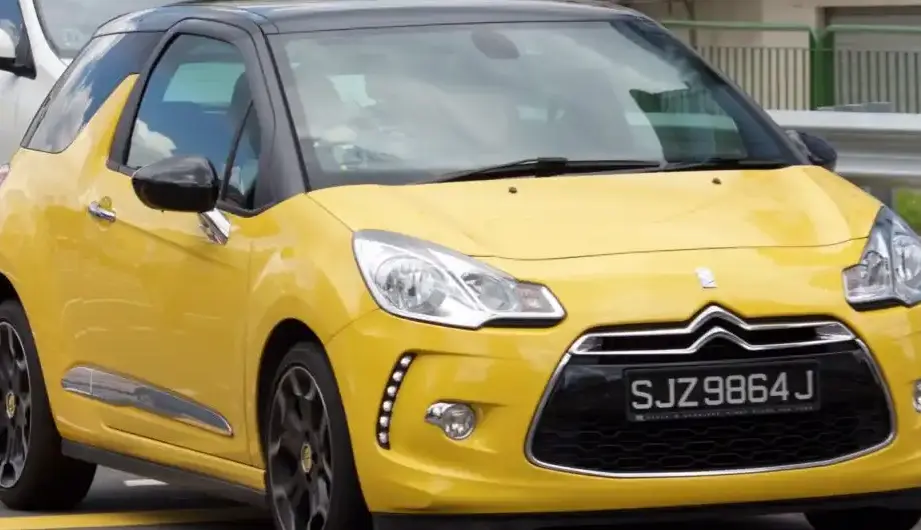
The Citroën DS 3 (Phase I) 1.6 e-HDi 115 FAP was a popular subcompact hatchback produced from 2012 to 2014. Positioned as a stylish and fuel-efficient option within the DS 3 range, it represented a key offering in Citroën’s attempt to establish a more premium image. This variant utilized a diesel engine with particulate filter technology, aimed at meeting increasingly stringent European emission standards. It was part of the first generation of the DS 3, built on the PF1 platform (also known as the 1HX0/A3 platform) shared with the Peugeot 207 and Citroën C2.
Technical Specifications
| Brand | Citroën |
| Model | DS3 |
| Generation | DS 3 (Phase I) |
| Type (Engine) | 1.6 e-HDi (115 Hp) FAP |
| Start of production | 2012 |
| End of production | 2014 |
| Powertrain Architecture | Internal Combustion engine |
| Body type | Hatchback |
| Seats | 5 |
| Doors | 3 |
| Fuel consumption (urban) | 4.6 l/100 km (61.4 UK mpg, 51.1 US mpg, 21.7 km/l) |
| Fuel consumption (extra urban) | 3.4 l/100 km (83.1 UK mpg, 69.2 US mpg, 29.4 km/l) |
| Fuel consumption (combined) | 3.9 l/100 km (72.4 UK mpg, 60.3 US mpg, 25.6 km/l) |
| CO2 emissions | 99 g/km |
| Fuel Type | Diesel |
| Acceleration 0 – 100 km/h | 9.7 sec |
| Acceleration 0 – 62 mph | 9.7 sec |
| Acceleration 0 – 60 mph | 9.2 sec |
| Maximum speed | 190 km/h (118.06 mph) |
| Emission standard | Euro 5 |
| Weight-to-power ratio | 9.5 kg/Hp, 105.5 Hp/tonne |
| Weight-to-torque ratio | 4 kg/Nm, 247.7 Nm/tonne |
| Power | 115 Hp @ 3600 rpm |
| Power per litre | 73.7 Hp/l |
| Torque | 270 Nm @ 1750 rpm (199.14 lb.-ft. @ 1750 rpm) |
| Engine layout | Front, Transverse |
| Engine Model/Code | 9HD DV6C, 9HL DV6C |
| Engine displacement | 1560 cm3 (95.2 cu. in.) |
| Number of cylinders | 4 |
| Engine configuration | Inline |
| Cylinder Bore | 75 mm (2.95 in.) |
| Piston Stroke | 88.3 mm (3.48 in.) |
| Fuel injection system | Diesel Commonrail |
| Engine aspiration | Turbocharger, Intercooler |
| Engine oil capacity | 3.8 l (4.02 US qt | 3.34 UK qt) |
| Kerb Weight | 1090-1182 kg (2403.04 – 2605.86 lbs.) |
| Max. weight | 1625 kg (3582.51 lbs.) |
| Max load | 443-535 kg (976.65 – 1179.47 lbs.) |
| Trunk (boot) space – minimum | 285 l (10.06 cu. ft.) |
| Trunk (boot) space – maximum | 980 l (34.61 cu. ft.) |
| Fuel tank capacity | 45 l (11.89 US gal | 9.9 UK gal) |
| Max. roof load | 70 kg (154.32 lbs.) |
| Permitted trailer load with brakes (12%) | 900 kg (1984.16 lbs.) |
| Permitted trailer load without brakes | 570 kg (1256.63 lbs.) |
| Permitted towbar download | 46 kg (101.41 lbs.) |
| Length | 3948 mm (155.43 in.) |
| Width | 1715 mm (67.52 in.) |
| Width including mirrors | 1994 mm (78.5 in.) |
| Height | 1458-1483 mm (57.4 – 58.39 in.) |
| Wheelbase | 2464 mm (97.01 in.) |
| Front track | 1465-1468 mm (57.68 – 57.8 in.) |
| Rear (Back) track | 1467-1471 mm (57.76 – 57.91 in.) |
| Front overhang | 824 mm (32.44 in.) |
| Rear overhang | 660 mm (25.98 in.) |
| Minimum turning circle | 10.2-10.4 m (33.46 – 34.12 ft.) |
| Drivetrain Architecture | The Internal combustion engine (ICE) drives the front wheels of the vehicle. |
| Drive wheel | Front wheel drive |
| Number of gears and type of gearbox | 6 gears, manual transmission |
| Front suspension | Independent, type McPherson with coil spring and anti-roll bar |
| Rear suspension | Independent coil spring, Elastic beam |
| Front brakes | Ventilated discs |
| Rear brakes | Disc |
| Assisting systems | ABS (Anti-lock braking system) |
| Steering type | Steering rack and pinion |
| Power steering | Electric Steering |
| Tires size | 205/45 R17 |
| Wheel rims size | 17 |
Powertrain & Engine Architecture
The DS 3 1.6 e-HDi 115 FAP was powered by the PSA Group’s DV6 engine family, specifically the 9HD or 9HL variant. This 1.6-liter, four-cylinder diesel engine featured common-rail direct injection and a turbocharger with an intercooler. The ‘e-HDi’ designation indicated the inclusion of a Stop & Start system, designed to improve fuel economy by automatically shutting off the engine when the vehicle was stationary. The FAP (Filtre à Particules) denoted the presence of a diesel particulate filter, crucial for reducing emissions and complying with Euro 5 standards. The engine produced 115 horsepower at 3600 rpm and 270 Nm (199 lb-ft) of torque at 1750 rpm. The engine’s architecture was relatively simple, contributing to its reliability. The 6-speed manual transmission was the standard offering, providing a balance between fuel efficiency and drivability.
Driving Characteristics
The 1.6 e-HDi 115 FAP offered a comfortable and economical driving experience. While not particularly sporty, the engine provided adequate power for everyday driving. Acceleration from 0 to 60 mph took around 9.2 seconds, and the top speed was 118 mph. The turbocharger helped to deliver a usable amount of torque from low engine speeds, making it easy to navigate city traffic. The manual transmission’s gear ratios were well-suited to the engine’s characteristics, allowing for smooth and efficient cruising. Compared to the more powerful petrol versions of the DS 3, the diesel offered significantly better fuel economy, but at the expense of outright performance. The Stop & Start system, while effective in reducing fuel consumption, could sometimes feel slightly jerky during restarts.
Equipment & Trim Levels
The DS 3 1.6 e-HDi 115 FAP typically came equipped with a reasonable level of standard features. These included air conditioning, electric front windows, a CD stereo with USB connectivity, and ABS brakes. Higher trim levels, such as Sport and Chic, added features like alloy wheels, automatic headlights and wipers, rear parking sensors, and a more premium interior trim. Interior upholstery was typically cloth, with options for leather upgrades. The dashboard featured a distinctive design with a central color screen for infotainment functions on higher-spec models. Optional extras included a panoramic sunroof, navigation system, and upgraded sound system.
Chassis & Braking
The DS 3 featured a McPherson strut front suspension and an elastic beam rear suspension. This setup provided a good balance between ride comfort and handling. The front brakes were ventilated discs, while the rear brakes were solid discs. ABS (Anti-lock Braking System) was standard. The chassis was relatively lightweight, contributing to the car’s agility. Stabilizer bars were fitted to both the front and rear axles to reduce body roll during cornering. The steering was electrically assisted, providing a light and precise feel.
Market Reception & Comparison
The DS 3 1.6 e-HDi 115 FAP was generally well-received by critics for its stylish design, fuel efficiency, and comfortable ride. It was seen as a strong competitor to other subcompact hatchbacks, such as the Ford Fiesta, Volkswagen Polo, and Renault Clio. The diesel engine offered significantly better fuel economy than the petrol alternatives, making it a popular choice for drivers who covered long distances. However, some critics noted that the engine could be slightly noisy compared to some of its rivals. Reliability was generally good, although diesel particulate filters could occasionally require maintenance or replacement.
Legacy
The Citroën DS 3 1.6 e-HDi 115 FAP remains a relatively common sight on used car markets. The DV6 engine is known for its durability, although regular maintenance is essential to ensure long-term reliability. The diesel particulate filter can be a potential source of problems if the car is primarily used for short journeys, as it may not reach the temperatures required to regenerate effectively. Overall, the DS 3 1.6 e-HDi 115 FAP represents a well-rounded and economical subcompact hatchback that continues to offer a stylish and practical option for budget-conscious buyers.
