
Technical Specifications
| Brand | Citroën |
| Model | DS3 |
| Generation | DS 3 (Phase I) |
| Type (Engine) | 1.6 e-HDi (90 Hp) FAP |
| Start of production | 2010 |
| End of production | 2014 |
| Powertrain Architecture | Internal Combustion engine |
| Body type | Hatchback |
| Seats | 5 |
| Doors | 3 |
| Fuel consumption (urban) | 4.1-4.2 l/100 km (57.4 – 56 US mpg, 68.9 – 67.3 UK mpg, 24.4 – 23.8 km/l) |
| Fuel consumption (extra urban) | 3.1-3.3 l/100 km (75.9 – 71.3 US mpg, 91.1 – 85.6 UK mpg, 32.3 – 30.3 km/l) |
| Fuel consumption (combined) | 3.5-3.6 l/100 km (67.2 – 65.3 US mpg, 80.7 – 78.5 UK mpg, 28.6 – 27.8 km/l) |
| CO2 emissions | 90-95 g/km |
| Fuel Type | Diesel |
| Acceleration 0 – 100 km/h | 11.3 sec |
| Acceleration 0 – 62 mph | 11.3 sec |
| Acceleration 0 – 60 mph | 10.7 sec |
| Maximum speed | 180 km/h (111.85 mph) |
| Emission standard | Euro 5 |
| Weight-to-power ratio | 12.1 kg/Hp, 82.9 Hp/tonne |
| Weight-to-torque ratio | 4.7 kg/Nm, 212 Nm/tonne |
| Power | 90 Hp @ 4000 rpm |
| Power per litre | 57.7 Hp/l |
| Torque | 230 Nm @ 1750 rpm (169.64 lb.-ft. @ 1750 rpm) |
| Engine layout | Front, Transverse |
| Engine Model/Code | 9HP DV6DTED |
| Engine displacement | 1560 cm3 (95.2 cu. in.) |
| Number of cylinders | 4 |
| Engine configuration | Inline |
| Cylinder Bore | 75 mm (2.95 in.) |
| Piston Stroke | 88.3 mm (3.48 in.) |
| Fuel injection system | Diesel Commonrail |
| Engine aspiration | Turbocharger, Intercooler |
| Engine oil capacity | 3.8 l (4.02 US qt | 3.34 UK qt) |
| Kerb Weight | 1085-1181 kg (2392.02 – 2603.66 lbs.) |
| Max. weight | 1602 kg (3531.81 lbs.) |
| Max load | 421-517 kg (928.15 – 1139.79 lbs.) |
| Trunk (boot) space – minimum | 285 l (10.06 cu. ft.) |
| Trunk (boot) space – maximum | 980 l (34.61 cu. ft.) |
| Fuel tank capacity | 45 l (11.89 US gal | 9.9 UK gal) |
| Max. roof load | 70 kg (154.32 lbs.) |
| Permitted trailer load with brakes (12%) | 900 kg (1984.16 lbs.) |
| Permitted trailer load without brakes | 570 kg (1256.63 lbs.) |
| Permitted towbar download | 46 kg (101.41 lbs.) |
| Length | 3948 mm (155.43 in.) |
| Width | 1715 mm (67.52 in.) |
| Width including mirrors | 1994 mm (78.5 in.) |
| Height | 1458-1483 mm (57.4 – 58.39 in.) |
| Wheelbase | 2464 mm (97.01 in.) |
| Front track | 1465-1468 mm (57.68 – 57.8 in.) |
| Rear (Back) track | 1467-1471 mm (57.76 – 57.91 in.) |
| Front overhang | 824 mm (32.44 in.) |
| Rear overhang | 660 mm (25.98 in.) |
| Minimum turning circle | 10.2-10.4 m (33.46 – 34.12 ft.) |
| Drivetrain Architecture | The Internal combustion engine (ICE) drives the front wheels of the vehicle. |
| Drive wheel | Front wheel drive |
| Number of gears and type of gearbox | 5 gears, manual transmission |
| Front suspension | Independent, type McPherson with coil spring and anti-roll bar |
| Rear suspension | Independent coil spring, Elastic beam |
| Front brakes | Ventilated discs |
| Rear brakes | Drum |
| Assisting systems | ABS (Anti-lock braking system) |
| Steering type | Steering rack and pinion |
| Power steering | Electric Steering |
| Tires size | 195/55 R16; 205/45 R17 |
| Wheel rims size | 16; 17 |
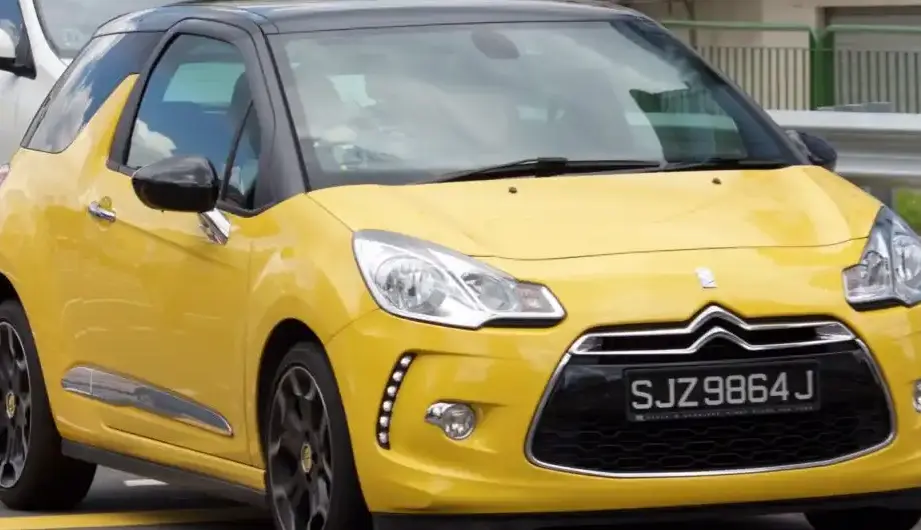
The Citroën DS 3 1.6 e-HDi 90 hp FAP, launched in 2010, represented Citroën’s attempt to inject a dose of style and sophistication into the supermini segment. The “DS” designation, standing for “Different Spirit,” signaled a move upmarket from Citroën’s traditional offerings. This particular variant, powered by the 1.6-liter e-HDi diesel engine, was a key component of the DS 3’s initial success, offering a compelling blend of fuel economy and reasonable performance. It was part of the first phase (Phase I) of the DS 3, produced until 2014, and shared its platform with the Peugeot 207 and Citroën C3.
Powertrain & Engine Architecture
At the heart of the DS 3 1.6 e-HDi 90 was the PSA Group’s DV6 engine family, specifically the 9HP DV6DTED code. This 1.6-liter, four-cylinder diesel engine utilized common-rail direct injection and a turbocharger with an intercooler to produce 90 horsepower at 4000 rpm and 230 Nm (169.64 lb-ft) of torque at 1750 rpm. The “e-HDi” designation indicated the inclusion of Stop & Start technology, designed to improve fuel economy by automatically shutting off the engine when the vehicle was stationary. The engine featured a 16-valve configuration and a compression ratio of 16.1:1. The FAP (Filtre à Particules) denoted the presence of a diesel particulate filter, crucial for meeting Euro 5 emission standards. This engine was typically paired with a five-speed manual transmission, although an automated manual transmission (ETG6) was also available as an option, though less common.
Driving Characteristics
The DS 3 1.6 e-HDi 90 hp offered a comfortable, if not particularly exhilarating, driving experience. Acceleration from 0 to 100 km/h (0-62 mph) took around 11.3 seconds, and top speed was limited to 180 km/h (112 mph). The engine’s strong low-end torque made it well-suited for urban driving and overtaking maneuvers, but it could feel strained at higher speeds. Compared to the more powerful DS 3 variants, such as those with the 1.6 THP petrol engine, the e-HDi 90 felt noticeably slower. However, its fuel economy was significantly better. The five-speed manual transmission provided a decent spread of gears, but the shift quality wasn’t always the smoothest. The ETG6 automated manual, while offering convenience, was often criticized for its slow and jerky gear changes.
Equipment & Trim Levels
The DS 3 1.6 e-HDi 90 typically came equipped with a reasonable level of standard equipment. This included air conditioning, electric front windows, a CD stereo with USB connectivity, and ABS brakes. Higher trim levels, such as Sport and DStyle, added features like alloy wheels, rear parking sensors, automatic headlights, and rain-sensing wipers. Interior upholstery was typically cloth, with options for leather available on higher-spec models. The DS 3 was also known for its customizable exterior styling options, including contrasting roof colors and mirror caps, allowing buyers to personalize their vehicles.
Chassis & Braking
The DS 3 1.6 e-HDi 90 featured a McPherson strut front suspension and an elastic beam rear suspension. This setup provided a comfortable ride, although it wasn’t particularly sporty. The front brakes were ventilated discs, while the rear brakes were drums. ABS (Anti-lock Braking System) was standard. The steering was electric power-assisted, offering light and precise control. The DS 3’s relatively compact size and light weight contributed to its agility in urban environments.
Market Reception & Comparison
The DS 3 1.6 e-HDi 90 was generally well-received by critics, who praised its stylish design, fuel efficiency, and comfortable ride. However, some criticized its performance and the sometimes-agricultural feel of the diesel engine. Compared to other diesel superminis of the time, such as the Volkswagen Polo 1.6 TDI and the Ford Fiesta 1.6 TDCi, the DS 3 offered a more distinctive and fashionable alternative. Its fuel economy was competitive, typically achieving around 65-70 mpg on the combined cycle. Reliability was generally good, although some owners reported issues with the diesel particulate filter and the ETG6 automated manual transmission.
Legacy
The Citroën DS 3 1.6 e-HDi 90 remains a popular choice on the used car market, particularly for buyers seeking a stylish and economical supermini. The DV6 engine, while not without its quirks, is generally considered to be durable and reliable if properly maintained. The availability of affordable spare parts and a relatively simple mechanical layout make it a relatively easy car to maintain. The DS 3’s distinctive design and customizable features continue to appeal to buyers looking for a car that stands out from the crowd. While newer generations of the DS 3 have been introduced, the Phase I model, and specifically the 1.6 e-HDi 90 variant, holds a special place as the car that launched the DS brand and established the DS 3 as a design icon.
