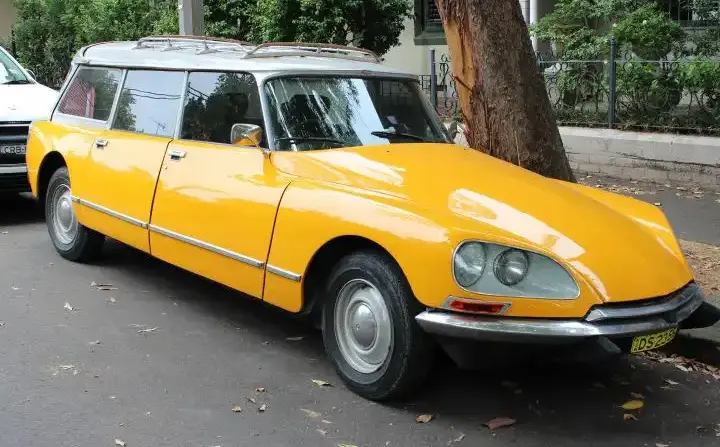
The Citroën DS Break 23, produced between 1972 and 1975, represented the estate (station wagon) variant of the iconic Citroën DS. Positioned as a more practical iteration of the DS, the Break offered increased cargo capacity without sacrificing the revolutionary hydropneumatic suspension and distinctive styling that defined the model. The “23” designation referred to the engine displacement, signifying a 2.3-liter powerplant producing 115 horsepower. This model occupied a mid-range position within the DS Break lineup, offering a balance between performance and economy compared to the smaller displacement engines and the more powerful Injection models.
Technical Specifications
| Brand | Citroen |
| Model | DS |
| Generation | DS Break |
| Type (Engine) | 23 (115 Hp) |
| Start of production | 1972 |
| End of production | 1975 |
| Powertrain Architecture | Internal Combustion engine |
| Body type | Station wagon (estate) |
| Seats | 5 |
| Doors | 5 |
| Fuel Type | Petrol (Gasoline) |
| Maximum speed | 171 km/h (106.25 mph) |
| Weight-to-power ratio | 12.5 kg/Hp, 80.1 Hp/tonne |
| Weight-to-torque ratio | 7.8 kg/Nm, 127.5 Nm/tonne |
| Power | 115 Hp @ 5500 rpm |
| Power per litre | 49 Hp/l |
| Torque | 183 Nm @ 3500 rpm (134.97 lb.-ft. @ 3500 rpm) |
| Engine layout | Front, Longitudinal |
| Engine Model/Code | M23-623 |
| Engine displacement | 2347 cm3 (143.22 cu. in.) |
| Number of cylinders | 4 |
| Engine configuration | Inline |
| Cylinder Bore | 93.5 mm (3.68 in.) |
| Piston Stroke | 85.5 mm (3.37 in.) |
| Compression ratio | 8.75:1 |
| Number of valves per cylinder | 2 |
| Fuel injection system | Carburettor |
| Engine aspiration | Naturally aspirated engine |
| Engine oil capacity | 5 l (5.28 US qt | 4.4 UK qt) |
| Coolant | 11.3 l (11.94 US qt | 9.94 UK qt) |
| Kerb Weight | 1435 kg (3163.63 lbs) |
| Max. weight | 2075 kg (4574.59 lbs) |
| Max load | 640 kg (1410.96 lbs) |
| Trunk (boot) space – maximum | 1900 l (67.1 cu. ft) |
| Fuel tank capacity | 65 l (17.17 US gal | 14.3 UK gal) |
| Max. roof load | 80 kg (176.37 lbs) |
| Permitted trailer load with brakes (12%) | 1250 kg (2755.78 lbs) |
| Permitted trailer load without brakes | 500 kg (1102.31 lbs) |
| Permitted towbar download | 30 kg (66.14 lbs) |
| Length | 5026 mm (197.87 in) |
| Width | 1803 mm (70.98 in) |
| Height | 1530 mm (60.24 in) |
| Wheelbase | 3125 mm (123.03 in) |
| Front track | 1516 mm (59.69 in) |
| Rear (Back) track | 1316 mm (51.81 in) |
| Front overhang | 1016 mm (40 in) |
| Rear overhang | 885 mm (34.84 in) |
| Ride height (ground clearance) | 145 mm (5.71 in) |
| Drag coefficient (Cd) | 0.42 |
| Minimum turning circle (turning diameter) | 12 m (39.37 ft) |
| Drivetrain Architecture | The Internal combustion engine (ICE) drives the front wheels of the vehicle. |
| Drive wheel | Front wheel drive |
| Number of gears and type of gearbox | 5 gears, manual transmission |
| Front suspension | Hydro-pneumatic element |
| Rear suspension | Hydro-pneumatic element |
| Front brakes | Disc |
| Rear brakes | Drum |
| Steering type | Steering rack and pinion |
| Power steering | Hydraulic Steering |
Powertrain & Engine Architecture
The Citroën DS Break 23 was powered by the M23-623 engine, a 2.3-liter inline-four cylinder gasoline engine. This engine featured a cast iron block and an aluminum cylinder head, utilizing a single overhead camshaft (SOHC) valvetrain with two valves per cylinder. Fuel delivery was managed by a Solex carburetor, a common setup for the era. The engine produced 115 horsepower at 5,500 rpm and 183 Nm (135 lb-ft) of torque at 3,500 rpm. The engine was mounted longitudinally in the front of the vehicle, driving the front wheels. The five-speed manual transmission was a key component, offering a relatively wide range of gear ratios for both acceleration and fuel efficiency. The transmission was known for its precise shift quality, though it required a firm hand.
Driving Characteristics
The DS Break 23, with its 115 hp and five-speed manual transmission, offered a comfortable and capable driving experience. While not overtly sporty, the engine provided adequate power for highway cruising and overtaking. The hydropneumatic suspension, a hallmark of the DS, delivered an exceptionally smooth ride, absorbing bumps and imperfections in the road with remarkable ease. The front-wheel-drive configuration provided good traction in most conditions. Compared to the smaller 1.6-liter engines available in the DS Break, the 2.3-liter offered noticeably more power and torque, making it a better choice for those who frequently carried passengers or cargo. However, it lacked the outright performance of the DS Injection models, which featured fuel injection and a higher compression ratio.
Equipment & Trim Levels
The DS Break 23 typically came equipped with a generous amount of standard features for its time. These included comfortable cloth upholstery, a well-appointed dashboard with analog gauges, and power-assisted steering. The DS was renowned for its interior space and practicality, and the Break variant amplified this with its expansive cargo area. Optional extras included leather upholstery, a sunroof, and upgraded audio systems. The trim level was relatively consistent across the 23 models, with variations primarily stemming from individual customer choices regarding optional equipment.
Chassis & Braking
The DS Break 23 utilized Citroën’s innovative hydropneumatic suspension system on both the front and rear axles. This system employed self-leveling spheres filled with a nitrogen gas and hydraulic fluid, providing a consistently smooth ride regardless of load. The front brakes were disc brakes, offering superior stopping power compared to the drum brakes used on the rear wheels. The steering system was a rack-and-pinion setup with hydraulic power assistance, making the car relatively easy to maneuver. Stabilizer bars were fitted to both the front and rear suspension to reduce body roll during cornering.
Market Reception & Comparison
The Citroën DS Break 23 was generally well-received by automotive critics and buyers alike. It was praised for its comfortable ride, spacious interior, and distinctive styling. However, some critics noted that the carburetor-equipped engine could be somewhat thirsty and that maintenance could be complex due to the advanced hydropneumatic system. Compared to other station wagons of the era, the DS Break 23 stood out for its unique design and sophisticated technology. In terms of fuel economy, it was comparable to other 2.3-liter gasoline-powered vehicles of the time. Reliability was generally good, but the hydropneumatic system required regular maintenance to prevent leaks and ensure optimal performance.
Legacy
The Citroën DS Break 23 remains a highly sought-after classic car today. Its innovative design and advanced technology continue to impress enthusiasts. The M23-623 engine, while not known for being particularly high-performance, is generally considered to be a reliable and durable powerplant when properly maintained. Finding well-preserved examples can be challenging, as many DS models have suffered from neglect or improper repairs. However, a thriving community of DS enthusiasts and specialist parts suppliers ensures that these iconic vehicles can be kept on the road for years to come. The DS Break 23 represents a high point in Citroën’s engineering and design history, and it continues to be celebrated as a symbol of French automotive innovation.