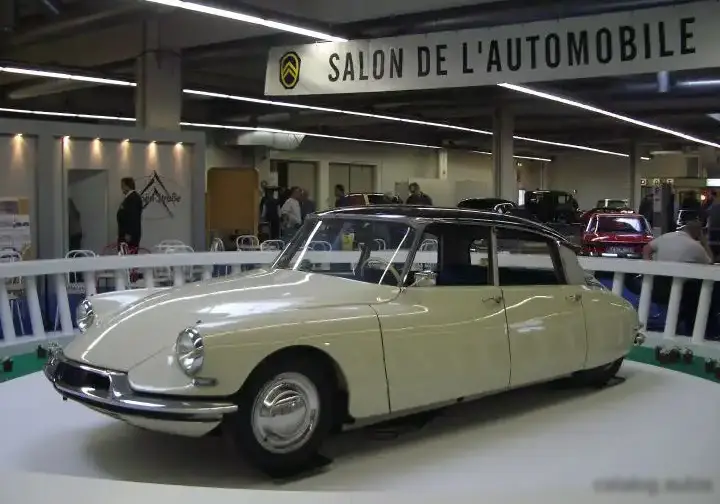
The Citroën DS 19, specifically the 1911cc variant producing 83 horsepower, represents a pivotal entry point into the revolutionary DS line. Produced between 1961 and 1962, this model served as a more accessible version of the groundbreaking DS, offering a taste of the advanced technology and comfort for a wider audience. It falls within the first generation of the DS (DS I), built upon the unique chassis and suspension systems that defined the car. While the more powerful ID 19 and DS Pallas models represented the luxury end of the spectrum, the DS 19 provided a compelling blend of innovation and affordability.
Technical Specifications
| Brand | Citroën |
| Model | DS |
| Generation | DS I |
| Type (Engine) | 19 (83 Hp) |
| Start of production | 1961 |
| End of production | 1962 |
| Powertrain Architecture | Internal Combustion engine |
| Body type | Sedan |
| Seats | 5 |
| Doors | 4 |
| Fuel Type | Petrol (Gasoline) |
| Maximum speed | 158 km/h (98.18 mph) |
| Weight-to-power ratio | 14.7 kg/Hp, 68 Hp/tonne |
| Weight-to-torque ratio | 8.6 kg/Nm, 116.4 Nm/tonne |
| Power | 83 Hp @ 4500 rpm |
| Power per litre | 43.4 Hp/l |
| Torque | 142 Nm @ 3000 rpm (104.73 lb.-ft. @ 3000 rpm) |
| Engine layout | Front, Longitudinal |
| Engine displacement | 1911 cm3 (116.62 cu. in.) |
| Number of cylinders | 4 |
| Engine configuration | Inline |
| Cylinder Bore | 78 mm (3.07 in.) |
| Piston Stroke | 100 mm (3.94 in.) |
| Compression ratio | 8.5:1 |
| Number of valves per cylinder | 2 |
| Fuel injection system | Carburettor |
| Engine aspiration | Naturally aspirated engine |
| Valvetrain | OHV |
| Engine oil capacity | 4 l (4.23 US qt | 3.52 UK qt) |
| Coolant | 11 l (11.62 US qt | 9.68 UK qt) |
| Kerb Weight | 1220 kg (2689.64 lbs.) |
| Max. weight | 1700 kg (3747.86 lbs.) |
| Max load | 480 kg (1058.22 lbs.) |
| Trunk (boot) space – minimum | 500 l (17.66 cu. ft.) |
| Fuel tank capacity | 65 l (17.17 US gal | 14.3 UK gal) |
| Length | 4800 mm (188.98 in.) |
| Width | 1790 mm (70.47 in.) |
| Height | 1470 mm (57.87 in.) |
| Wheelbase | 3125 mm (123.03 in.) |
| Front track | 1500 mm (59.06 in.) |
| Rear (Back) track | 1300 mm (51.18 in.) |
| Drag coefficient (Cd) | 0.38 |
| Minimum turning circle (turning diameter) | 11 m (36.09 ft.) |
| Drivetrain Architecture | The Internal combustion engine (ICE) drives the front wheels of the vehicle. |
| Drive wheel | Front wheel drive |
| Number of gears and type of gearbox | 4 gears, manual transmission |
| Front suspension | Hydro-pneumatic element |
| Rear suspension | Hydro-pneumatic element |
| Front brakes | Disc |
| Rear brakes | Drum |
| Steering type | Steering rack and pinion |
Powertrain & Engine Architecture
The heart of the DS 19 was a 1911cc inline-four cylinder engine. This engine, designated with various codes depending on the specific year and market, featured a cast iron block and cylinder head. It utilized a single overhead valve (OHV) valvetrain, a relatively conventional design for the time, but paired with the advanced Citroën chassis, it provided a unique driving experience. Fuel delivery was managed by a Solex carburetor, a common setup for European cars of the era. The engine’s longitudinal mounting within the front-wheel-drive layout contributed to the car’s balanced handling. The 4-speed manual transmission was the standard offering for the DS 19, providing a direct connection between the engine and the front wheels.
Driving Characteristics
The DS 19, with its 83 horsepower and 142 Nm (104.73 lb-ft) of torque, offered respectable performance for the early 1960s. Acceleration was adequate, but the car wasn’t designed for outright speed. Its strength lay in its ride quality, a direct result of the innovative hydro-pneumatic suspension system. This system, a Citroën hallmark, provided a remarkably smooth and comfortable ride, absorbing bumps and imperfections in the road with ease. The front-wheel-drive configuration contributed to good handling, although it lacked the precision of rear-wheel-drive cars. Compared to the more powerful ID 19, the DS 19 felt less effortless in overtaking maneuvers and uphill climbs. However, the lighter weight of the DS 19, due to its simpler engine, arguably made it more nimble and engaging to drive on winding roads.
Equipment & Trim Levels
The DS 19 was positioned as the entry-level model in the DS range. Standard equipment included comfortable seating for five, a spacious cabin, and the aforementioned hydro-pneumatic suspension. Interior upholstery was typically cloth, although leather was available as an option. The dashboard featured a minimalist design, with a focus on functionality. Optional extras included a radio, heated seats, and a sunroof. While not as lavishly equipped as the ID 19 or DS Pallas, the DS 19 still offered a level of refinement and comfort that was unmatched by most of its contemporaries.
Chassis & Braking
The DS 19’s chassis was a monocoque construction, providing a strong and rigid platform. The hydro-pneumatic suspension system, with its self-leveling and height-adjustable features, was the defining characteristic of the chassis. Front brakes were discs, offering superior stopping power compared to the drum brakes fitted to the rear wheels. The steering was rack and pinion, providing precise and responsive control. The suspension geometry was carefully tuned to provide a comfortable ride and stable handling.
Market Reception & Comparison
The Citroën DS 19 was generally well-received by critics and the public. It was praised for its innovative technology, comfortable ride, and stylish design. However, some critics noted that the engine was somewhat underpowered for the size and weight of the car. Compared to the ID 19, the DS 19 offered a more affordable entry point into the DS world, but at the expense of some performance and luxury. Fuel economy was reasonable for the time, and the car proved to be relatively reliable, although the complex hydro-pneumatic suspension system required specialized maintenance.
Legacy
The Citroën DS 19 played a significant role in establishing Citroën as a leader in automotive innovation. Its hydro-pneumatic suspension system, power steering, and disc brakes were groundbreaking features that set it apart from its competitors. Today, the DS 19 is a sought-after classic car, prized for its unique design, comfortable ride, and historical significance. While the hydro-pneumatic suspension system can require specialized maintenance, the engine is relatively straightforward and reliable. The DS 19 remains a testament to Citroën’s engineering ingenuity and its commitment to providing a unique and enjoyable driving experience.