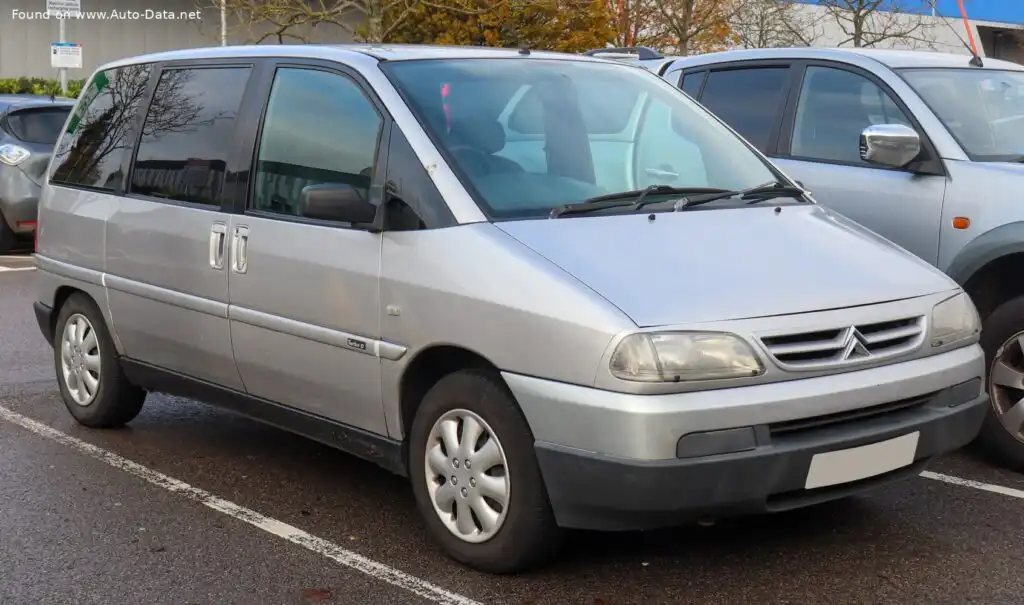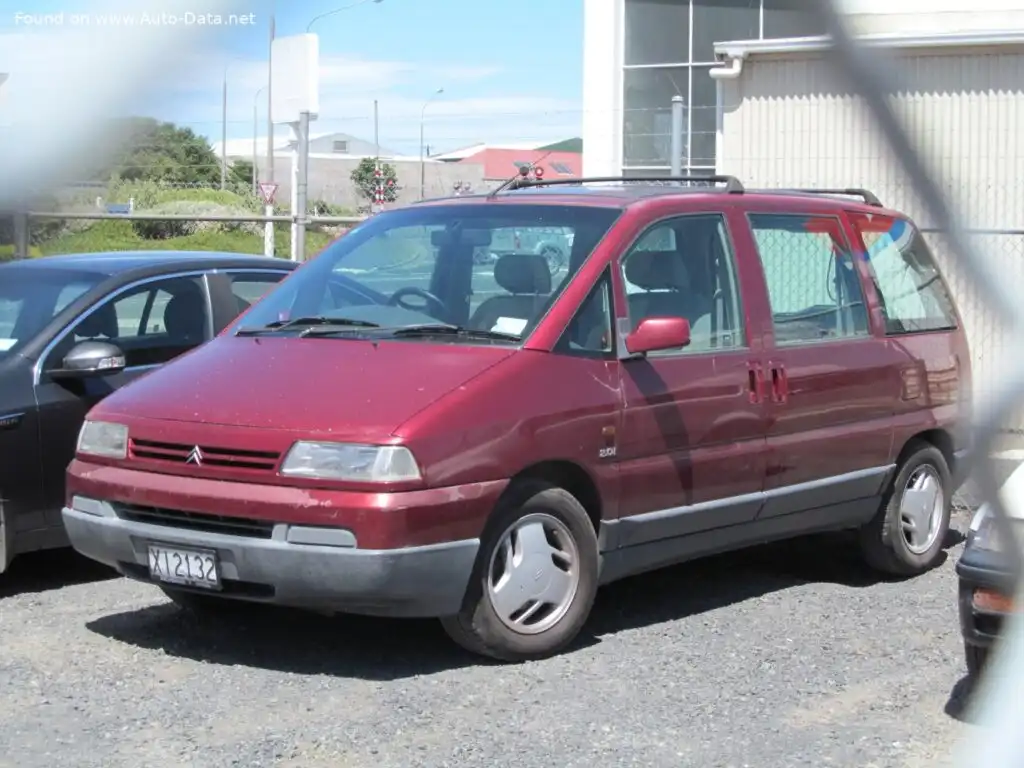
The Citroën Evasion 2.0 16V, produced primarily during the 1998 model year, represents a refined iteration of Citroën’s spacious and versatile minivan. Part of the second generation Evasion (designated 22), this variant occupied a mid-range position within the lineup, offering a balance between performance and practicality. The Evasion, known as the Eurovan in North America through a partnership with Ford, was designed to compete with other European MPVs like the Renault Espace and Volkswagen Sharan. This specific 2.0 16V model aimed to provide a more engaging driving experience than the base engine options, while remaining more affordable than the top-of-the-line trims.
Technical Specifications
| Brand | Citroen |
| Model | Evasion |
| Generation | Evasion (22) |
| Type (Engine) | 2.0 16V (132 Hp) |
| Start of production | 1998 |
| End of production | 1998 |
| Powertrain Architecture | Internal Combustion engine |
| Body type | Minivan |
| Seats | 5 |
| Doors | 5 |
| Fuel consumption (economy) – urban (NEDC) | 13.5 l/100 km (17.4 US mpg, 20.9 UK mpg, 7.4 km/l) |
| Fuel consumption (economy) – extra urban (NEDC) | 8.5 l/100 km (27.7 US mpg, 33.2 UK mpg, 11.8 km/l) |
| Fuel consumption (economy) – combined (NEDC) | 10.3 l/100 km (22.8 US mpg, 27.4 UK mpg, 9.7 km/l) |
| CO2 emissions (NEDC) | 247 g/km |
| Fuel Type | Petrol (Gasoline) |
| Acceleration 0 – 100 km/h | 12.1 sec |
| Acceleration 0 – 62 mph | 12.1 sec |
| Acceleration 0 – 60 mph | 11.5 sec |
| Maximum speed | 186 km/h (115.58 mph) |
| Weight-to-power ratio | 11.8 kg/Hp, 84.9 Hp/tonne |
| Weight-to-torque ratio | 8.6 kg/Nm, 115.8 Nm/tonne |
| Power | 132 Hp @ 4200 rpm |
| Power per litre | 66.1 Hp/l |
| Torque | 180 Nm @ 2600 rpm (132.76 lb.-ft. @ 2600 rpm) |
| Engine layout | Front, Transverse |
| Engine Model/Code | RFV XU10J4R |
| Engine displacement | 1998 cm3 (121.93 cu. in.) |
| Number of cylinders | 4 |
| Engine configuration | Inline |
| Cylinder Bore | 86 mm (3.39 in.) |
| Piston Stroke | 86 mm (3.39 in.) |
| Compression ratio | 9.5:1 |
| Number of valves per cylinder | 4 |
| Fuel injection system | Multi-port manifold injection |
| Engine aspiration | Naturally aspirated engine |
| Valvetrain | OHC |
| Engine oil capacity | 4.25 l (4.49 US qt | 3.74 UK qt) |
| Coolant | 8.5 l (8.98 US qt | 7.48 UK qt) |
| Kerb Weight | 1555 kg (3428.19 lbs.) |
| Max. weight | 2360 kg (5202.91 lbs.) |
| Max load | 805 kg (1774.72 lbs.) |
| Trunk (boot) space – minimum | 340 l (12.01 cu. ft.) |
| Trunk (boot) space – maximum | 3300 l (116.54 cu. ft.) |
| Fuel tank capacity | 80 l (21.13 US gal | 17.6 UK gal) |
| Max. roof load | 100 kg (220.46 lbs.) |
| Permitted trailer load with brakes (12%) | 1300 kg (2866.01 lbs.) |
| Permitted trailer load without brakes | 750 kg (1653.47 lbs.) |
| Length | 4454 mm (175.35 in.) |
| Width | 1834 mm (72.2 in.) |
| Height | 1714 mm (67.48 in.) |
| Wheelbase | 2824 mm (111.18 in.) |
| Front track | 1534 mm (60.39 in.) |
| Rear (Back) track | 1540 mm (60.63 in.) |
| Front overhang | 881 mm (34.69 in.) |
| Rear overhang | 749 mm (29.49 in.) |
| Drag coefficient (Cd) | 0.39 |
| Minimum turning circle (turning diameter) | 12.35 m (40.52 ft.) |
| Drivetrain Architecture | The Internal combustion engine (ICE) drives the front wheels of the vehicle. |
| Drive wheel | Front wheel drive |
| Number of gears and type of gearbox | 5 gears, manual transmission |
| Front suspension | Independent type McPherson, Transverse stabilizer |
| Rear suspension | independent torsion suspension, Wishbone |
| Front brakes | Ventilated discs |
| Rear brakes | Drum |
| Assisting systems | ABS (Anti-lock braking system) |
| Steering type | Steering rack and pinion |
| Power steering | Hydraulic Steering |
| Tires size | 205/65R15 |
| Wheel rims size | 15 |
Powertrain & Engine Architecture
The heart of the Evasion 2.0 16V is the RFV XU10J4R engine, a 1.998-liter inline-four cylinder gasoline engine. This engine is part of the PSA Group’s XU series, known for its robustness and relatively simple design. The “16V” designation indicates a dual overhead camshaft (DOHC) valvetrain, featuring four valves per cylinder, enhancing breathing and contributing to the engine’s increased power output compared to single overhead cam (SOHC) versions. Fuel delivery is managed by a multi-port fuel injection system, providing precise fuel metering for improved efficiency and performance. The engine produces 132 horsepower at 4200 rpm and 180 Nm (132.76 lb-ft) of torque at 2600 rpm. The engine’s transverse mounting and front-wheel-drive configuration were standard for this class of vehicle in Europe. The Evasion 2.0 16V was typically paired with a 5-speed manual transmission, although an automatic transmission was also available, albeit less common.
Driving Characteristics
The 2.0 16V engine provided a noticeable step up in performance compared to the lower-displacement engines offered in the Evasion lineup. While not a sports car by any means, the 132 hp engine offered adequate power for highway cruising and overtaking maneuvers. The 5-speed manual transmission allowed drivers to keep the engine in its optimal power band, resulting in a more responsive driving experience. The automatic transmission, while offering convenience, did diminish acceleration slightly due to its less efficient power transfer. The Evasion’s suspension, featuring independent McPherson struts at the front and a torsion beam setup at the rear, provided a comfortable ride, prioritizing passenger comfort over sporty handling. Steering was light and precise, making the Evasion easy to maneuver in urban environments.
Equipment & Trim Levels
The Evasion 2.0 16V typically came equipped with a reasonable level of standard features. These included power windows, central locking, power steering, and an adjustable steering column. Interior upholstery was typically cloth, with options for upgraded materials available. Higher trim levels could add features like air conditioning, a sunroof, and upgraded audio systems. The Evasion’s modular interior was a key selling point, with flexible seating arrangements allowing for various configurations to maximize cargo space. The dashboard layout was functional and straightforward, prioritizing ease of use over stylistic flair.
Chassis & Braking
The Evasion’s chassis was designed to provide a comfortable and stable ride. The front suspension utilized independent McPherson struts, while the rear employed a torsion beam setup. This combination offered a good balance between ride quality and handling. Braking duties were handled by ventilated discs at the front and drum brakes at the rear. Anti-lock Braking System (ABS) was standard, enhancing safety by preventing wheel lockup during hard braking. The Evasion’s relatively lightweight construction, at around 1555 kg (3428.19 lbs), helped to contribute to its decent handling characteristics.
Market Reception & Comparison
The Citroën Evasion 2.0 16V was generally well-received by automotive critics. It was praised for its spacious interior, comfortable ride, and relatively strong engine performance. However, some critics noted that the interior styling was somewhat dated compared to newer MPVs on the market. Compared to the base engine options, the 2.0 16V offered a significant improvement in performance, making it a more appealing choice for drivers who frequently carried passengers or cargo. Fuel economy, at around 10.3 l/100 km (22.8 US mpg), was typical for a vehicle of this size and class. Reliability was generally good, although routine maintenance was essential to ensure the longevity of the engine and other components.
Legacy
The Citroën Evasion, and specifically the 2.0 16V variant, remains a popular choice among enthusiasts seeking a spacious and reliable minivan. The XU10J4R engine is known for its durability and relatively simple maintenance requirements. While finding parts may become more challenging as the vehicle ages, the engine’s widespread use in other PSA Group vehicles ensures that components are still available. Today, well-maintained Evasions can be found on the used car market at affordable prices, offering a practical and comfortable transportation solution for families and individuals alike. The Evasion’s legacy lies in its ability to provide a versatile and spacious interior, combined with a reliable and reasonably powerful engine.