Technical Specifications
| Brand | Citroen |
| Model | Jumpy |
| Generation | Jumpy I |
| Type (Engine) | 1.9D (71 Hp) |
| Start of production | October, 1995 |
| End of production | April, 1999 |
| Powertrain Architecture | Internal Combustion engine |
| Body type | Minivan |
| Seats | 2-3 |
| Doors | 4 |
| Fuel consumption (urban) | 8.3 l/100 km (28.3 US mpg, 34 UK mpg, 12 km/l) |
| Fuel consumption (extra urban) | 6.4 l/100 km (36.8 US mpg, 44.1 UK mpg, 15.6 km/l) |
| Fuel consumption (combined) | 8 l/100 km (29.4 US mpg, 35.3 UK mpg, 12.5 km/l) |
| Fuel Type | Diesel |
| Acceleration 0 – 100 km/h | 22.3 sec |
| Acceleration 0 – 62 mph | 22.3 sec |
| Acceleration 0 – 60 mph | 21.2 sec |
| Maximum speed | 137 km/h (85.13 mph) |
| Weight-to-power ratio | 18.5 kg/Hp, 54.2 Hp/tonne |
| Weight-to-torque ratio | 10.9 kg/Nm, 91.6 Nm/tonne |
| Power | 71 Hp @ 4600 rpm |
| Power per litre | 37.3 Hp/l |
| Torque | 120 Nm @ 2000 rpm (88.51 lb.-ft. @ 2000 rpm) |
| Engine layout | Front, Transverse |
| Engine Model/Code | XUD9 |
| Engine displacement | 1905 cm3 (116.25 cu. in.) |
| Number of cylinders | 4 |
| Engine configuration | Inline |
| Cylinder Bore | 83 mm (3.27 in.) |
| Piston Stroke | 88 mm (3.46 in.) |
| Compression ratio | 23:1 |
| Number of valves per cylinder | 2 |
| Fuel injection system | Precombustion chamber injection |
| Engine aspiration | Naturally aspirated engine |
| Valvetrain | SOHC |
| Engine oil capacity | 4.2 l (4.44 US qt | 3.7 UK qt) |
| Coolant | 9 l (9.51 US qt | 7.92 UK qt) |
| Kerb Weight | 1310 kg (2888.06 lbs.) |
| Max. weight | 2190 kg (4828.12 lbs.) |
| Max load | 880 kg (1940.07 lbs.) |
| Trunk (boot) space – maximum | 4000 l (141.26 cu. ft.) |
| Fuel tank capacity | 80 l (21.13 US gal | 17.6 UK gal) |
| Max. roof load | 150 kg (330.69 lbs.) |
| Permitted trailer load with brakes (12%) | 1100 kg (2425.08 lbs.) |
| Permitted trailer load without brakes | 685 kg (1510.17 lbs.) |
| Permitted towbar download | 60 kg (132.28 lbs.) |
| Length | 4440 mm (174.8 in.) |
| Width | 1810 mm (71.26 in.) |
| Width including mirrors | 2134 mm (84.02 in.) |
| Height | 1927 mm (75.87 in.) |
| Wheelbase | 2824 mm (111.18 in.) |
| Front track | 1540 mm (60.63 in.) |
| Rear (Back) track | 1540 mm (60.63 in.) |
| Front overhang | 846 mm (33.31 in.) |
| Rear overhang | 770 mm (30.31 in.) |
| Drag coefficient (Cd) | 0.35 |
| Minimum turning circle (turning diameter) | 12.38 m (40.62 ft.) |
| Drivetrain Architecture | The Internal combustion engine (ICE) drives the front wheels of the vehicle. |
| Drive wheel | Front wheel drive |
| Number of gears and type of gearbox | 5 gears, manual transmission |
| Front suspension | Independent, type McPherson with coil spring and anti-roll bar |
| Rear suspension | Trailing arm |
| Front brakes | Ventilated discs |
| Rear brakes | Drum |
| Assisting systems | ABS (Anti-lock braking system) |
| Steering type | Steering rack and pinion |
| Power steering | Hydraulic Steering |
| Tires size | 195/70 R14 |
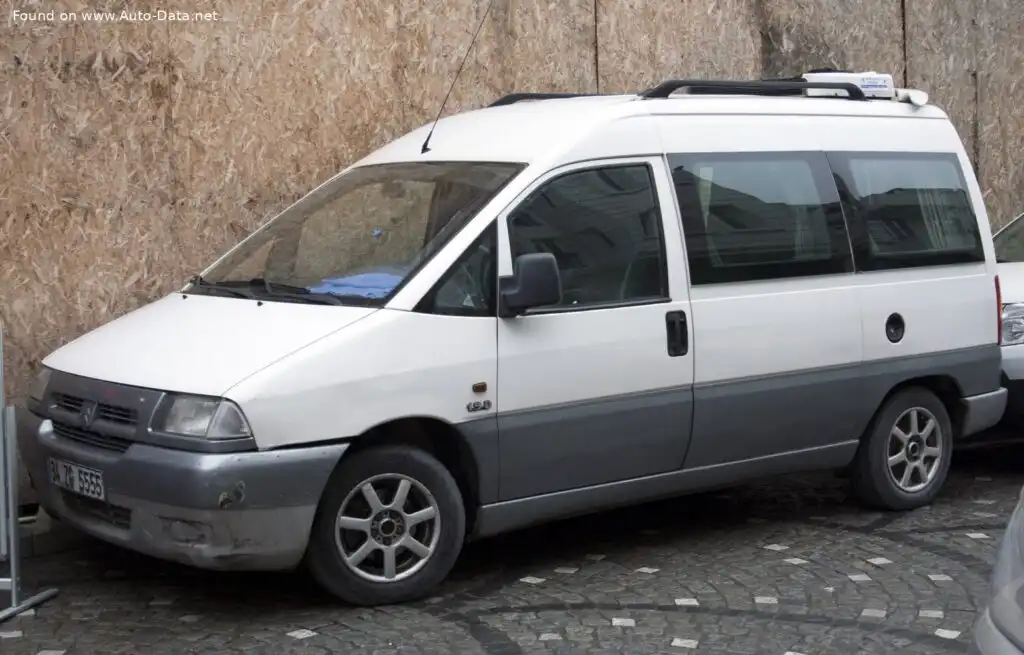
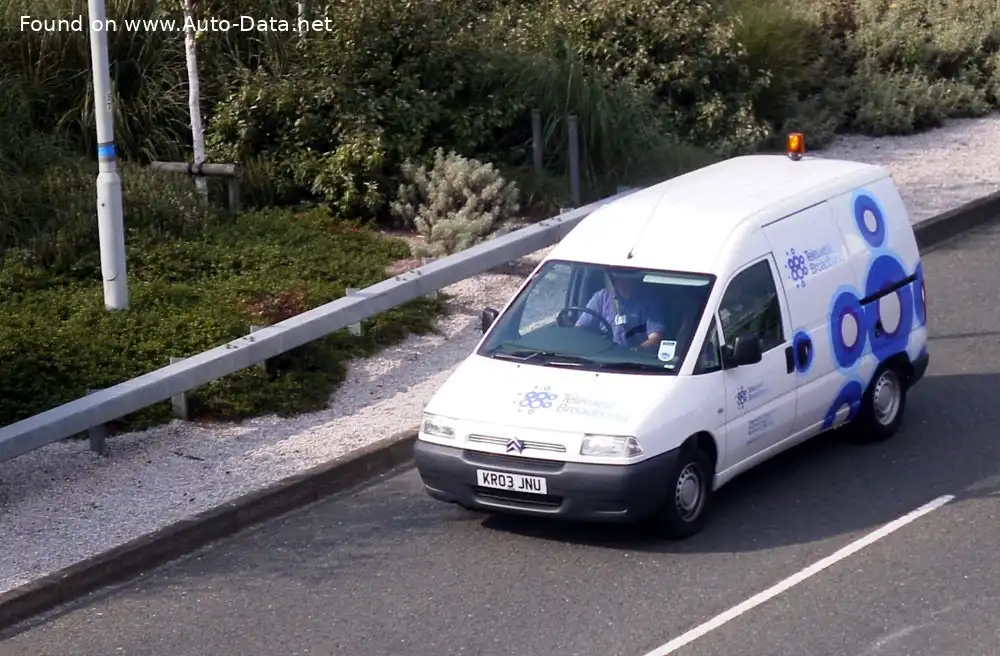
The Citroen Jumpy I 1.9D, produced from October 1995 to April 1999, was a cornerstone of Citroen’s light commercial vehicle offerings in Europe. Part of the first generation Jumpy range – also sold as the Peugeot Expert, Fiat Scudo, and Lancia Pratica – this variant was specifically positioned as an entry-level workhorse, prioritizing affordability and fuel economy. Built on the collaborative Sevel Nord platform developed with Peugeot and Fiat, the Jumpy I aimed to provide a versatile and practical van solution for small businesses and tradespeople. The 1.9D engine configuration represented a substantial portion of early Jumpy sales, appealing to operators who needed a dependable, if unhurried, vehicle for daily tasks.
Powertrain & Engine Architecture
The Jumpy I 1.9D’s powertrain revolved around the XUD9 diesel engine, a 1.9-liter inline-four cylinder unit. This engine was a long-serving and well-regarded powerplant within the Citroen and Peugeot lineups, known for its robustness. The XUD9 employed a precombustion chamber injection system, a common technology for diesel engines of the period. This system involved injecting fuel into a small precombustion chamber, which then ignited the main charge in the cylinder, promoting more efficient combustion. A single overhead camshaft (SOHC) operated two valves per cylinder. While relatively simple in its design, the XUD9 was celebrated for its durability and ability to accumulate high mileage. The engine produced 71 horsepower at 4600 rpm, and 120 Nm (88.51 lb-ft) of torque at 2000 rpm. The engine was mounted transversely at the front of the vehicle, driving the front wheels through a standard five-speed manual transmission, geared for economy rather than outright performance.
Driving Characteristics
The Jumpy I 1.9D was not built for speed. Acceleration was modest, requiring approximately 22.3 seconds to reach 62 mph. The vehicle’s design focused on providing adequate power for carrying loads and navigating urban environments. The five-speed manual transmission allowed drivers to keep the engine within its optimal operating range, but the limited horsepower meant that overtaking required careful consideration. Compared to higher-output Jumpy variants, such as those equipped with the 2.0-liter HDI engine, the 1.9D felt noticeably slower. However, the lower power output contributed to improved fuel economy, making it a cost-effective choice for businesses prioritizing operational expenses. The gear ratios were optimized for fuel efficiency, resulting in a driving experience that, by modern standards, could be described as somewhat basic.
Equipment & Trim Levels
The 1.9D Jumpy I was typically offered in a basic trim level, reflecting its entry-level positioning within the range. Standard equipment generally included a driver’s airbag, power steering, and a simple audio system. The interior was functional and utilitarian, featuring durable plastic trim and cloth upholstery. Optional extras, such as air conditioning, electric windows, and a passenger airbag, were available. The van’s interior was designed with practicality in mind, maximizing cargo space. Rear seating configurations varied, offering either a two-seater bench or a three-seater arrangement, depending on the customer’s needs.
Chassis & Braking
The Jumpy I utilized an independent McPherson strut suspension system at the front, providing a reasonable level of ride comfort. The rear suspension employed a simpler trailing arm setup, contributing to cost savings. The front brakes were ventilated discs, offering adequate stopping power, while the rear brakes were drums. ABS (Anti-lock Braking System) was included as standard equipment, enhancing safety. The steering system was a rack and pinion type with hydraulic assistance, providing relatively light steering feel. The suspension was tuned to accommodate carrying loads, resulting in a slightly firmer ride when the vehicle was unladen.
Market Reception & Comparison
The Citroen Jumpy I 1.9D was well-received in the European market as a practical and affordable light commercial vehicle. Critics acknowledged its fuel efficiency and durability, but also noted its lack of performance. Compared to the more powerful Jumpy variants, the 1.9D offered a lower purchase price and reduced running costs, making it appealing to budget-conscious buyers. The Peugeot Expert 1.9D and Fiat Scudo 1.9D, being mechanically identical, presented direct competition with similar characteristics. The Jumpy 1.9D’s fuel economy was competitive within its class, and its reliability was generally considered to be good.
Legacy
The XUD9 engine, powering the Jumpy I 1.9D, has earned a reputation for exceptional longevity and relative simplicity. Numerous examples of this engine continue to operate reliably today, even after accumulating significant mileage. The Jumpy I, as a whole, solidified Citroen’s position as a key player in the light commercial vehicle segment. In the used car market, the 1.9D variant remains a popular choice for those seeking a basic, reliable, and affordable van. While it may not offer the refinement or performance of more modern vans, its simplicity and durability continue to appeal to a broad range of users. Parts availability remains good, contributing to its continued viability as a dependable work vehicle.