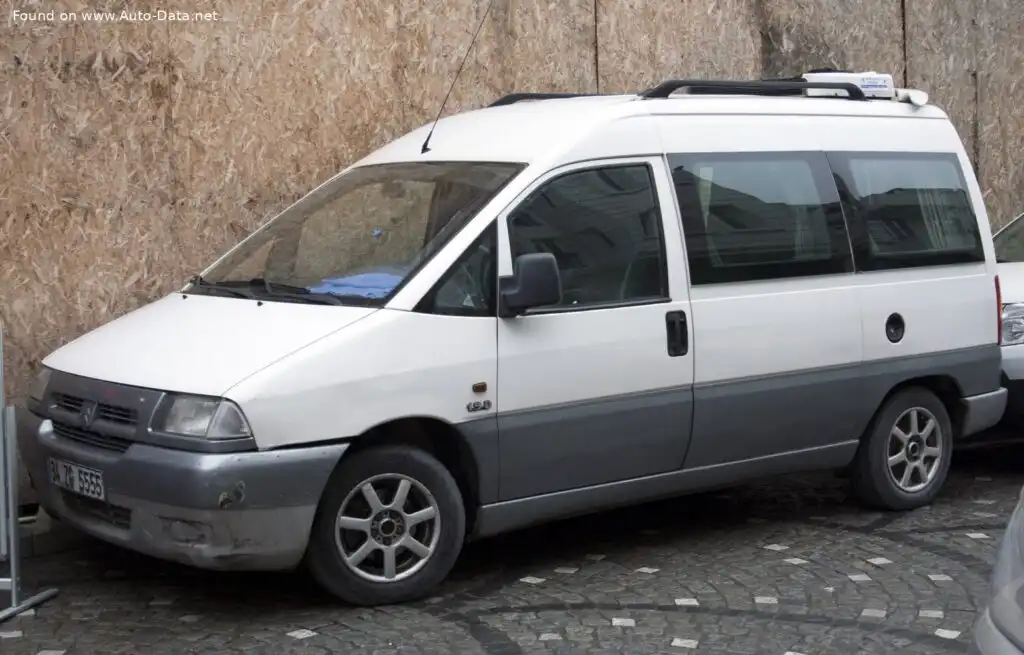
The Citroen Jumpy I Combi, specifically the facelifted version produced from 2004 to 2006, represented a significant offering in the European leisure activity vehicle (LAV) segment. This variant, equipped with the 2.0-liter (136 horsepower) petrol engine, aimed to provide a balance between practicality, space, and reasonable performance for families and those requiring a versatile vehicle. The Jumpy I, co-developed with Fiat and Peugeot (resulting in the Fiat Scudo and Peugeot 807 respectively), was built on the shared 1HX0 platform, offering a modular design that allowed for various body configurations and trim levels. This particular 2.0L engine option positioned itself as a mid-range offering, bridging the gap between the more economical diesel variants and the higher-performance options.
Technical Specifications
| Brand | Citroen |
| Model | Jumpy |
| Generation | Jumpy I Combi (facelift 2004) |
| Type (Engine) | 2.0 (136 Hp) |
| Start of production | 2004 |
| End of production | 2006 |
| Powertrain Architecture | Internal Combustion engine |
| Body type | Minivan |
| Seats | 7 |
| Doors | 4 |
| Fuel consumption (urban) | 12 l/100 km (19.6 US mpg, 23.5 UK mpg, 8.3 km/l) |
| Fuel consumption (extra urban) | 7.3 l/100 km (32.2 US mpg, 38.7 UK mpg, 13.7 km/l) |
| Fuel consumption (combined) | 9 l/100 km (26.1 US mpg, 31.4 UK mpg, 11.1 km/l) |
| CO2 emissions | 216 g/km |
| Fuel Type | Petrol (Gasoline) |
| Acceleration 0 – 100 km/h | 11.5 sec |
| Acceleration 0 – 62 mph | 11.5 sec |
| Acceleration 0 – 60 mph | 10.9 sec |
| Maximum speed | 175 km/h (108.74 mph) |
| Emission standard | Euro 3 D4 |
| Weight-to-power ratio | 11 kg/Hp, 90.6 Hp/tonne |
| Weight-to-torque ratio | 7.9 kg/Nm, 126.6 Nm/tonne |
| Power | 136 Hp @ 6000 rpm |
| Power per litre | 68.1 Hp/l |
| Torque | 190 Nm @ 4100 rpm (140.14 lb.-ft. @ 4100 rpm) |
| Engine layout | Front, Transverse |
| Engine Model/Code | RFN EW10J4 |
| Engine displacement | 1997 cm3 (121.86 cu. in.) |
| Number of cylinders | 4 |
| Engine configuration | Inline |
| Cylinder Bore | 85 mm (3.35 in.) |
| Piston Stroke | 88 mm (3.46 in.) |
| Number of valves per cylinder | 4 |
| Fuel injection system | Multi-port manifold injection |
| Engine aspiration | Naturally aspirated engine |
| Valvetrain | DOHC |
| Engine oil capacity | 4.25 l (4.49 US qt | 3.74 UK qt) |
| Coolant | 8.5 l (8.98 US qt | 7.48 UK qt) |
| Kerb Weight | 1501 kg (3309.14 lbs.) |
| Max. weight | 2505 kg (5522.58 lbs.) |
| Max load | 1004 kg (2213.44 lbs.) |
| Fuel tank capacity | 80 l (21.13 US gal | 17.6 UK gal) |
| Max. roof load | 100 kg (220.46 lbs.) |
| Permitted trailer load with brakes (8%) | 1700 kg (3747.86 lbs.) |
| Permitted trailer load with brakes (12%) | 1300 kg (2866.01 lbs.) |
| Permitted trailer load without brakes | 750 kg (1653.47 lbs.) |
| Permitted towbar download | 60 kg (132.28 lbs.) |
| Length | 4522 mm (178.03 in.) |
| Width | 1844 mm (72.6 in.) |
| Height | 1936 mm (76.22 in.) |
| Wheelbase | 2824 mm (111.18 in.) |
| Front track | 1540 mm (60.63 in.) |
| Rear track | 1540 mm (60.63 in.) |
| Front overhang | 919 mm (36.18 in.) |
| Rear overhang | 779 mm (30.67 in.) |
| Drivetrain Architecture | The Internal combustion engine (ICE) drives the front wheels of the vehicle. |
| Drive wheel | Front wheel drive |
| Number of gears and type of gearbox | 5 gears, manual transmission |
| Front suspension | Independent, type McPherson with coil spring and anti-roll bar |
| Rear suspension | Semi-dependent beam with stabilizer lateral stability, Coil spring |
| Front brakes | Ventilated discs |
| Rear brakes | Drum |
| Assisting systems | ABS (Anti-lock braking system) |
| Steering type | Steering rack and pinion |
| Power steering | Hydraulic Steering |
| Tires size | 205/65 R15 |
| Wheel rims size | 6.5J x 15 |
Powertrain & Engine Architecture
The heart of this Jumpy variant is the RFN (EW10J4) 2.0-liter inline-four cylinder petrol engine. This engine, a product of PSA Peugeot Citroën’s engineering, utilizes a multi-port fuel injection system and a double overhead camshaft (DOHC) valvetrain. The engine’s 1997cc displacement, combined with a compression ratio of approximately 9.5:1, allowed it to produce 136 horsepower at 6000 rpm and 190 Nm (140 lb-ft) of torque at 4100 rpm. The engine is transversely mounted in the front of the vehicle. The transmission is a five-speed manual gearbox, chosen for its simplicity and cost-effectiveness. While an automatic transmission was offered on some Jumpy models, it was less common with this particular engine.
Driving Characteristics
The 2.0-liter engine, paired with the five-speed manual transmission, provided adequate, though not exhilarating, performance. Acceleration from 0-100 km/h (0-62 mph) took around 11.5 seconds, and top speed was rated at 175 km/h (108.74 mph). The engine felt relatively responsive in the mid-range, making it suitable for everyday driving and highway cruising. However, it lacked the low-end torque of the diesel options, requiring more frequent downshifts when fully loaded or tackling inclines. The manual transmission offered precise shifts, but the gear ratios were spaced to prioritize fuel economy over outright performance. Compared to the more powerful petrol engines available in other Jumpy variants, this 2.0L felt less strained during long journeys, but also less capable of rapid acceleration.
Equipment & Trim Levels
The 2004-2006 Jumpy I Combi 2.0L typically came with a reasonable level of standard equipment. This included power steering, ABS brakes, a driver’s airbag, and central locking. Interior features generally consisted of cloth upholstery, a basic audio system, and manually adjustable windows and mirrors. Higher trim levels offered options such as air conditioning, alloy wheels, a CD player, and additional airbags. The Combi designation indicated a focus on passenger comfort, with seating for up to seven occupants arranged in a flexible configuration. The interior plastics were durable but not particularly luxurious, reflecting the vehicle’s utilitarian nature.
Chassis & Braking
The Jumpy I Combi utilized a McPherson strut front suspension and a semi-independent beam rear suspension. This setup provided a comfortable ride quality, particularly on smoother roads. The front brakes were ventilated discs, offering good stopping power, while the rear brakes were drums, a cost-saving measure common in this class of vehicle. A stabilizer bar was fitted to both the front and rear axles to reduce body roll during cornering. The steering was a hydraulic rack and pinion system, providing reasonably precise control.
Market Reception & Comparison
The Citroen Jumpy I Combi 2.0L was generally well-received as a practical and versatile family vehicle. Critics praised its spacious interior, flexible seating arrangements, and reasonable fuel economy (around 9 l/100 km combined). However, the petrol engine was often seen as a less desirable option compared to the more fuel-efficient diesel variants, which dominated the European market. The 2.0L engine offered a smoother and quieter driving experience than the diesels, but at the cost of higher fuel consumption and slightly lower performance. Compared to competitors like the Renault Espace and Volkswagen Sharan, the Jumpy offered a more affordable price point, but lacked some of their refinement and features.
Legacy
The RFN EW10J4 engine, while not known for being exceptionally durable, proved to be reasonably reliable with regular maintenance. Common issues included occasional oil leaks and sensor failures. The Jumpy I Combi, as a whole, has developed a reputation for being a robust and practical vehicle, particularly among those seeking a spacious and affordable people carrier. On the used car market, these models are generally available at relatively low prices, making them an attractive option for budget-conscious buyers. However, potential buyers should be aware of the age-related wear and tear and ensure that the vehicle has been properly maintained.