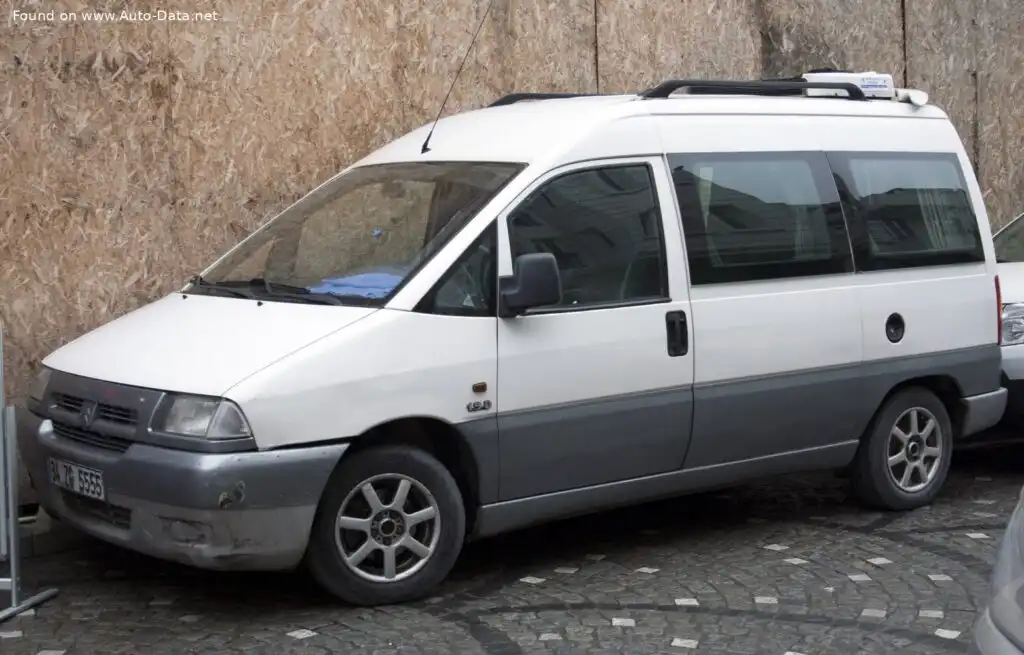
The Citroen Jumpy I Combi, specifically the facelifted version produced from 2004 to 2005 with the 2.0-liter (136 hp) engine and automatic transmission, represented a significant offering in the European leisure activity vehicle (LAV) segment. Positioned as a mid-range option within the Jumpy lineup, it catered to families and individuals needing a versatile and spacious vehicle. The Jumpy I, launched in 1995, was the result of a joint venture between PSA (Peugeot-Citroën) and Fiat, sharing its platform and many components with the Peugeot 806, Fiat Ulysse, and Lancia Zeta. The 2004 facelift brought subtle styling updates and refinements to the interior, aiming to maintain competitiveness in a rapidly evolving market. This variant aimed to provide a balance between performance, fuel economy, and convenience, appealing to buyers who preferred the ease of an automatic gearbox.
Technical Specifications
| Brand | Citroen |
| Model | Jumpy |
| Generation | Jumpy I Combi (facelift 2004) |
| Type (Engine) | 2.0 (136 Hp) Automatic |
| Start of production | 2004 |
| End of production | 2005 |
| Powertrain Architecture | Internal Combustion engine |
| Body type | Minivan |
| Seats | 7 |
| Doors | 4 |
| Fuel consumption (urban) | 13.5 l/100 km (17.4 US mpg, 20.9 UK mpg, 7.4 km/l) |
| Fuel consumption (extra urban) | 7.6 l/100 km (30.9 US mpg, 37.2 UK mpg, 13.2 km/l) |
| Fuel consumption (combined) | 9.7 l/100 km (24.2 US mpg, 29.1 UK mpg, 10.3 km/l) |
| CO2 emissions | 232 g/km |
| Fuel Type | Petrol (Gasoline) |
| Acceleration 0 – 100 km/h | 13.7 sec |
| Acceleration 0 – 62 mph | 13.7 sec |
| Acceleration 0 – 60 mph | 13 sec |
| Maximum speed | 172 km/h (106.88 mph) |
| Emission standard | Euro 3 |
| Weight-to-power ratio | 11.3 kg/Hp, 88.3 Hp/tonne |
| Weight-to-torque ratio | 8.1 kg/Nm, 123.4 Nm/tonne |
| Power | 136 Hp @ 6000 rpm |
| Power per litre | 68.1 Hp/l |
| Torque | 190 Nm @ 4100 rpm (140.14 lb.-ft. @ 4100 rpm) |
| Engine layout | Front, Transverse |
| Engine Model/Code | RFN EW10J4 |
| Engine displacement | 1997 cm3 (121.86 cu. in.) |
| Number of cylinders | 4 |
| Engine configuration | Inline |
| Cylinder Bore | 85 mm (3.35 in.) |
| Piston Stroke | 88 mm (3.46 in.) |
| Number of valves per cylinder | 4 |
| Fuel injection system | Multi-port manifold injection |
| Engine aspiration | Naturally aspirated engine |
| Valvetrain | DOHC |
| Engine oil capacity | 4.25 l (4.49 US qt | 3.74 UK qt) |
| Coolant | 8.5 l (8.98 US qt | 7.48 UK qt) |
| Kerb Weight | 1540 kg (3395.12 lbs.) |
| Max. weight | 2320 kg (5114.72 lbs.) |
| Max load | 780 kg (1719.61 lbs.) |
| Fuel tank capacity | 80 l (21.13 US gal | 17.6 UK gal) |
| Max. roof load | 100 kg (220.46 lbs.) |
| Permitted trailer load with brakes (8%) | 1700 kg (3747.86 lbs.) |
| Permitted trailer load with brakes (12%) | 1300 kg (2866.01 lbs.) |
| Permitted trailer load without brakes | 750 kg (1653.47 lbs.) |
| Permitted towbar download | 60 kg (132.28 lbs.) |
| Length | 4522 mm (178.03 in.) |
| Width | 1844 mm (72.6 in.) |
| Height | 1936 mm (76.22 in.) |
| Wheelbase | 2824 mm (111.18 in.) |
| Front track | 1540 mm (60.63 in.) |
| Rear track | 1540 mm (60.63 in.) |
| Front overhang | 919 mm (36.18 in.) |
| Rear overhang | 779 mm (30.67 in.) |
| Drivetrain Architecture | Front wheel drive |
| Drive wheel | Front wheel drive |
| Number of gears and type of gearbox | 4 gears, automatic transmission |
| Front suspension | Independent, type McPherson with coil spring and anti-roll bar |
| Rear suspension | Semi-dependent beam with stabilizer lateral stability, Coil spring |
| Front brakes | Ventilated discs |
| Rear brakes | Drum |
| Assisting systems | ABS (Anti-lock braking system) |
| Steering type | Steering rack and pinion |
| Power steering | Hydraulic Steering |
| Tires size | 205/65 R15 |
| Wheel rims size | 6.5J x 15 |
Powertrain & Engine Architecture
The heart of this Jumpy variant is the RFN (EW10J4) 2.0-liter inline-four cylinder gasoline engine. This engine, a product of PSA’s engineering, utilizes a multi-port fuel injection system and a double overhead camshaft (DOHC) valvetrain. The engine’s 136 horsepower peak is achieved at 6000 rpm, while its 190 Nm (140 lb-ft) of torque is delivered at 4100 rpm. The engine is transversely mounted in the front of the vehicle. Paired with this engine is a four-speed automatic transmission, designed to provide smooth and convenient gear changes. This transmission, while offering ease of use, wasn’t known for its particularly quick shifts or fuel efficiency compared to manual counterparts.
Driving Characteristics
The 2.0-liter automatic Jumpy offered a comfortable, if not particularly sporty, driving experience. Acceleration from 0-100 km/h (0-62 mph) took approximately 13.7 seconds, making it noticeably slower than versions equipped with manual transmissions or the more powerful engine options. The automatic transmission’s gear ratios were geared towards providing adequate performance for everyday driving, but lacked the responsiveness needed for more spirited driving. The focus was on ease of use and relaxed cruising, making it well-suited for family trips and urban commutes. The relatively high kerb weight of 1540 kg further contributed to the less-than-dynamic driving experience.
Equipment & Trim Levels
The 2004 facelifted Jumpy I Combi 2.0 Automatic typically came equipped with features such as power steering, ABS brakes, central locking, and electric front windows. Interior upholstery was generally cloth, with options for upgraded materials available. The dashboard layout was functional and straightforward, prioritizing practicality over luxury. Optional extras included air conditioning, a radio/CD player, and rear parking sensors. The seven-seat configuration was standard, with flexible seating arrangements to accommodate varying passenger and cargo needs.
Chassis & Braking
The Jumpy I Combi utilized an independent McPherson strut suspension setup at the front, providing a reasonable level of ride comfort. The rear suspension employed a semi-dependent beam with a stabilizer bar, which helped to maintain stability during cornering. Braking duties were handled by ventilated discs at the front and drum brakes at the rear. While adequate for the vehicle’s weight and performance, the rear drum brakes were a cost-saving measure and didn’t offer the same stopping power as disc brakes on all four wheels.
Market Reception & Comparison
The Citroen Jumpy I Combi 2.0 Automatic was generally well-received as a practical and versatile family vehicle. Critics noted its spacious interior, comfortable ride, and ease of use. However, the automatic transmission was often criticized for its lack of responsiveness and impact on fuel economy. Compared to the manual transmission versions, the automatic suffered a noticeable penalty in fuel consumption. The 2.0-liter engine was considered adequate for most driving situations, but those requiring more power often opted for the higher-output engine options available in the Jumpy lineup.
Legacy
The Citroen Jumpy I Combi, including the 2.0-liter automatic variant, has proven to be a relatively reliable vehicle in the used car market. The RFN engine, while not without its quirks, is generally considered durable and capable of high mileage with proper maintenance. The automatic transmission, however, can be prone to issues if not serviced regularly. Today, these vehicles are often found as affordable and practical options for families or individuals needing a spacious and versatile vehicle. Their simple mechanical design makes them relatively easy and inexpensive to repair, contributing to their continued popularity in the used car market.