Technical Specifications
| Brand | Citroen |
| Model | Jumpy |
| Generation | Jumpy I Combi (facelift 2004) |
| Type (Engine) | 2.0 HDi 16V (109 Hp) 8 Seat |
| Start of production | 2004 |
| End of production | 2006 |
| Powertrain Architecture | Internal Combustion engine |
| Body type | Minivan |
| Seats | 8 |
| Doors | 4 |
| Fuel consumption (urban) | 8.9 l/100 km (26.4 US mpg, 31.7 UK mpg, 11.2 km/l) |
| Fuel consumption (extra urban) | 6.0 l/100 km (39.2 US mpg, 47.1 UK mpg, 16.7 km/l) |
| Fuel consumption (combined) | 7.0 l/100 km (33.6 US mpg, 40.4 UK mpg, 14.3 km/l) |
| CO2 emissions | 186 g/km |
| Fuel Type | Diesel |
| Acceleration 0 – 100 km/h | 15.0 sec |
| Acceleration 0 – 62 mph | 15.0 sec |
| Acceleration 0 – 60 mph | 14.3 sec |
| Maximum speed | 165 km/h (102.53 mph) |
| Emission standard | Euro 3 |
| Weight-to-power ratio | 15 kg/Hp, 66.5 Hp/tonne |
| Weight-to-torque ratio | 6.1 kg/Nm, 164.6 Nm/tonne |
| Power | 109 Hp @ 4000 rpm |
| Power per litre | 54.6 Hp/l |
| Torque | 270 Nm @ 1750 rpm (199.14 lb.-ft. @ 1750 rpm) |
| Engine layout | Front, Transverse |
| Engine Model/Code | RHW DW10ATED |
| Engine displacement | 1997 cm3 (121.86 cu. in.) |
| Number of cylinders | 4 |
| Engine configuration | Inline |
| Cylinder Bore | 85 mm (3.35 in.) |
| Piston Stroke | 88 mm (3.46 in.) |
| Number of valves per cylinder | 4 |
| Fuel injection system | Diesel Commonrail |
| Engine aspiration | Turbocharger, Intercooler |
| Engine oil capacity | 4.7 l (4.97 US qt | 4.14 UK qt) |
| Coolant | 9 l (9.51 US qt | 7.92 UK qt) |
| Kerb Weight | 1640 kg (3615.58 lbs.) |
| Max. weight | 2505 kg (5522.58 lbs.) |
| Max load | 865 kg (1907 lbs.) |
| Fuel tank capacity | 80 l (21.13 US gal | 17.6 UK gal) |
| Max. roof load | 100 kg (220.46 lbs.) |
| Permitted trailer load with brakes (8%) | 1800 kg (3968.32 lbs.) |
| Permitted trailer load with brakes (12%) | 1300 kg (2866.01 lbs.) |
| Permitted trailer load without brakes | 750 kg (1653.47 lbs.) |
| Permitted towbar download | 60 kg (132.28 lbs.) |
| Length | 4522 mm (178.03 in.) |
| Width | 1844 mm (72.6 in.) |
| Height | 1936 mm (76.22 in.) |
| Wheelbase | 2824 mm (111.18 in.) |
| Front track | 1540 mm (60.63 in.) |
| Rear track | 1540 mm (60.63 in.) |
| Front overhang | 919 mm (36.18 in.) |
| Rear overhang | 779 mm (30.67 in.) |
| Drivetrain Architecture | Front wheel drive |
| Number of gears and type of gearbox | 5 gears, manual transmission |
| Front suspension | Independent, type McPherson with coil spring and anti-roll bar |
| Rear suspension | Semi-dependent beam with stabilizer lateral stability, Coil spring |
| Front brakes | Ventilated discs |
| Rear brakes | Drum |
| Assisting systems | ABS (Anti-lock braking system) |
| Steering type | Steering rack and pinion |
| Power steering | Hydraulic Steering |
| Tires size | 205/65 R15 |
| Wheel rims size | 6.5J x 15 |
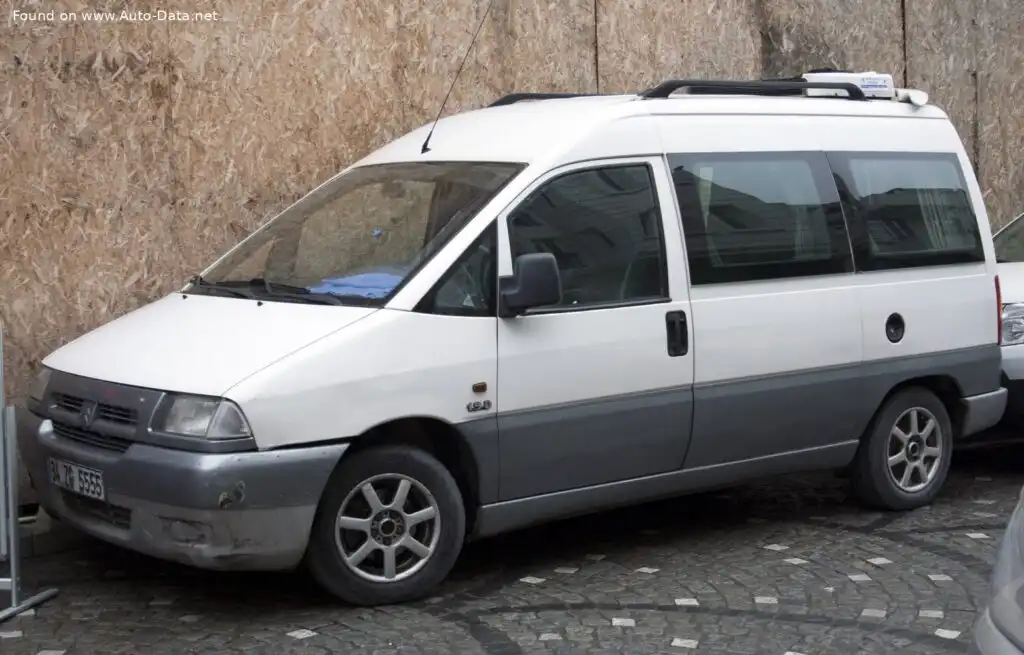
The Citroen Jumpy I Combi, specifically the facelifted version produced between 2004 and 2006, was a popular choice in the European market for those needing a versatile and spacious people carrier. This variant, powered by the 2.0 HDi 16V engine producing 109 horsepower and capable of seating up to eight passengers, occupied a middle ground within the Jumpy lineup. It aimed to strike a balance between fuel efficiency, performance, and practicality, appealing to both families and commercial users. Built on the shared Peugeot-Citroen X7 platform, the Jumpy I Combi offered a compelling package for those requiring a flexible and adaptable vehicle.
Powertrain & Engine Architecture
The 2.0 HDi 16V engine, designated with the code RHW or DW10ATED, forms the core of this Jumpy variant. This engine is a four-cylinder, inline diesel engine equipped with a turbocharger and intercooler to boost power output. The 16-valve cylinder head (four valves per cylinder) enhances airflow and contributes to improved efficiency. A key feature of this engine is its Diesel Commonrail direct injection system. This technology injects fuel at extremely high pressure, resulting in finer fuel atomization, more complete combustion, and reduced engine noise and emissions. The engine delivers 109 horsepower at 4000 rpm and 270 Nm (199 lb-ft) of torque at a low 1750 rpm, providing ample pulling power for a vehicle of this size. The standard transmission was a five-speed manual, chosen for its cost-effectiveness and efficiency. While an automatic transmission was offered on some Jumpy models, it was less frequently paired with this particular engine.
Driving Characteristics
The 2.0 HDi 16V engine, producing 109 hp, provided adequate, though not particularly sporty, performance in the Jumpy I Combi. Acceleration from 0 to 60 mph took approximately 14.3 seconds, with a top speed around 102.5 mph. The engine’s strength lay in its torque delivery, making it well-suited for carrying passengers and cargo. The five-speed manual transmission allowed drivers to maintain the engine within its optimal power band. Compared to the more powerful gasoline engines available in the Jumpy range, this diesel version prioritized fuel economy over outright speed. It also offered a more relaxed driving experience than the higher-output diesel versions, which could feel strained when fully loaded. The gear ratios were optimized for practicality, emphasizing low-end power for everyday driving.
Equipment & Trim Levels
The 2.0 HDi 16V 8-seat Combi typically came with a reasonable level of standard equipment. This included power steering, ABS brakes, a driver’s airbag, and a basic audio system. The interior was generally upholstered in cloth, with durable plastics used throughout the cabin. Optional extras included air conditioning, electric windows, central locking, and upgraded audio systems. Higher trim levels offered features such as alloy wheels, rear parking sensors, and more luxurious interior appointments. The eight-seat configuration provided a flexible seating arrangement, with the rear seats capable of being folded or removed to maximize cargo space.
Chassis & Braking
The Jumpy I Combi featured a McPherson strut front suspension with coil springs and an anti-roll bar, delivering a comfortable ride and predictable handling. The rear suspension utilized a semi-independent beam axle with coil springs, a cost-effective solution that provided adequate stability. Braking was accomplished with ventilated discs at the front and drum brakes at the rear. While sufficient for normal use, the rear drum brakes could lack the stopping power of disc brakes when the vehicle was heavily loaded. Hydraulic power steering provided light and easy steering, enhancing maneuverability in urban environments.
Market Reception & Comparison
The Citroen Jumpy I Combi 2.0 HDi 16V 8-seat was generally well-received by automotive critics as a practical and versatile family vehicle. Its fuel efficiency was a significant selling point, especially when compared to gasoline-powered alternatives. However, some reviewers noted that the engine could feel underpowered when fully loaded or when climbing steep hills. Compared to the more powerful 2.0 HDi 130 hp version, this 109 hp variant offered a lower purchase price but sacrificed some performance. The 1.9 TDI versions, while offering comparable fuel economy, were often perceived as being noisier and less refined.
Legacy
The 2.0 HDi engine, in its various iterations, proved to be a reliable and durable powerplant. While not entirely without potential issues – such as turbocharger wear and commonrail injector problems – these engines generally offered good longevity with proper maintenance. Today, the Jumpy I Combi 2.0 HDi 16V can be found on the used car market at affordable prices. Its practicality and fuel efficiency continue to make it an appealing option for those needing a spacious and versatile vehicle, although potential buyers should be prepared for age-related maintenance requirements.