Technical Specifications
| Brand | Citroen |
| Model | Jumpy |
| Generation | Jumpy I Dispatch |
| Type (Engine) | 2.0 HDi (94 Hp) |
| Start of production | 2000 year |
| End of production | 2001 year |
| Powertrain Architecture | Internal Combustion engine |
| Body type | Minivan |
| Seats | 5-6 |
| Doors | 5 |
| Fuel consumption (urban) | 8.4 l/100 km (28 US mpg, 33.6 UK mpg, 11.9 km/l) |
| Fuel consumption (extra urban) | 5.8 l/100 km (40.6 US mpg, 48.7 UK mpg, 17.2 km/l) |
| Fuel consumption (combined) | 6.8 l/100 km (34.6 US mpg, 41.5 UK mpg, 14.7 km/l) |
| Fuel Type | Diesel |
| Acceleration 0 – 100 km/h | 16.4 sec |
| Acceleration 0 – 62 mph | 16.4 sec |
| Acceleration 0 – 60 mph | 15.6 sec |
| Maximum speed | 160 km/h (99.42 mph) |
| Weight-to-power ratio | 16.2 kg/Hp, 61.7 Hp/tonne |
| Weight-to-torque ratio | 7.1 kg/Nm, 141.1 Nm/tonne |
| Power | 94 Hp @ 4000 rpm |
| Power per litre | 47.1 Hp/l |
| Torque | 215 Nm @ 1750 rpm (158.58 lb.-ft. @ 1750 rpm) |
| Engine layout | Front, Transverse |
| Engine Model/Code | RHX DW10BTED |
| Engine displacement | 1997 cm3 (121.86 cu. in.) |
| Number of cylinders | 4 |
| Engine configuration | Inline |
| Cylinder Bore | 85 mm (3.35 in.) |
| Piston Stroke | 88 mm (3.46 in.) |
| Number of valves per cylinder | 2 |
| Fuel injection system | Diesel Commonrail |
| Engine aspiration | Turbocharger, Intercooler |
| Valvetrain | SOHC |
| Engine oil capacity | 4.3 l (4.54 US qt | 3.78 UK qt) |
| Kerb Weight | 1524 kg (3359.84 lbs.) |
| Max. weight | 2330 kg (5136.77 lbs.) |
| Max load | 806 kg (1776.93 lbs.) |
| Fuel tank capacity | 80 l (21.13 US gal | 17.6 UK gal) |
| Max. roof load | 100 kg (220.46 lbs.) |
| Permitted trailer load with brakes (8%) | 1800 kg (3968.32 lbs.) |
| Permitted trailer load with brakes (12%) | 1300 kg (2866.01 lbs.) |
| Permitted trailer load without brakes | 750 kg (1653.47 lbs.) |
| Permitted towbar download | 60 kg (132.28 lbs.) |
| Length | 4440 mm (174.8 in.) |
| Width | 1810 mm (71.26 in.) |
| Width including mirrors | 2134 mm (84.02 in.) |
| Height | 1927 mm (75.87 in.) |
| Wheelbase | 2824 mm (111.18 in.) |
| Front track | 1540 mm (60.63 in.) |
| Rear track | 1540 mm (60.63 in.) |
| Front overhang | 846 mm (33.31 in.) |
| Rear overhang | 770 mm (30.31 in.) |
| Minimum turning circle | 12.35 m (40.52 ft.) |
| Drivetrain Architecture | The Internal combustion engine (ICE) drives the front wheels of the vehicle. |
| Drive wheel | Front wheel drive |
| Number of gears and type of gearbox | 5 gears, manual transmission |
| Front suspension | Independent, type McPherson with coil spring and anti-roll bar |
| Rear suspension | Trailing arm, Torsion |
| Front brakes | Ventilated discs |
| Rear brakes | Drum |
| Assisting systems | ABS (Anti-lock braking system) |
| Steering type | Steering rack and pinion |
| Power steering | Hydraulic Steering |
| Tires size | 205/65 R15 |
| Wheel rims size | 6.5J x 15 |
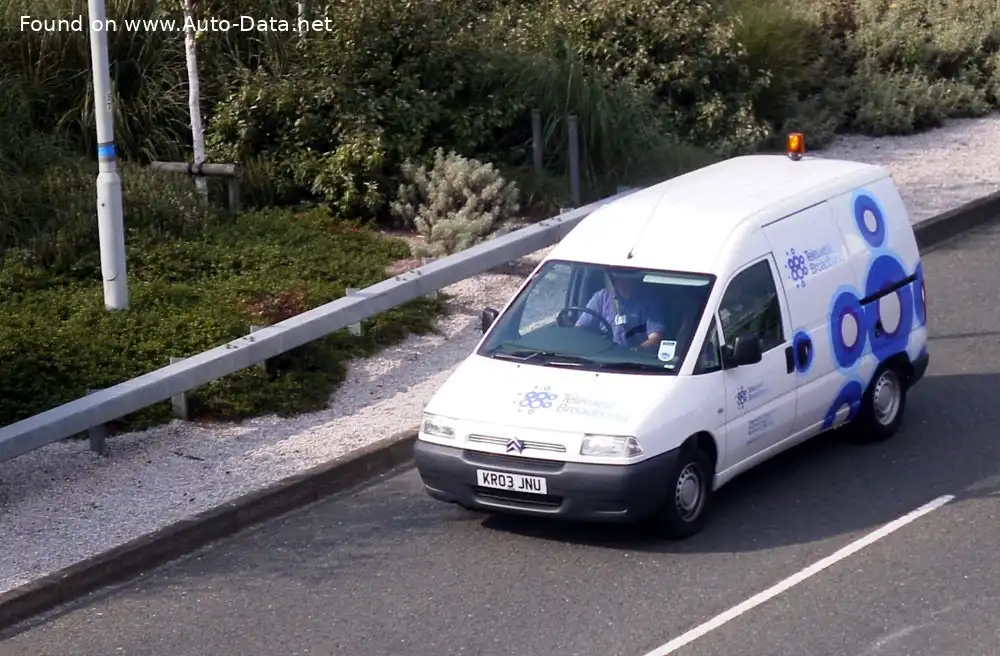
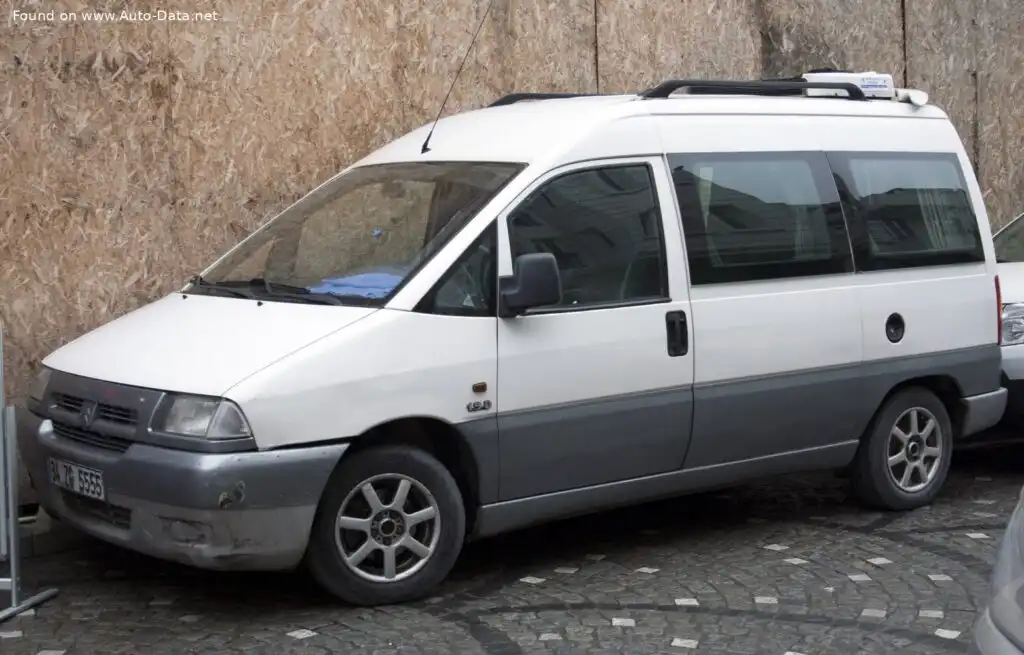
The Citroen Jumpy I, marketed in the United Kingdom as the Dispatch, was a light commercial vehicle and passenger van produced from 1995 to 2006. The 2.0 HDi 94 horsepower variant, produced from 2000 to 2001, represented an entry-level engine option within the Jumpy/Dispatch range. This model was a collaborative effort between Citroen, Peugeot, and Fiat, resulting in the Peugeot Expert and Fiat Scudo being nearly identical vehicles. The 94 hp version was aimed at buyers prioritizing fuel efficiency and practicality over outright performance, offering a more affordable alternative to the higher-powered HDi engines and providing a balance between capability and running costs for commercial users and families.
Powertrain & Engine Architecture
The 2.0 HDi engine, identified by the RHX DW10BTED code, was a four-cylinder, inline diesel engine utilizing a turbocharger with intercooling. This engine was part of the DW10 family developed by PSA Peugeot Citroën. The 94 horsepower version employed a common rail direct injection system, delivering fuel at high pressure directly into the combustion chamber for improved efficiency and reduced emissions. The engine featured a single overhead camshaft (SOHC) valvetrain operating two valves per cylinder. A five-speed manual transmission was the standard offering for this variant, chosen for its simplicity and cost-effectiveness. The transmission’s gear ratios were optimized for fuel economy rather than rapid acceleration, reflecting the intended use case of the vehicle.
Driving Characteristics
The 2.0 HDi 94 hp engine in the Jumpy/Dispatch provided adequate, but not exhilarating, performance. Acceleration was leisurely, with a 0-60 mph time of around 15.6 seconds. The engine’s 215 Nm (158.58 lb-ft) of torque, available from 1750 rpm, provided sufficient pulling power for everyday driving and moderate loads. However, when fully loaded or tackling steep inclines, the engine could feel strained. Compared to the more powerful 1.9 TDI and 2.0 HDi variants, the 94 hp version lacked the responsiveness and overall performance needed for demanding commercial applications. The five-speed manual transmission offered a reasonable spread of gears, but the long gearing further emphasized the engine’s focus on fuel efficiency over outright speed.
Equipment & Trim Levels
The 2.0 HDi 94 hp Jumpy/Dispatch typically came with a basic level of equipment, reflecting its position as an entry-level model. Standard features generally included power steering, ABS brakes, a driver’s airbag, and basic cloth upholstery. Higher trim levels, available as options, added features such as air conditioning, electric windows, a radio/CD player, and upgraded interior trim. The van was available in various configurations, including panel van, passenger van (Combi), and crew van layouts, with seating arrangements for five to six occupants. The interior was functional and durable, designed for practicality rather than luxury.
Chassis & Braking
The Jumpy/Dispatch utilized a McPherson strut front suspension with a torsion beam rear suspension. This setup provided a reasonable balance between ride comfort and handling, although it was not particularly sporty. The front brakes were ventilated discs, while the rear brakes were drums. This configuration was typical for vehicles in this weight class and price range. The hydraulic power steering provided light and easy steering, making it maneuverable in urban environments. The vehicle’s relatively high center of gravity and soft suspension settings meant that it was prone to body roll during cornering.
Market Reception & Comparison
The Citroen Jumpy I Dispatch 2.0 HDi 94 hp was generally well-received as a practical and economical workhorse. Critics praised its fuel efficiency, spacious interior, and competitive pricing. However, the engine’s lack of power was a common criticism, particularly when compared to the more powerful alternatives available in the range. The 1.9 TDI offered by Fiat and Peugeot provided a more refined driving experience, while the higher-output HDi engines delivered significantly better performance. Despite its limitations, the 94 hp version remained a popular choice for businesses and families seeking a reliable and affordable van.
Legacy
The 2.0 HDi engine, in its various iterations, proved to be a durable and reliable powerplant. The DW10 engine family became a mainstay in PSA vehicles for many years. While the Jumpy I Dispatch is now considered a relatively old vehicle, well-maintained examples continue to be used today. The 2.0 HDi 94 hp variant, while not the most powerful option, offers a good balance of reliability and fuel economy, making it a viable choice for those seeking a budget-friendly van. Parts availability remains reasonable, and the vehicle’s simple mechanical design makes it relatively easy to maintain and repair.