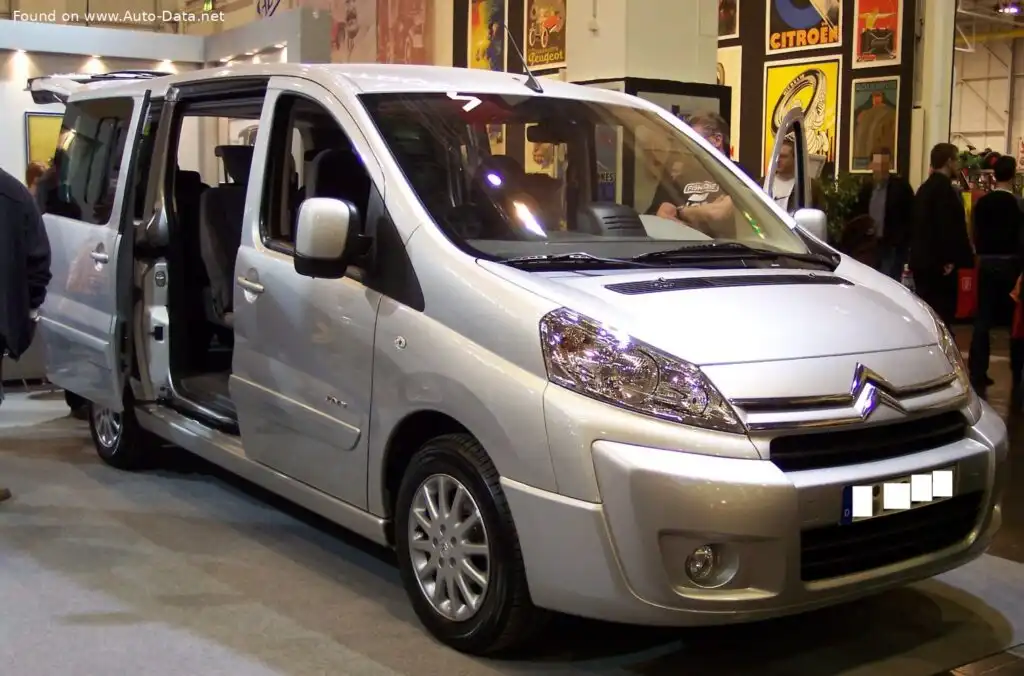
The Citroen Jumpy II Multispace 2.0 HDi (136 Hp) L1 DPF is a versatile minivan produced between 2007 and 2010. Part of the second generation of the Jumpy (known as the Dispatch in the UK and Ireland), this variant occupied a middle ground within the lineup, offering a balance between practicality, fuel efficiency, and reasonable performance for family and commercial use. It was primarily marketed in Europe as a passenger-carrying alternative to light commercial vans, appealing to those needing space and flexibility without the bulk of a full-size van. The “L1” designation indicates the short wheelbase version, making it more manageable in urban environments.
Technical Specifications
| Brand | Citroen |
| Model | Jumpy |
| Generation | Jumpy II Multispace |
| Type (Engine) | 2.0 HDi (136 Hp) L1 DPF |
| Start of production | October, 2007 |
| End of production | 2010 |
| Powertrain Architecture | Internal Combustion engine |
| Body type | Minivan |
| Seats | 5-6 |
| Doors | 4 |
| Fuel consumption (urban) | 9.2 l/100 km (25.6 US mpg, 30.7 UK mpg, 10.9 km/l) |
| Fuel consumption (extra urban) | 6.4 l/100 km (36.8 US mpg, 44.1 UK mpg, 15.6 km/l) |
| Fuel consumption (combined) | 7.4 l/100 km (31.8 US mpg, 38.2 UK mpg, 13.5 km/l) |
| CO2 emissions | 196 g/km |
| Fuel Type | Diesel |
| Acceleration 0 – 100 km/h | 13.8 sec |
| Acceleration 0 – 62 mph | 13.8 sec |
| Acceleration 0 – 60 mph | 13.1 sec |
| Maximum speed | 170 km/h (105.63 mph) |
| Emission standard | Euro 4 |
| Weight-to-power ratio | 13.4 kg/Hp, 74.6 Hp/tonne |
| Weight-to-torque ratio | 5.7 kg/Nm, 175.4 Nm/tonne |
| Power | 136 Hp @ 4000 rpm |
| Power per litre | 68.1 Hp/l |
| Torque | 320 Nm @ 2000 rpm (236.02 lb.-ft. @ 2000 rpm) |
| Engine layout | Front, Transverse |
| Engine Model/Code | RHR DW10BTED4 |
| Engine displacement | 1997 cm3 (121.86 cu. in.) |
| Number of cylinders | 4 |
| Engine configuration | Inline |
| Cylinder Bore | 85 mm (3.35 in.) |
| Piston Stroke | 88 mm (3.46 in.) |
| Number of valves per cylinder | 4 |
| Fuel injection system | Diesel Commonrail |
| Engine aspiration | Turbocharger, Intercooler |
| Engine oil capacity | 5 l (5.28 US qt | 4.4 UK qt) |
| Kerb Weight | 1824-1901 kg (4021.23 – 4190.99 lbs.) |
| Max. weight | 2774 kg (6115.62 lbs.) |
| Max load | 873-950 kg (1924.64 – 2094.39 lbs.) |
| Trunk (boot) space – maximum | 3015 l (106.47 cu. ft.) |
| Fuel tank capacity | 80 l (21.13 US gal | 17.6 UK gal) |
| Max. roof load | 170 kg (374.79 lbs.) |
| Permitted trailer load with brakes (12%) | 2000 kg (4409.25 lbs.) |
| Permitted trailer load without brakes | 750 kg (1653.47 lbs.) |
| Permitted towbar download | 80 kg (176.37 lbs.) |
| Length | 4805 mm (189.17 in.) |
| Width | 1895 mm (74.61 in.) |
| Width with mirrors folded | 1986 mm (78.19 in.) |
| Width including mirrors | 2194 mm (86.38 in.) |
| Height | 1880 mm (74.02 in.) |
| Wheelbase | 3000 mm (118.11 in.) |
| Front track | 1562 mm (61.5 in.) |
| Rear (Back) track | 1596 mm (62.83 in.) |
| Front overhang | 975 mm (38.39 in.) |
| Rear overhang | 830 mm (32.68 in.) |
| Minimum turning circle | 12.2 m (40.03 ft.) |
| Drivetrain Architecture | Front wheel drive |
| Drive wheel | Front wheel drive |
| Number of gears and type of gearbox | 6 gears, manual transmission |
| Front suspension | Independent, type McPherson with coil spring and anti-roll bar |
| Rear suspension | Semi-dependent beam with stabilizer lateral stability |
| Front brakes | Ventilated discs |
| Rear brakes | Disc |
| Assisting systems | ABS (Anti-lock braking system) |
| Steering type | Steering rack and pinion |
| Tires size | 215/60 R16 |
| Wheel rims size | 16 |
INTRODUCTION
The Citroen Jumpy II Multispace 2.0 HDi (136 Hp) L1 DPF, launched in late 2007, represented a significant update to Citroen’s popular mid-size people carrier. Built on the 1HX0/A3 platform shared with Peugeot and Fiat, the Jumpy II offered increased space, improved comfort, and a more refined driving experience compared to its predecessor. The 2.0 HDi engine, coupled with a manual transmission, was a common configuration, providing a balance between fuel economy and usability. This particular variant aimed at families and individuals needing a practical and spacious vehicle for both everyday transport and leisure activities.
Powertrain & Engine Architecture
At the heart of the Jumpy II Multispace 2.0 HDi (136 Hp) L1 DPF lies the DW10BTED4 engine, a 1997cc four-cylinder diesel. This engine, designated with the code RHR, utilizes a common rail direct injection system, delivering fuel at extremely high pressure for improved combustion efficiency and reduced emissions. The engine features a turbocharger with an intercooler, boosting power output to 136 horsepower at 4000 rpm and 320 Nm of torque at 2000 rpm. The engine’s inline configuration and four valves per cylinder contribute to its relatively smooth operation. The six-speed manual transmission was the standard offering, providing a good spread of gears for both fuel efficiency and responsive acceleration. The transmission’s ratios were geared towards maximizing fuel economy while still providing adequate power for highway cruising and overtaking.
Driving Characteristics
The Jumpy II Multispace 2.0 HDi (136 Hp) L1 DPF offered a comfortable, if not particularly sporty, driving experience. The 136 horsepower engine provided adequate power for most driving situations, but acceleration was not its strong suit, taking around 13.8 seconds to reach 62 mph. The torque, however, was readily available from low engine speeds, making it easy to navigate urban traffic and maintain speed on inclines. The six-speed manual transmission allowed drivers to keep the engine in its optimal power band. Compared to higher-output versions of the Jumpy, this variant prioritized fuel economy and ease of driving over outright performance. The suspension, tuned for comfort, absorbed bumps and imperfections in the road well, providing a smooth ride for passengers.
Equipment & Trim Levels
The Jumpy II Multispace 2.0 HDi (136 Hp) L1 DPF typically came equipped with a reasonable level of standard features. These included air conditioning, power steering, electric front windows, and a basic audio system. Higher trim levels offered additional features such as alloy wheels, rear parking sensors, cruise control, and upgraded upholstery. Interior upholstery was typically cloth, with options for more premium materials available. The dashboard layout was functional and straightforward, prioritizing usability over aesthetics. Optional extras included a panoramic sunroof, navigation system, and various safety features.
Chassis & Braking
The Jumpy II Multispace utilized an independent McPherson strut suspension setup at the front, providing good handling and stability. The rear suspension employed a semi-dependent beam with a stabilizer bar, offering a comfortable ride and adequate load-carrying capacity. The braking system consisted of ventilated discs at the front and solid discs at the rear, providing sufficient stopping power for the vehicle’s weight. Anti-lock Braking System (ABS) was standard, enhancing safety during emergency braking situations.
Market Reception & Comparison
The Citroen Jumpy II Multispace 2.0 HDi (136 Hp) L1 DPF was generally well-received by critics for its practicality, spaciousness, and fuel efficiency. It was often praised as a sensible and versatile option for families and individuals needing a large vehicle. Compared to the more powerful HDi variants, this 136 hp version offered a lower purchase price and slightly better fuel economy, but at the expense of performance. It also proved to be more economical to maintain than some of the more complex engine options. Against competitors like the Renault Scenic and Volkswagen Touran, the Jumpy offered a more utilitarian approach, prioritizing space and practicality over outright refinement.
Legacy
The DW10BTED4 engine, found in the Jumpy II Multispace 2.0 HDi (136 Hp) L1 DPF, is known for its durability and reliability, provided it is properly maintained. The particulate filter (DPF) can be a potential point of failure if the vehicle is primarily used for short journeys, as it requires regular regeneration to prevent clogging. In the used car market, these Jumpy models represent a good value proposition, offering a lot of space and practicality for a relatively affordable price. However, potential buyers should be aware of the potential DPF issues and ensure the vehicle has a full service history.