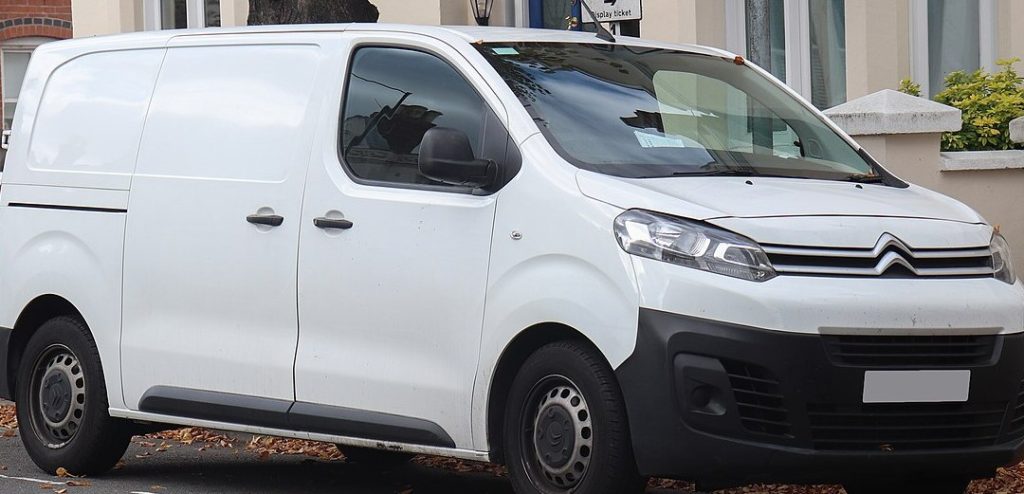
The Citroen Jumpy III XS 2.0 BlueHDi (122 hp) is a commercial vehicle produced by the French manufacturer Citroen from September 2016 onwards. It forms part of the third generation of the Jumpy, known as the Jumpy III, which is based on the PSA Group’s EMP2 platform shared with the Peugeot Expert and Opel/Vauxhall Vivaro. This particular variant, equipped with the 2.0 BlueHDi engine and a six-speed manual transmission, was positioned as a versatile workhorse, offering a balance between fuel efficiency, payload capacity, and reasonable running costs. The Jumpy III XS caters to businesses and tradespeople requiring a medium-sized van for deliveries, transport, and mobile workshops.
Technical Specifications
| Brand | Citroen |
| Model | Jumpy |
| Generation | Jumpy III XS |
| Type (Engine) | 2.0 BlueHDi (122 Hp) |
| Start of production | September, 2016 |
| Powertrain Architecture | Internal Combustion engine |
| Body type | Minivan |
| Seats | 2-3 |
| Doors | 4 |
| Fuel consumption (urban) | 5.9 l/100 km (39.9 US mpg, 47.9 UK mpg, 16.9 km/l) |
| Fuel consumption (extra urban) | 4.9 l/100 km (48 US mpg, 57.6 UK mpg, 20.4 km/l) |
| Fuel consumption (combined) | 5.3 l/100 km (44.4 US mpg, 53.3 UK mpg, 18.9 km/l) |
| CO2 emissions | 139 g/km |
| Fuel Type | Diesel |
| Maximum speed | 170 km/h (105.63 mph) |
| Emission standard | Euro 6 |
| Weight-to-power ratio | 13 kg/Hp, 76.7 Hp/tonne |
| Weight-to-torque ratio | 4.7 kg/Nm, 213.8 Nm/tonne |
| Power | 122 Hp @ 3750 rpm |
| Power per litre | 61.1 Hp/l |
| Torque | 340 Nm @ 1750 rpm (250.77 lb.-ft. @ 1750 rpm) |
| Engine layout | Front, Transverse |
| Engine Model/Code | AHK DW10FE |
| Engine displacement | 1997 cm3 (121.86 cu. in.) |
| Number of cylinders | 4 |
| Engine configuration | Inline |
| Number of valves per cylinder | 4 |
| Fuel injection system | Diesel Commonrail |
| Engine aspiration | Turbocharger, Intercooler |
| Engine oil capacity | 6 l (6.34 US qt | 5.28 UK qt) |
| Kerb Weight | 1590-1831 kg (3505.35 – 4036.66 lbs.) |
| Max. weight | 3100 kg (6834.33 lbs.) |
| Max load | 1269-1510 kg (2797.67 – 3328.98 lbs.) |
| Fuel tank capacity | 70 l (18.49 US gal | 15.4 UK gal) |
| Permitted trailer load with brakes (12%) | 2500 kg (5511.56 lbs.) |
| Permitted trailer load without brakes | 750 kg (1653.47 lbs.) |
| Permitted towbar download | 100 kg (220.46 lbs.) |
| Length | 4609 mm (181.46 in.) |
| Width | 1920 mm (75.59 in.) |
| Width including mirrors | 2204 mm (86.77 in.) |
| Height | 1877-1950 mm (73.9 – 76.77 in.) |
| Wheelbase | 2925 mm (115.16 in.) |
| Front track | 1630 mm (64.17 in.) |
| Front overhang | 881 mm (34.69 in.) |
| Rear overhang | 803 mm (31.61 in.) |
| Drivetrain Architecture | The Internal combustion engine (ICE) drives the front wheels of the vehicle. |
| Drive wheel | Front wheel drive |
| Number of gears and type of gearbox | 6 gears, manual transmission |
| Front suspension | Independent type McPherson |
| Front brakes | Ventilated discs |
| Rear brakes | Ventilated discs |
| Assisting systems | ABS (Anti-lock braking system) |
| Steering type | Steering rack and pinion |
| Tires size | 215/65 R16 |
Powertrain & Engine Architecture
The heart of the Jumpy III XS 2.0 BlueHDi is the DW10FE engine, a four-cylinder diesel engine displacing 1997cc. This engine is part of the PSA Group’s BlueHDi range, designed to meet stringent Euro 6 emissions standards. The engine utilizes a common rail direct injection system, delivering fuel at extremely high pressure for optimized combustion. A turbocharger with an intercooler further enhances performance and efficiency. The 122 hp output is achieved at 3750 rpm, while peak torque of 340 Nm (250.77 lb-ft) is available from just 1750 rpm, providing strong low-end pulling power. The six-speed manual transmission offers a good balance between fuel economy and driver control. The gear ratios are tuned for commercial use, prioritizing torque delivery over outright acceleration.
Driving Characteristics
The Jumpy III XS 2.0 BlueHDi, with its 122 hp and manual transmission, delivers a practical and functional driving experience. While not particularly sporty, it provides sufficient power for everyday use and typical commercial applications. The readily available torque makes it easy to navigate urban environments and handle loaded conditions. Compared to higher-output versions of the 2.0 BlueHDi, this variant offers a more economical driving experience, but at the expense of outright performance. The manual gearbox allows for precise control, but requires more driver involvement than an automatic transmission. The suspension is tuned for comfort and load-carrying capacity, resulting in a slightly softer ride compared to passenger car derivatives.
Equipment & Trim Levels
The Jumpy III XS 2.0 BlueHDi typically came equipped with a functional, rather than luxurious, interior. Standard features included a driver’s airbag, ABS brakes, a basic audio system, and power steering. The XS trim level generally offered a step up in terms of comfort and convenience compared to the base model, potentially including features like air conditioning, electric windows, and a more comprehensive dashboard display. Optional extras could include a navigation system, rear parking sensors, and various load securing options. Interior upholstery was typically durable and practical, designed to withstand the rigors of commercial use.
Chassis & Braking
The Jumpy III XS utilizes a front-wheel-drive layout, contributing to its relatively low weight and good fuel efficiency. The front suspension employs an independent McPherson strut design, providing a comfortable ride and predictable handling. The rear suspension typically features a twist beam setup, optimized for load-carrying capacity. Braking is provided by ventilated discs on all four wheels, offering adequate stopping power even when fully loaded. An Anti-lock Braking System (ABS) is standard, enhancing safety and stability during emergency braking maneuvers.
Market Reception & Comparison
The Citroen Jumpy III XS 2.0 BlueHDi (122 hp) was generally well-received by critics as a practical and efficient commercial vehicle. Its fuel economy was a key selling point, particularly for businesses concerned about operating costs. Compared to the more powerful 150 hp and 180 hp versions of the 2.0 BlueHDi, this variant offered a lower purchase price and reduced running costs, making it an attractive option for those who didn’t require maximum performance. However, some reviewers noted that the 122 hp engine could feel strained when carrying heavy loads or driving uphill. Compared to competitors like the Ford Transit Custom and Volkswagen Transporter, the Jumpy offered a competitive package in terms of price, fuel efficiency, and payload capacity.
Legacy
The 2.0 BlueHDi engine has proven to be a relatively reliable unit, although, like all diesel engines, it is susceptible to issues related to the diesel particulate filter (DPF) if not properly maintained. Regular servicing and the use of high-quality diesel fuel are essential for ensuring long-term reliability. In the used car market, the Jumpy III XS 2.0 BlueHDi (122 hp) represents a good value proposition for businesses and individuals seeking a practical and economical van. Its relatively simple mechanicals and readily available parts contribute to its affordability and ease of maintenance. The Jumpy III continues to be a popular choice in the commercial vehicle segment, known for its versatility and dependability.