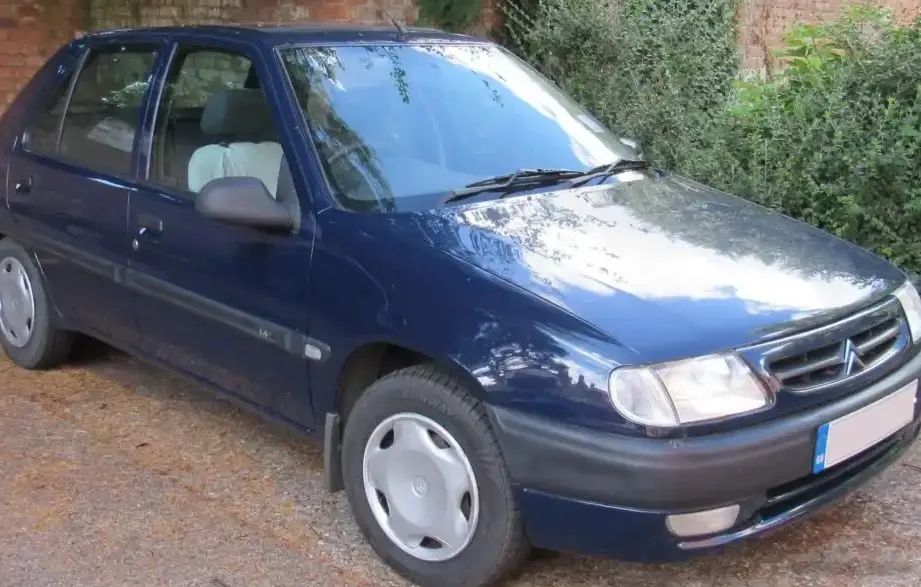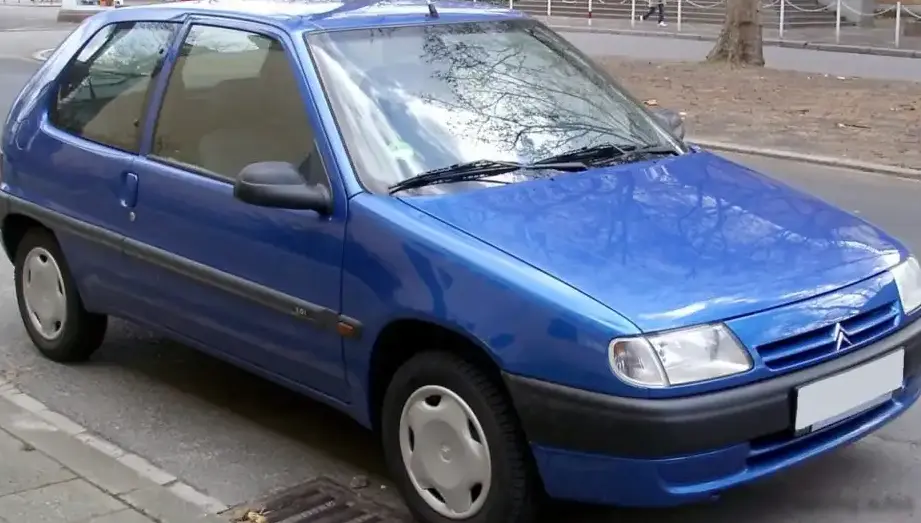
The Citroen Saxo 1.6i Automatic, produced between 1996 and 1999, represents a specific configuration within the first phase (Phase I) of the Saxo model range. Positioned as a comfortably equipped, albeit not overtly sporty, variant, it offered an alternative to the more common manual transmission options and the lower-powered engine choices. The Saxo itself was Citroen’s entry into the supermini segment, intended to replace the aging AX and compete with rivals like the Peugeot 206, Renault Clio, and Volkswagen Polo. This 3-door hatchback aimed for affordability and practicality, and the 1.6i Automatic trim catered to buyers prioritizing ease of driving over outright performance.
Technical Specifications
| Brand | Citroen |
| Model | Saxo |
| Generation | Saxo (Phase I, 1996) 3-door |
| Type (Engine) | 1.6i (90 Hp) Automatic |
| Start of production | 1996 |
| End of production | 1999 |
| Powertrain Architecture | Internal Combustion engine |
| Body type | Hatchback |
| Seats | 5 |
| Doors | 3 |
| Fuel consumption (urban) | 9.4 l/100 km (25 US mpg, 30.1 UK mpg, 10.6 km/l) |
| Fuel consumption (extra urban) | 5.9 l/100 km (39.9 US mpg, 47.9 UK mpg, 16.9 km/l) |
| Fuel consumption (combined) | 7.6 l/100 km (30.9 US mpg, 37.2 UK mpg, 13.2 km/l) |
| Fuel Type | Petrol (Gasoline) |
| Acceleration 0 – 100 km/h | 12.5 sec |
| Acceleration 0 – 62 mph | 12.5 sec |
| Acceleration 0 – 60 mph | 11.9 sec |
| Maximum speed | 176 km/h (109.36 mph) |
| Weight-to-power ratio | 10.1 kg/Hp, 99.4 Hp/tonne |
| Weight-to-torque ratio | 6.7 kg/Nm, 149.2 Nm/tonne |
| Power | 90 Hp @ 5600 rpm |
| Power per litre | 56.7 Hp/l |
| Torque | 135 Nm @ 3000 rpm (99.57 lb.-ft. @ 3000 rpm) |
| Engine layout | Front, Transverse |
| Engine Model/Code | TU5 JP |
| Engine displacement | 1587 cm3 (96.84 cu. in.) |
| Number of cylinders | 4 |
| Engine configuration | Inline |
| Cylinder Bore | 78.5 mm (3.09 in.) |
| Piston Stroke | 82 mm (3.23 in.) |
| Compression ratio | 9.6:1 |
| Number of valves per cylinder | 2 |
| Fuel injection system | Multi-port manifold injection |
| Engine aspiration | Naturally aspirated engine |
| Valvetrain | OHC |
| Engine oil capacity | 3.5 l (3.7 US qt | 3.08 UK qt) |
| Coolant | 5.8 l (6.13 US qt | 5.1 UK qt) |
| Kerb Weight | 905 kg (1995.18 lbs.) |
| Max. weight | 1380 kg (3042.38 lbs.) |
| Max load | 475 kg (1047.2 lbs.) |
| Trunk (boot) space – minimum | 280 l (9.89 cu. ft.) |
| Trunk (boot) space – maximum | 953 l (33.65 cu. ft.) |
| Fuel tank capacity | 45 l (11.89 US gal | 9.9 UK gal) |
| Max. roof load | 50 kg (110.23 lbs.) |
| Permitted trailer load with brakes (12%) | 700 kg (1543.24 lbs.) |
| Permitted trailer load without brakes | 465 kg (1025.15 lbs.) |
| Permitted towbar download | 50 kg (110.23 lbs.) |
| Length | 3718 mm (146.38 in.) |
| Width | 1595 mm (62.8 in.) |
| Height | 1390 mm (54.72 in.) |
| Wheelbase | 2385 mm (93.9 in.) |
| Front track | 1381 mm (54.37 in.) |
| Rear (Back) track | 1301 mm (51.22 in.) |
| Front overhang | 748 mm (29.45 in.) |
| Rear overhang | 585 mm (23.03 in.) |
| Minimum turning circle | 10.9 m (35.76 ft.) |
| Drivetrain Architecture | The Internal combustion engine (ICE) drives the front wheels of the vehicle. |
| Drive wheel | Front wheel drive |
| Number of gears and type of gearbox | 3 gears, automatic transmission |
| Front suspension | Independent type McPherson, Transverse stabilizer |
| Rear suspension | Trailing arm, Torsion |
| Front brakes | Disc |
| Rear brakes | Drum |
| Assisting systems | ABS (Anti-lock braking system) |
| Steering type | Steering rack and pinion |
| Power steering | Hydraulic Steering |
| Tires size | 165/65 R14 |
| Wheel rims size | 5.5J x 14 |
Powertrain & Engine Architecture
The heart of the Saxo 1.6i Automatic is the TU5 JP engine, a 1.6-liter inline-four cylinder petrol engine. This engine, part of Citroen/Peugeot’s XU series, is known for its relative simplicity and durability. The TU5 JP features a single overhead camshaft (OHC) operating two valves per cylinder. Fuel delivery is managed by a multi-port fuel injection system, providing adequate, though not cutting-edge, performance. The engine produces 90 horsepower at 5600 rpm and 135 Nm (99.57 lb-ft) of torque at 3000 rpm. Paired with this engine is a 3-speed automatic transmission. This transmission, while offering convenience, is a relatively basic unit and contributes to the car’s somewhat leisurely acceleration. It’s important to note that this 3-speed automatic was not known for its sophistication or fuel efficiency compared to more modern automatic gearboxes.
Driving Characteristics
The Saxo 1.6i Automatic delivers a comfortable, if uninspiring, driving experience. The automatic transmission smooths out gear changes, making it ideal for urban driving. However, the limited number of gears and the engine’s modest output mean that acceleration is noticeably slower than the manual versions or the higher-powered Saxo variants. Overtaking maneuvers require planning, and the engine can feel strained when climbing hills. The gear ratios are optimized for fuel economy rather than performance. Compared to the 1.4-liter models, the 1.6i offers a more relaxed cruising experience, but it lacks the responsiveness of the sportier VTS models. The steering is light and easy, contributing to the car’s maneuverability in tight spaces.
Equipment & Trim Levels
The 1.6i Automatic trim generally included features such as central locking, power steering, and an AM/FM radio. Interior upholstery was typically cloth, with a relatively basic dashboard layout. Optional extras could include electric windows, a sunroof, and upgraded audio systems. The level of equipment was generally considered adequate for the price point, but it didn’t compete with more premium superminis. The focus was on providing a functional and affordable package.
Chassis & Braking
The Saxo utilizes a McPherson strut front suspension and a trailing arm rear suspension. This setup provides a reasonable balance between ride comfort and handling. The front brakes are discs, while the rear brakes are drums – a cost-saving measure common in this class of vehicle. ABS (Anti-lock Braking System) was often included as standard equipment, enhancing safety. The suspension is tuned for comfort, resulting in a slightly softer ride compared to the sportier VTS models. Stabilizer bars were fitted to improve body roll during cornering.
Market Reception & Comparison
The Saxo 1.6i Automatic was generally well-received as a practical and affordable supermini. Critics acknowledged its comfortable ride and ease of driving, but noted its lack of performance compared to manual versions and rivals. Fuel economy was considered reasonable for the time, but not exceptional. Compared to the 1.4-liter Saxo, the 1.6i offered a noticeable improvement in power and refinement. However, the automatic transmission reduced fuel economy and added to the car’s overall cost. The Saxo faced stiff competition from the Peugeot 206, Renault Clio, and Volkswagen Polo, all of which offered similar levels of practicality and affordability.
Legacy
The TU5 JP engine, when properly maintained, is known for its reliability. The automatic transmission, however, can be a potential weak point, and regular fluid changes are crucial to prevent premature failure. Today, the Saxo 1.6i Automatic is a relatively affordable used car, appealing to buyers looking for a simple and economical runabout. Parts availability is generally good, and the car’s straightforward mechanical design makes it relatively easy to repair. While not a collector’s item, it represents a practical and dependable example of 1990s supermini design. Its enduring appeal lies in its affordability, ease of use, and the relatively robust nature of its core components.