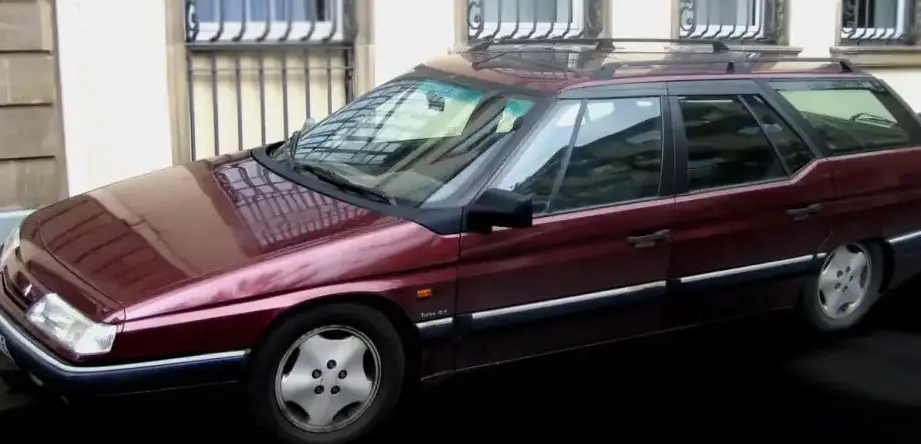
The Citroen XM Break (Y4) 2.0i 16V, produced between 1994 and 1999, represents a compelling blend of French engineering and practical estate car design. Positioned as a mid-range offering within the XM Break lineup, it slotted between the lower-powered 1.8i and the flagship 3.0 V6 models. The XM, in general, was Citroen’s attempt to replace the aging CX, offering a more modern and aerodynamic design while retaining the company’s commitment to innovative suspension technology. The ‘Break’ designation signified the estate (station wagon) body style, offering increased cargo capacity and versatility. This particular 2.0i 16V variant aimed to provide a balance of performance and fuel economy for family buyers and those needing a spacious, comfortable long-distance cruiser.
Technical Specifications
| Brand | Citroen |
| Model | XM |
| Generation | XM Break (Y4) |
| Type (Engine) | 2.0 i 16V (132 Hp) |
| Start of production | 1994 |
| End of production | 1999 |
| Powertrain Architecture | Internal Combustion engine |
| Body type | Station wagon (estate) |
| Seats | 5 |
| Doors | 5 |
| Fuel consumption (urban) | 11.6 l/100 km (20.3 US mpg) |
| Fuel consumption (extra urban) | 6.6 l/100 km (35.6 US mpg) |
| Fuel Type | Petrol (Gasoline) |
| Acceleration 0 – 100 km/h | 11.8 sec |
| Acceleration 0 – 62 mph | 11.8 sec |
| Acceleration 0 – 60 mph | 11.2 sec |
| Maximum speed | 198 km/h (123.03 mph) |
| Weight-to-power ratio | 11.1 kg/Hp |
| Weight-to-torque ratio | 8.2 kg/Nm |
| Power | 132 Hp @ 5500 rpm |
| Power per litre | 66.1 Hp/l |
| Torque | 180 Nm @ 4200 rpm (132.76 lb.-ft. @ 4200 rpm) |
| Engine layout | Front, Transverse |
| Engine Model/Code | RFV XU10J4R |
| Engine displacement | 1998 cm3 (121.93 cu. in.) |
| Number of cylinders | 4 |
| Engine configuration | Inline |
| Cylinder Bore | 86 mm (3.39 in.) |
| Piston Stroke | 86 mm (3.39 in.) |
| Compression ratio | 10.4:1 |
| Number of valves per cylinder | 4 |
| Fuel injection system | Multi-port manifold injection |
| Engine aspiration | Naturally aspirated engine |
| Valvetrain | DOHC |
| Engine oil capacity | 5.4 l (5.71 US qt | 4.75 UK qt) |
| Coolant capacity | 7.5 l (7.93 US qt | 6.6 UK qt) |
| Kerb Weight | 1467 kg (3234.18 lbs.) |
| Max. weight | 2070 kg (4563.57 lbs.) |
| Max load | 603 kg (1329.39 lbs.) |
| Trunk (boot) space – minimum | 750 l (26.49 cu. ft.) |
| Trunk (boot) space – maximum | 1960 l (69.22 cu. ft.) |
| Fuel tank capacity | 80 l (21.13 US gal | 17.6 UK gal) |
| Length | 4963 mm (195.39 in.) |
| Width | 1794 mm (70.63 in.) |
| Height | 1456 mm (57.32 in.) |
| Wheelbase | 2850 mm (112.2 in.) |
| Front track | 1520 mm (59.84 in.) |
| Rear track | 1447 mm (56.97 in.) |
| Front overhang | 1068 mm (42.05 in.) |
| Rear overhang | 1045 mm (41.14 in.) |
| Ride height (ground clearance) | 141 mm (5.55 in.) |
| Drivetrain Architecture | Front wheel drive |
| Number of gears | 5 |
| Gearbox type | Manual transmission |
| Front suspension | Independent type McPherson, Wishbone |
| Rear suspension | Hydro-pneumatic element, Trailing arm |
| Front brakes | Ventilated discs |
| Rear brakes | Disc |
| Assisting systems | ABS (Anti-lock braking system) |
| Steering type | Steering rack and pinion |
| Power steering | Hydraulic Steering |
| Tires size | 195/65 R15 |
Powertrain & Engine Architecture
The heart of the XM Break 2.0i 16V is the RFV XU10J4R engine, a 1998cc inline-four cylinder powerplant. This engine is part of the PSA Group’s XU series, known for its robustness and relatively simple design. The ‘16V’ designation indicates a dual overhead camshaft (DOHC) valvetrain with four valves per cylinder, enhancing breathing and contributing to the engine’s 132 horsepower output at 5500 rpm and 180 Nm (132.76 lb-ft) of torque at 4200 rpm. Fuel delivery is managed by a multi-port fuel injection system, providing precise fuel metering for improved efficiency and performance. The engine’s design prioritizes drivability over outright speed, making it well-suited for everyday use. The engine is transversely mounted, driving the front wheels. The five-speed manual transmission, while not particularly sporty, offers a reasonable spread of gears for both urban and highway driving.
Driving Characteristics
The 2.0i 16V XM Break offers a comfortable and refined driving experience. Acceleration is adequate, taking around 11.8 seconds to reach 62 mph, but it’s not a particularly quick car. The engine feels most at home in the mid-range, providing sufficient power for overtaking maneuvers. Compared to the more powerful 3.0 V6, the 2.0i feels noticeably less responsive, but it offers better fuel economy. The five-speed manual transmission is smooth and easy to use, although the gear ratios are geared towards economy rather than performance. The XM’s signature hydro-pneumatic suspension provides an exceptionally smooth ride, absorbing bumps and imperfections in the road with ease. This suspension system also allows for self-leveling, maintaining a consistent ride height regardless of load. Steering is light and precise, making the XM easy to maneuver in tight spaces.
Equipment & Trim Levels
The 2.0i 16V XM Break typically came equipped with a reasonable level of standard features. These included central locking, electric front windows, power steering, and an ABS anti-lock braking system. Interior upholstery was typically cloth, with a functional and durable design. Optional extras included leather upholstery, a sunroof, climate control, and a premium sound system. The dashboard layout is typical of early 1990s Citroens, with a focus on ergonomics and ease of use. The instrument cluster is comprehensive, providing information on speed, engine temperature, fuel level, and other vital parameters.
Chassis & Braking
The XM Break utilizes an independent McPherson strut front suspension and a hydro-pneumatic trailing arm rear suspension. This combination provides a unique and highly effective ride quality. The hydro-pneumatic system allows for adjustable ride height and damping, further enhancing comfort and handling. Braking duties are handled by ventilated discs at the front and solid discs at the rear. The ABS system helps to prevent wheel lockup during hard braking, improving stability and control. The XM’s chassis is relatively lightweight, contributing to its nimble handling characteristics.
Market Reception & Comparison
The Citroen XM Break 2.0i 16V was generally well-received by critics, who praised its comfortable ride, spacious interior, and innovative suspension system. However, some criticized its relatively modest performance and somewhat dated interior design. Compared to other estate cars of the time, such as the Ford Mondeo Estate or the Volvo 850 Estate, the XM offered a more unique and sophisticated driving experience, but it lacked the outright practicality and performance of some of its rivals. Fuel economy was respectable for its class, averaging around 35.6 US mpg on the extra-urban cycle.
Legacy
The XU10J4R engine, found in the XM Break 2.0i 16V, is known for its reliability and durability, provided it is properly maintained. The hydro-pneumatic suspension system, while innovative, can be prone to leaks and requires specialized maintenance. Today, the XM Break 2.0i 16V is a relatively rare sight on the roads, but it has gained a following among enthusiasts who appreciate its unique character and engineering. Parts availability can be a challenge, but a dedicated network of Citroen specialists and online retailers can help owners keep their XMs running. The XM Break represents a high point in Citroen’s history, showcasing the company’s commitment to innovation and comfort.