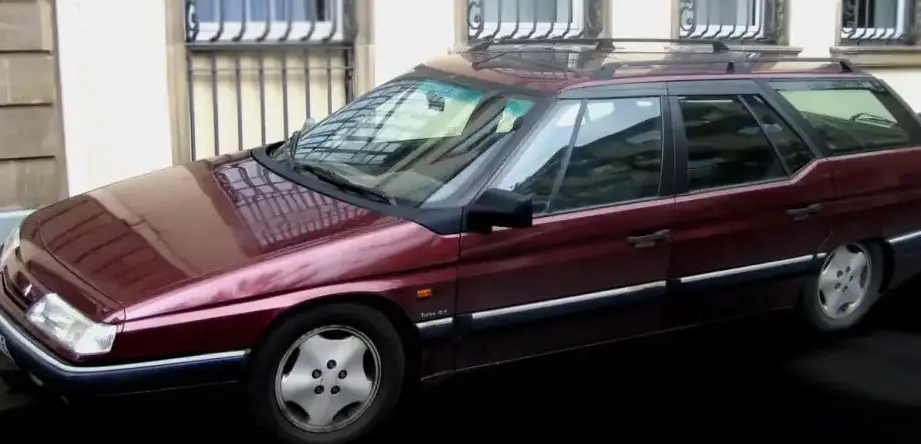
The Citroën XM Break 3.0 V6, produced between 1997 and 1999, represents the pinnacle of the second-generation XM (Y4) series. Positioned as the flagship estate variant, it combined the spaciousness of a station wagon with a potent V6 engine. The XM, in general, was Citroën’s attempt to replace the aging CX, offering a blend of luxury, advanced technology – particularly its signature hydropneumatic suspension – and distinctive styling. The Break (estate) body style was crucial to the XM’s success, offering practicality alongside its avant-garde design. This 3.0 V6 model was aimed at buyers seeking a refined, high-performance touring car with ample space for passengers and cargo.
Technical Specifications
| Brand | Citroen |
| Model | XM |
| Generation | XM Break (Y4) |
| Type (Engine) | 3.0 V6 (190 Hp) |
| Start of production | 1997 |
| End of production | 1999 |
| Powertrain Architecture | Internal Combustion engine |
| Body type | Station wagon (estate) |
| Seats | 5 |
| Doors | 5 |
| Fuel consumption (urban) | 15.9 l/100 km (14.8 US mpg, 17.8 UK mpg, 6.3 km/l) |
| Fuel consumption (extra urban) | 8 l/100 km (29.4 US mpg, 35.3 UK mpg, 12.5 km/l) |
| Fuel consumption (combined) | 10.9 l/100 km (21.6 US mpg, 25.9 UK mpg, 9.2 km/l) |
| CO2 emissions | 260 g/km |
| Fuel Type | Petrol (Gasoline) |
| Acceleration 0 – 100 km/h | 8.9 sec |
| Acceleration 0 – 62 mph | 8.9 sec |
| Acceleration 0 – 60 mph | 8.5 sec |
| Maximum speed | 228 km/h (141.67 mph) |
| Weight-to-power ratio | 8.9 kg/Hp, 112.4 Hp/tonne |
| Weight-to-torque ratio | 6.3 kg/Nm, 158 Nm/tonne |
| Power | 190 Hp @ 5500 rpm |
| Power per litre | 64.5 Hp/l |
| Torque | 267 Nm @ 4000 rpm (196.93 lb.-ft. @ 4000 rpm) |
| Engine layout | Front, Transverse |
| Engine Model/Code | XZF ES9J4-L3 |
| Engine displacement | 2946 cm3 (179.78 cu. in.) |
| Number of cylinders | 6 |
| Engine configuration | V-engine |
| Cylinder Bore | 87 mm (3.43 in.) |
| Piston Stroke | 82.6 mm (3.25 in.) |
| Compression ratio | 10.5:1 |
| Number of valves per cylinder | 4 |
| Fuel injection system | Multi-port manifold injection |
| Engine aspiration | Naturally aspirated engine |
| Valvetrain | DOHC |
| Engine oil capacity | 7 l (7.4 US qt | 6.16 UK qt) |
| Coolant | 10 l (10.57 US qt | 8.8 UK qt) |
| Kerb Weight | 1690 kg (3725.81 lbs.) |
| Max. weight | 2220 kg (4894.26 lbs.) |
| Max load | 530 kg (1168.45 lbs.) |
| Trunk (boot) space – minimum | 750 l (26.49 cu. ft.) |
| Trunk (boot) space – maximum | 1960 l (69.22 cu. ft.) |
| Fuel tank capacity | 80 l (21.13 US gal | 17.6 UK gal) |
| Max. roof load | 100 kg (220.46 lbs.) |
| Permitted trailer load with brakes (12%) | 1500 kg (3306.93 lbs.) |
| Permitted trailer load without brakes | 750 kg (1653.47 lbs.) |
| Permitted towbar download | 80 kg (176.37 lbs.) |
| Length | 4963 mm (195.39 in.) |
| Width | 1794 mm (70.63 in.) |
| Height | 1457 mm (57.36 in.) |
| Wheelbase | 2850 mm (112.2 in.) |
| Front track | 1520 mm (59.84 in.) |
| Rear track | 1447 mm (56.97 in.) |
| Front overhang | 1068 mm (42.05 in.) |
| Rear overhang | 1045 mm (41.14 in.) |
| Ride height (ground clearance) | 141 mm (5.55 in.) |
| Drivetrain Architecture | The Internal combustion engine (ICE) drives the front wheels of the vehicle. |
| Drive wheel | Front wheel drive |
| Number of gears and type of gearbox | 5 gears, manual transmission |
| Front suspension | Independent type McPherson, Wishbone |
| Rear suspension | Hydro-pneumatic element, Trailing arm |
| Front brakes | Ventilated discs |
| Rear brakes | Disc |
| Assisting systems | ABS (Anti-lock braking system) |
| Steering type | Steering rack and pinion |
| Power steering | Hydraulic Steering |
| Tires size | 205/65 R15 |
Powertrain & Engine Architecture
The heart of the XM Break 3.0 V6 is the XFZ ES9J4-L3 engine, a 2.9-liter, naturally aspirated V6. This engine, derived from the Peugeot-Renault-Volvo (PRV) V6 family, was known for its smooth operation and respectable power output. It featured a 60-degree V-angle, four valves per cylinder, and a multi-port fuel injection system. The engine produced 190 horsepower at 5500 rpm and 267 Nm (197 lb-ft) of torque at 4000 rpm. The engine’s transverse mounting in the front of the vehicle contributed to its balanced handling. The five-speed manual transmission was the standard offering, providing a direct connection between the engine and the front wheels. The gear ratios were tuned for a balance of acceleration and cruising efficiency.
Driving Characteristics
The XM Break 3.0 V6 offered a unique driving experience, largely due to Citroën’s renowned hydropneumatic suspension. This system provided an exceptionally comfortable ride, absorbing bumps and imperfections in the road with ease. The V6 engine delivered smooth and linear power, making it well-suited for long-distance cruising. While not a sports car, the XM Break 3.0 V6 could accelerate from 0 to 60 mph in around 8.5 seconds and reach a top speed of 141.67 mph. Compared to the lower-powered 1.8-liter and 2.0-liter versions, the V6 offered significantly more performance, but at the cost of increased fuel consumption. The manual transmission allowed for greater driver control, while the suspension minimized body roll during cornering.
Equipment & Trim Levels
The XM Break 3.0 V6 typically came well-equipped, reflecting its position as the range-topping model. Standard features included power windows, central locking, air conditioning, and an upgraded audio system. Interior upholstery was typically a high-quality cloth or leather. Optional extras included a sunroof, upgraded sound system, and metallic paint. The dashboard layout was functional and ergonomically designed, with easy-to-read gauges and intuitive controls. The spacious interior offered ample headroom and legroom for all passengers.
Chassis & Braking
The XM Break featured an independent McPherson strut front suspension and a hydro-pneumatic trailing arm rear suspension. This combination provided a comfortable ride and good handling characteristics. The braking system consisted of ventilated discs at the front and solid discs at the rear, with ABS (Anti-lock Braking System) as standard. The steering was rack and pinion with hydraulic power assistance, providing precise and responsive steering feel. The tires were typically 205/65 R15, offering a good balance of grip and ride comfort.
Market Reception & Comparison
The Citroën XM Break 3.0 V6 was generally well-received by critics, who praised its comfortable ride, spacious interior, and refined engine. However, it was also criticized for its relatively high price and complex hydropneumatic suspension, which could be expensive to maintain. Compared to other estate cars of the time, such as the Volvo 850 and the Ford Mondeo Estate, the XM offered a more distinctive and luxurious experience. Fuel economy was a weak point, with combined fuel consumption of around 21.6 US mpg. The V6 model was significantly more expensive than the 1.8L and 2.0L variants, appealing to a smaller, more discerning customer base.
Legacy
The Citroën XM Break 3.0 V6 remains a sought-after classic car, particularly among enthusiasts who appreciate its unique blend of comfort, performance, and style. The hydropneumatic suspension, while complex, is a key part of the XM’s appeal, providing a ride quality that is rarely matched by modern cars. The V6 engine is generally reliable, but regular maintenance is essential. Today, well-maintained examples of the XM Break 3.0 V6 are becoming increasingly rare and valuable, representing a unique chapter in Citroën’s history.