
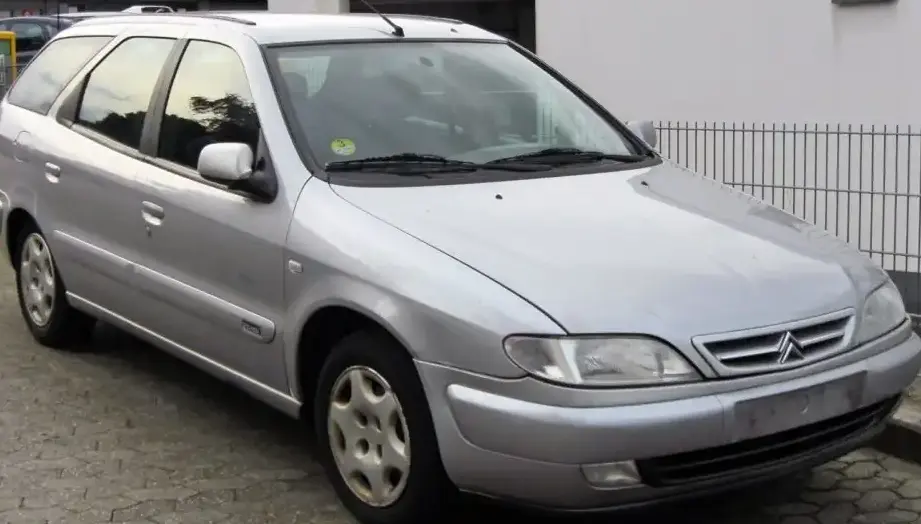
The Citroën Xsara Break 1.8i Automatic, produced between 1997 and 2000, represents a practical and comfortable offering within the first generation (N2) of the Xsara Break estate car range. Positioned as a mid-range variant, it aimed to provide a balance between affordability, reasonable performance, and the convenience of an automatic transmission. This model was primarily marketed in Europe, where station wagons held a significant share of the family car market. The Xsara Break, in general, was Citroën’s replacement for the BX estate, offering a more modern and refined package. The 1.8i Automatic specifically targeted buyers seeking a spacious, versatile vehicle for family use or carrying larger loads, without the need for a manual gearbox.
Technical Specifications
| Brand | Citroen |
| Model | Xsara |
| Generation | Xsara Break (N2, Phase I) |
| Type (Engine) | 1.8 i (101 Hp) Automatic |
| Start of production | 1997 |
| End of production | 2000 |
| Powertrain Architecture | Internal Combustion engine |
| Body type | Station wagon (estate) |
| Seats | 5 |
| Doors | 5 |
| Fuel consumption (urban) | 12.9 l/100 km (18.2 US mpg, 21.9 UK mpg, 7.8 km/l) |
| Fuel consumption (extra urban) | 6.9 l/100 km (34.1 US mpg, 40.9 UK mpg, 14.5 km/l) |
| Fuel consumption (combined) | 9.1 l/100 km (25.8 US mpg, 31 UK mpg, 11 km/l) |
| Fuel Type | Petrol (Gasoline) |
| Acceleration 0 – 100 km/h | 15.8 sec |
| Acceleration 0 – 62 mph | 15.8 sec |
| Acceleration 0 – 60 mph | 15 sec |
| Maximum speed | 177 km/h (109.98 mph) |
| Weight-to-power ratio | 11.3 kg/Hp, 88.2 Hp/tonne |
| Weight-to-torque ratio | 7.5 kg/Nm, 133.6 Nm/tonne |
| Power | 101 Hp @ 6000 rpm |
| Power per litre | 57.3 Hp/l |
| Torque | 153 Nm @ 3000 rpm (112.85 lb.-ft. @ 3000 rpm) |
| Engine layout | Front, Transverse |
| Engine Model/Code | LFZ XU7JP |
| Engine displacement | 1762 cm3 (107.52 cu. in.) |
| Number of cylinders | 4 |
| Engine configuration | Inline |
| Cylinder Bore | 83 mm (3.27 in.) |
| Piston Stroke | 81.4 mm (3.2 in.) |
| Compression ratio | 9.3:1 |
| Number of valves per cylinder | 2 |
| Fuel injection system | Multi-port manifold injection |
| Engine aspiration | Naturally aspirated engine |
| Valvetrain | OHC |
| Engine oil capacity | 4.3 l (4.54 US qt | 3.78 UK qt) |
| Coolant | 7 l (7.4 US qt | 6.16 UK qt) |
| Kerb Weight | 1145 kg (2524.29 lbs.) |
| Max. weight | 1630 kg (3593.53 lbs.) |
| Max load | 485 kg (1069.24 lbs.) |
| Trunk (boot) space – minimum | 517 l (18.26 cu. ft.) |
| Trunk (boot) space – maximum | 1512 l (53.4 cu. ft.) |
| Fuel tank capacity | 54 l (14.27 US gal | 11.88 UK gal) |
| Max. roof load | 100 kg (220.46 lbs.) |
| Permitted trailer load with brakes (12%) | 1100 kg (2425.08 lbs.) |
| Permitted trailer load without brakes | 610 kg (1344.82 lbs.) |
| Length | 4354 mm (171.42 in.) |
| Width | 1698 mm (66.85 in.) |
| Width including mirrors | 1994 mm (78.5 in.) |
| Height | 1426 mm (56.14 in.) |
| Wheelbase | 2540 mm (100 in.) |
| Front track | 1423 mm (56.02 in.) |
| Rear (Back) track | 1430 mm (56.3 in.) |
| Front overhang | 868 mm (34.17 in.) |
| Rear overhang | 946 mm (37.24 in.) |
| Minimum turning circle | 11.5 m (37.73 ft.) |
| Drivetrain Architecture | Front wheel drive |
| Number of gears and type of gearbox | 4 gears, automatic transmission |
| Front suspension | Independent, type McPherson with coil spring and anti-roll bar |
| Rear suspension | Torsion |
| Front brakes | Ventilated discs |
| Rear brakes | Drum |
| Assisting systems | ABS (Anti-lock braking system) |
| Steering type | Steering rack and pinion |
| Power steering | Hydraulic Steering |
| Tires size | 185/65 R14 |
Powertrain & Engine Architecture
The heart of the Xsara Break 1.8i Automatic is the XU7JP engine, a 1762cc inline-four cylinder petrol engine. This engine, often referred to by its engine code LFZ, was a mainstay of the PSA Group (Peugeot-Citroën) for many years. It features a single overhead camshaft (OHC) design with two valves per cylinder. Fuel delivery is managed by a multi-port fuel injection system, providing a balance between efficiency and performance. The XU7JP engine is known for its relative simplicity and durability, although it isn’t particularly powerful. The automatic transmission paired with this engine is a four-speed unit, designed for smooth and comfortable operation rather than outright performance. This transmission was a conventional hydraulic automatic, lacking the modern electronic controls found in later designs.
Driving Characteristics
The 101 horsepower and 153 Nm (113 lb-ft) of torque produced by the 1.8i engine, coupled with the four-speed automatic transmission, resulted in a driving experience focused on comfort and ease of use. Acceleration from 0-60 mph took around 15 seconds, and top speed was approximately 109 mph. The automatic transmission’s gear ratios were geared towards fuel economy and relaxed cruising, rather than spirited driving. Compared to the manual transmission version of the same engine, the automatic offered less direct control and slightly reduced fuel efficiency. It also felt noticeably slower than higher-performance Xsara variants, such as those equipped with the 2.0L 16V engine. However, it provided a more accessible and less demanding driving experience for those unfamiliar or uninterested in manual gearboxes.
Equipment & Trim Levels
The 1.8i Automatic trim level typically included features such as power steering, central locking, electric front windows, and an adjustable steering column. Interior upholstery was generally cloth, with a practical and durable finish. Optional extras available for this trim included air conditioning, alloy wheels, and a radio/cassette player. The dashboard layout was functional and straightforward, prioritizing usability over aesthetic flair. Safety features included ABS (Anti-lock Braking System) as standard, a significant improvement over earlier Citroën models.
Chassis & Braking
The Xsara Break featured an independent McPherson strut front suspension with a coil spring and anti-roll bar, providing a comfortable ride and reasonable handling. The rear suspension utilized a torsion beam setup, which was cost-effective and space-efficient. Braking was handled by ventilated discs at the front and drum brakes at the rear. While adequate for everyday driving, the braking system wasn’t particularly powerful, especially when the vehicle was fully loaded. The steering was rack and pinion, providing precise and responsive control.
Market Reception & Comparison
The Citroën Xsara Break 1.8i Automatic was generally well-received as a practical and affordable family car. Critics praised its spacious interior, comfortable ride, and the convenience of the automatic transmission. However, some reviewers noted its lack of outright performance and the somewhat dated design of the interior. Compared to other trims in the Xsara lineup, the 1.8i Automatic offered a good balance between price and features. It was more affordable than the higher-powered variants but offered more convenience than the base-model 1.6i. Fuel economy was reasonable for its class, although not class-leading.
Legacy
The XU7JP engine, found in the Xsara Break 1.8i Automatic, is known for its reliability and longevity when properly maintained. While not without its potential issues (such as occasional oil leaks), it’s generally considered a robust and durable engine. The four-speed automatic transmission is also relatively reliable, although it can be prone to wear and tear with high mileage. Today, the Xsara Break 1.8i Automatic represents an affordable and practical classic car option. It’s often sought after by those looking for a spacious and comfortable estate car with a simple and reliable powertrain. Parts availability is generally good, and maintenance costs are relatively low, making it a viable option for those seeking a budget-friendly vehicle.
