
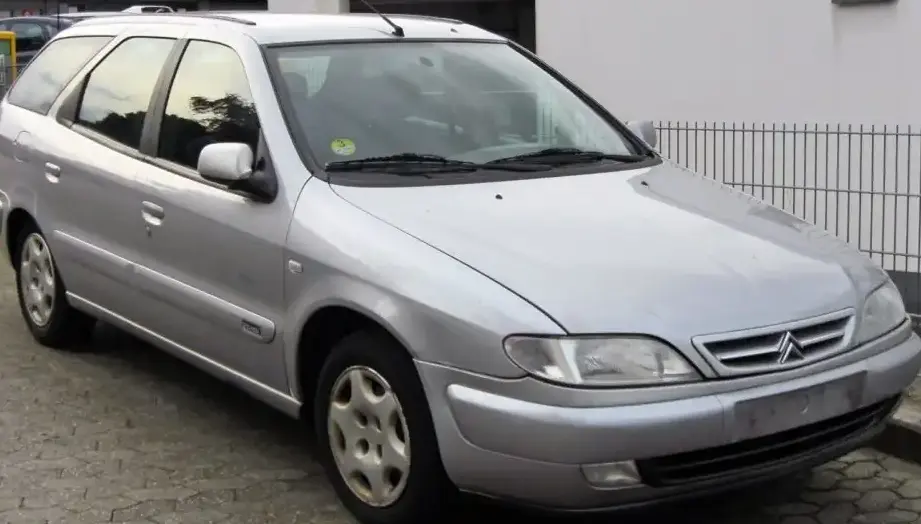
The Citroën Xsara Break 1.8 i (90 hp) represents a practical and affordable offering within the first generation (N2) of the Xsara Break, produced between 1997 and 2000. Positioned as a mid-range trim level, this variant aimed to provide a balance between fuel efficiency, reasonable performance, and the spaciousness expected of a European-market station wagon. It was a key component of Citroën’s strategy to compete in the increasingly popular compact family car segment, offering a versatile alternative to hatchbacks and sedans. The N2 Xsara Break, built on the PSA Group’s 1HX0 platform (shared with the Peugeot 306), was designed to offer a comfortable ride and a generous cargo capacity, making it a popular choice for families and those requiring a practical vehicle.
Technical Specifications
| Brand | Citroen |
| Model | Xsara |
| Generation | Xsara Break (N2, Phase I) |
| Type (Engine) | 1.8 i (90 Hp) |
| Start of production | 1997 |
| End of production | 2000 |
| Powertrain Architecture | Internal Combustion engine |
| Body type | Station wagon (estate) |
| Seats | 5 |
| Doors | 5 |
| Fuel consumption (urban) | 11.1 l/100 km (21.2 US mpg, 25.4 UK mpg, 9 km/l) |
| Fuel consumption (extra urban) | 6.3 l/100 km (37.3 US mpg, 44.8 UK mpg, 15.9 km/l) |
| Fuel consumption (combined) | 8 l/100 km (29.4 US mpg, 35.3 UK mpg, 12.5 km/l) |
| CO2 emissions | 192 g/km |
| Fuel Type | Petrol (Gasoline) |
| Acceleration 0 – 100 km/h | 13.5 sec |
| Acceleration 0 – 62 mph | 13.5 sec |
| Acceleration 0 – 60 mph | 12.8 sec |
| Maximum speed | 182 km/h (113.09 mph) |
| Weight-to-power ratio | 12.4 kg/Hp, 80.5 Hp/tonne |
| Weight-to-torque ratio | 7.6 kg/Nm, 131.5 Nm/tonne |
| Power | 90 Hp @ 5000 rpm |
| Power per litre | 51.1 Hp/l |
| Torque | 147 Nm @ 2600 rpm (108.42 lb.-ft. @ 2600 rpm) |
| Engine layout | Front, Transverse |
| Engine Model/Code | LFX XU7JB |
| Engine displacement | 1761 cm3 (107.46 cu. in.) |
| Number of cylinders | 4 |
| Engine configuration | Inline |
| Cylinder Bore | 83 mm (3.27 in.) |
| Piston Stroke | 81.4 mm (3.2 in.) |
| Compression ratio | 9.5:1 |
| Number of valves per cylinder | 2 |
| Fuel injection system | Multi-port manifold injection |
| Engine aspiration | Naturally aspirated engine |
| Valvetrain | OHC |
| Engine oil capacity | 4.75 l (5.02 US qt | 4.18 UK qt) |
| Coolant | 7 l (7.4 US qt | 6.16 UK qt) |
| Kerb Weight | 1118 kg (2464.77 lbs.) |
| Max. weight | 1630 kg (3593.53 lbs.) |
| Max load | 512 kg (1128.77 lbs.) |
| Trunk (boot) space – minimum | 517 l (18.26 cu. ft.) |
| Trunk (boot) space – maximum | 1512 l (53.4 cu. ft.) |
| Fuel tank capacity | 54 l (14.27 US gal | 11.88 UK gal) |
| Max. roof load | 100 kg (220.46 lbs.) |
| Permitted trailer load with brakes (12%) | 1100 kg (2425.08 lbs.) |
| Permitted trailer load without brakes | 595 kg (1311.75 lbs.) |
| Permitted towbar download | 70 kg (154.32 lbs.) |
| Length | 4354 mm (171.42 in.) |
| Width | 1698 mm (66.85 in.) |
| Width including mirrors | 1994 mm (78.5 in.) |
| Height | 1426 mm (56.14 in.) |
| Wheelbase | 2540 mm (100 in.) |
| Front track | 1423 mm (56.02 in.) |
| Rear (Back) track | 1430 mm (56.3 in.) |
| Front overhang | 868 mm (34.17 in.) |
| Rear overhang | 946 mm (37.24 in.) |
| Minimum turning circle | 11.5 m (37.73 ft.) |
| Drivetrain Architecture | The Internal combustion engine (ICE) drives the front wheels of the vehicle. |
| Drive wheel | Front wheel drive |
| Number of gears and type of gearbox | 5 gears, manual transmission |
| Front suspension | Independent, type McPherson with coil spring and anti-roll bar |
| Rear suspension | Torsion |
| Front brakes | Ventilated discs |
| Rear brakes | Drum |
| Assisting systems | ABS (Anti-lock braking system) |
| Steering type | Steering rack and pinion |
| Power steering | Hydraulic Steering |
| Tires size | 185/65 R14 |
Powertrain & Engine Architecture
The heart of the Xsara Break 1.8 i is the XU7JB engine, a 1761cc inline-four cylinder petrol engine. This engine, part of the XU series developed by Peugeot-Citroën, is known for its relative simplicity and durability. The LFX engine code specifically denotes a version tuned to 90 horsepower at 5000 rpm and 147 Nm (108 lb-ft) of torque at 2600 rpm. It utilizes a multi-port fuel injection system, delivering fuel to each cylinder individually for improved efficiency and responsiveness. The engine features a single overhead camshaft (OHC) valvetrain, operating two valves per cylinder. The XU7JB is a naturally aspirated engine, meaning it doesn’t employ a turbocharger or supercharger. The transmission paired with this engine is a 5-speed manual gearbox, although a 4-speed automatic transmission was also available, impacting performance and fuel economy. The automatic version was less common and generally targeted buyers prioritizing convenience over driving engagement.
Driving Characteristics
The 1.8L 90 hp Xsara Break offered a comfortable, if not particularly exhilarating, driving experience. Acceleration from 0 to 60 mph took around 12.8 seconds, and top speed was approximately 113 mph. The engine provided adequate power for everyday driving, but felt strained when fully loaded or tackling steep inclines. The 5-speed manual transmission allowed drivers to keep the engine in its optimal power band, while the optional automatic transmission, though convenient, resulted in noticeable performance loss due to its less efficient gear ratios. The suspension, featuring McPherson struts at the front and a torsion beam at the rear, prioritized ride comfort over sporty handling. Steering was light and precise, making it easy to maneuver in urban environments.
Equipment & Trim Levels
The 1.8 i trim level typically included features such as power steering, central locking, electric front windows, and an adjustable steering column. Interior upholstery was generally cloth, with a functional and durable design. Optional extras included air conditioning, alloy wheels, a sunroof, and upgraded audio systems. The dashboard layout was typical of Citroëns of the era, with a focus on ergonomics and ease of use. Safety features included ABS anti-lock brakes, which were standard equipment.
Chassis & Braking
The Xsara Break’s chassis was designed to provide a comfortable ride and good stability. The front suspension utilized McPherson struts with coil springs and an anti-roll bar, while the rear suspension employed a torsion beam. This setup offered a good balance between ride comfort and handling. The braking system consisted of ventilated discs at the front and drum brakes at the rear. While adequate for most driving conditions, the rear drum brakes were a cost-saving measure and didn’t offer the same stopping power as disc brakes on all four wheels.
Market Reception & Comparison
The Citroën Xsara Break 1.8 i was generally well-received by critics as a practical and affordable family car. It offered a good level of equipment for its price and a spacious interior. However, some reviewers noted that the engine lacked refinement and that the performance was underwhelming, especially when compared to competitors like the Ford Focus or Volkswagen Golf. The 1.8L engine offered a compromise between the more economical 1.6L and the more powerful 2.0L variants. The 1.6L was favored by those prioritizing fuel efficiency, while the 2.0L appealed to drivers seeking more performance. The automatic transmission version of the 1.8L was often criticized for its sluggishness and reduced fuel economy.
Legacy
The XU7JB engine, found in the Xsara Break 1.8 i, is known for its reliability and longevity when properly maintained. While not without its quirks (such as potential for coolant leaks and timing belt failures), it’s generally considered a robust and durable engine. Today, the Xsara Break 1.8 i can be found as an affordable used car, appealing to those seeking a practical and spacious vehicle. Its simplicity and relatively low running costs make it a viable option for budget-conscious buyers. However, potential buyers should be aware of the age-related issues common to vehicles of this era, such as corrosion and wear and tear on suspension components.
