
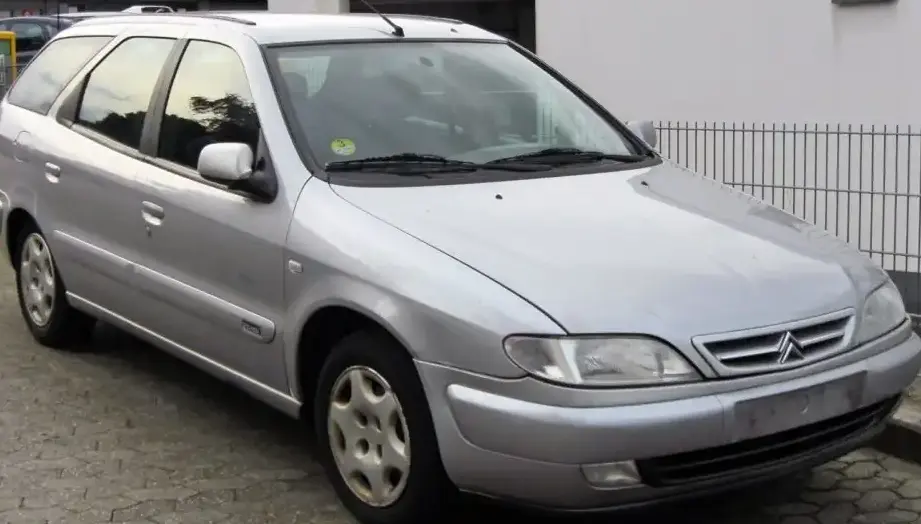
Technical Specifications
| Brand | Citroen |
| Model | Xsara |
| Generation | Xsara Break (N2, Phase I) |
| Type (Engine) | 1.9 Turbo D (90 Hp) |
| Start of production | 1999 |
| End of production | 2000 |
| Powertrain Architecture | Internal Combustion engine |
| Body type | Station wagon (estate) |
| Seats | 5 |
| Doors | 5 |
| Fuel consumption (urban) | 8.8 l/100 km (26.7 US mpg, 32.1 UK mpg, 11.4 km/l) |
| Fuel consumption (extra urban) | 5.2 l/100 km (45.2 US mpg, 54.3 UK mpg, 19.2 km/l) |
| Fuel consumption (combined) | 6.6 l/100 km (35.6 US mpg, 42.8 UK mpg, 15.2 km/l) |
| CO2 emissions | 175 g/km |
| Fuel Type | Diesel |
| Acceleration 0 – 100 km/h | 12.8 sec |
| Acceleration 0 – 62 mph | 12.8 sec |
| Acceleration 0 – 60 mph | 12.2 sec |
| Maximum speed | 178 km/h (110.6 mph) |
| Emission standard | Euro 2 |
| Weight-to-power ratio | 13.3 kg/Hp, 75.2 Hp/tonne |
| Weight-to-torque ratio | 6.1 kg/Nm, 163.7 Nm/tonne |
| Power | 90 Hp @ 4000 rpm |
| Power per litre | 47.2 Hp/l |
| Torque | 196 Nm @ 2250 rpm (144.56 lb.-ft. @ 2250 rpm) |
| Engine layout | Front, Transverse |
| Engine Model/Code | DHY XUD9TE/Y |
| Engine displacement | 1905 cm3 (116.25 cu. in.) |
| Number of cylinders | 4 |
| Engine configuration | Inline |
| Cylinder Bore | 83 mm (3.27 in.) |
| Piston Stroke | 88 mm (3.46 in.) |
| Number of valves per cylinder | 2 |
| Fuel injection system | Precombustion chamber injection |
| Engine aspiration | Turbocharger, Intercooler |
| Engine oil capacity | 4.8 l (5.07 US qt | 4.22 UK qt) |
| Coolant | 9 l (9.51 US qt | 7.92 UK qt) |
| Kerb Weight | 1197 kg (2638.93 lbs.) |
| Max. weight | 1740 kg (3836.04 lbs.) |
| Max load | 543 kg (1197.11 lbs.) |
| Trunk (boot) space – minimum | 517 l (18.26 cu. ft.) |
| Trunk (boot) space – maximum | 1512 l (53.4 cu. ft.) |
| Fuel tank capacity | 54 l (14.27 US gal | 11.88 UK gal) |
| Max. roof load | 100 kg (220.46 lbs.) |
| Permitted trailer load with brakes (12%) | 1100 kg (2425.08 lbs.) |
| Permitted trailer load without brakes | 635 kg (1399.94 lbs.) |
| Length | 4354 mm (171.42 in.) |
| Width | 1698 mm (66.85 in.) |
| Width including mirrors | 1994 mm (78.5 in.) |
| Height | 1426 mm (56.14 in.) |
| Wheelbase | 2540 mm (100 in.) |
| Front track | 1423 mm (56.02 in.) |
| Rear (Back) track | 1430 mm (56.3 in.) |
| Front overhang | 868 mm (34.17 in.) |
| Rear overhang | 946 mm (37.24 in.) |
| Minimum turning circle (turning diameter) | 11.5 m (37.73 ft.) |
| Drivetrain Architecture | The Internal combustion engine (ICE) drives the front wheels of the vehicle. |
| Drive wheel | Front wheel drive |
| Number of gears and type of gearbox | 5 gears, manual transmission |
| Front suspension | Coil spring |
| Rear suspension | Torsion |
| Front brakes | Ventilated discs |
| Rear brakes | Drum |
| Steering type | Steering rack and pinion |
| Power steering | Hydraulic Steering |
| Tires size | 185/65 R14 |
The Citroën Xsara Break 1.9 Turbo D, produced between 1999 and 2000, represents a practical and economical offering within the second generation (N2) of the Xsara range. As a station wagon (estate) variant, it aimed to provide increased cargo capacity and versatility compared to the hatchback model. This particular version, equipped with the 90 horsepower turbocharged diesel engine, occupied a mid-range position in the lineup, appealing to buyers prioritizing fuel efficiency and load-lugging capability over outright performance. It was part of the Phase I refresh of the N2 series, building upon the foundation laid by the initial 1997 launch.
Powertrain & Engine Architecture
The heart of this Xsara Break variant is the XUD9TE/Y engine, a 1.9-liter inline-four cylinder diesel. This engine, often referred to by its code DHY, is a stalwart of the PSA Group (Peugeot-Citroën) and known for its durability. It utilizes precombustion chamber injection, a system common in older diesel engines where fuel is injected into a pre-chamber before entering the main cylinder, promoting more complete combustion. A turbocharger with an intercooler is employed to boost power output to 90 horsepower at 4000 rpm and 196 Nm (144.56 lb-ft) of torque at 2250 rpm. The five-speed manual transmission was the standard offering for this engine, providing a balance between fuel economy and usability. The engine’s transverse mounting and front-wheel-drive configuration were typical for vehicles in this class.
Driving Characteristics
The 1.9 Turbo D with the manual transmission offered a practical, if not exhilarating, driving experience. Acceleration to 60 mph took around 12.2 seconds, and top speed was approximately 110.6 mph. The engine’s torque peak at 2250 rpm meant that usable power was available from relatively low engine speeds, making it well-suited for everyday driving and hauling loads. Compared to the more powerful petrol (gasoline) versions of the Xsara, this diesel lacked outright speed, but it excelled in fuel economy. The gear ratios were geared towards maximizing efficiency rather than performance, resulting in a relaxed cruising experience. The manual transmission allowed for greater driver control compared to the optional automatic.
Equipment & Trim Levels
The 1.9 Turbo D Break typically came with a reasonable level of standard equipment. This included power steering, central locking, electric front windows, and an adjustable steering column. Interior upholstery was generally cloth, with a functional, if somewhat basic, dashboard layout. Optional extras could include air conditioning, alloy wheels, and a radio/cassette player. The Break (estate) body style itself added to the practicality with a large cargo area, making it a popular choice for families and those needing to transport bulky items.
Chassis & Braking
The Xsara Break’s chassis featured a coil spring suspension at the front and a torsion beam suspension at the rear. This setup provided a comfortable ride, although it wasn’t particularly sporty. The front brakes were ventilated discs, offering good stopping power, while the rear brakes were drums, a cost-saving measure common in this segment. The hydraulic power steering provided light and easy steering, making it maneuverable in urban environments.
Market Reception & Comparison
The Citroën Xsara Break 1.9 Turbo D was well-received in European markets as a practical and economical family car. Critics praised its fuel efficiency, spacious interior, and comfortable ride. Compared to the petrol versions, the diesel offered significantly better fuel economy, making it a popular choice for high-mileage drivers. However, it was criticized for its relatively slow acceleration and somewhat noisy engine. Against competitors like the Ford Focus Estate and Volkswagen Golf Estate, the Xsara offered a competitive package, particularly in terms of value for money.
Legacy
The XUD9 engine family, including the DHY variant, has a reputation for being exceptionally durable and reliable. Many examples have exceeded high mileage with proper maintenance. In the used car market today, the Xsara Break 1.9 Turbo D remains an affordable and practical option. While finding well-maintained examples may require some searching, its robust engine and simple mechanicals make it a relatively easy car to live with. Parts availability is generally good, and the car’s straightforward design makes it accessible to amateur mechanics. It represents a solid, if unspectacular, example of late-1990s European family car design.
