
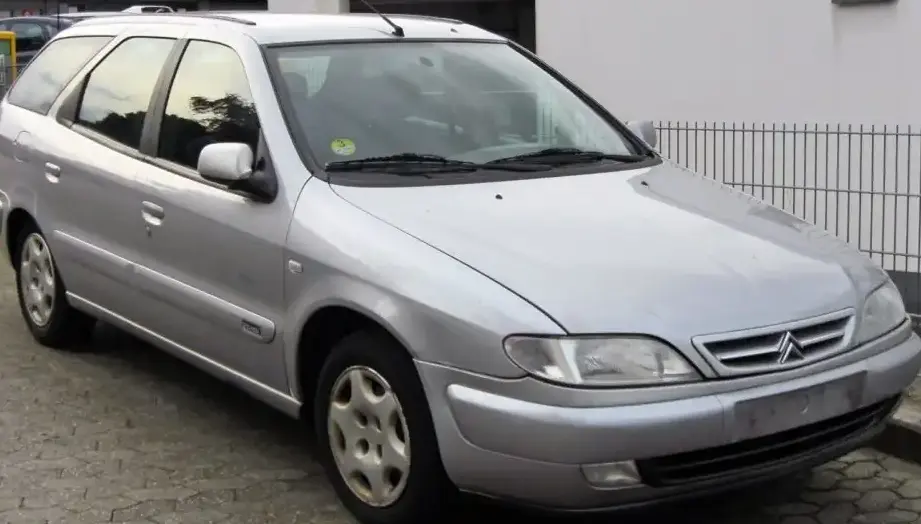
The Citroën Xsara Break 2.0 16V, produced between 1998 and 2000, represents a compelling blend of practicality and performance within the first phase (N2) of the Xsara Break model range. Positioned as a mid-range offering, this variant aimed to provide a more engaging driving experience than the base models while remaining a more accessible option than the flagship trims. The Xsara Break, as a whole, was Citroën’s entry in the competitive compact estate car segment, designed to appeal to families and those requiring versatile cargo space. It was built on the PSA Group’s 1HX0 platform, shared with the Peugeot 306 Break.
Technical Specifications
| Brand | Citroen |
| Model | Xsara |
| Generation | Xsara Break (N2, Phase I) |
| Type (Engine) | 2.0 16V (135 Hp) |
| Start of production | 1998 |
| End of production | 2000 |
| Powertrain Architecture | Internal Combustion engine |
| Body type | Station wagon (estate) |
| Seats | 5 |
| Doors | 5 |
| Fuel consumption (urban) | 12.5 l/100 km (18.8 US mpg, 22.6 UK mpg, 8 km/l) |
| Fuel consumption (extra urban) | 6.5 l/100 km (36.2 US mpg, 43.5 UK mpg, 15.4 km/l) |
| Fuel consumption (combined) | 8.7 l/100 km (27 US mpg, 32.5 UK mpg, 11.5 km/l) |
| CO2 emissions | 209 g/km |
| Fuel Type | Petrol (Gasoline) |
| Acceleration 0 – 100 km/h | 10.2 sec |
| Acceleration 0 – 62 mph | 10.2 sec |
| Acceleration 0 – 60 mph | 9.7 sec |
| Maximum speed | 206 km/h (128 mph) |
| Weight-to-power ratio | 8.8 kg/Hp, 113.4 Hp/tonne |
| Weight-to-torque ratio | 6.6 kg/Nm, 151.3 Nm/tonne |
| Power | 135 Hp @ 5500 rpm |
| Power per litre | 67.6 Hp/l |
| Torque | 180 Nm @ 4200 rpm (132.76 lb.-ft. @ 4200 rpm) |
| Engine layout | Front, Transverse |
| Engine Model/Code | RFV XU10J4R |
| Engine displacement | 1998 cm3 (121.93 cu. in.) |
| Number of cylinders | 4 |
| Engine configuration | Inline |
| Cylinder Bore | 86 mm (3.39 in.) |
| Piston Stroke | 86 mm (3.39 in.) |
| Compression ratio | 10.4:1 |
| Number of valves per cylinder | 4 |
| Fuel injection system | Multi-port manifold injection |
| Engine aspiration | Naturally aspirated engine |
| Valvetrain | DOHC |
| Engine oil capacity | 4.25 l (4.49 US qt | 3.74 UK qt) |
| Coolant | 7 l (7.4 US qt | 6.16 UK qt) |
| Kerb Weight | 1190 kg (2623.5 lbs.) |
| Max. weight | 1710 kg (3769.9 lbs.) |
| Max load | 520 kg (1146.4 lbs.) |
| Trunk (boot) space – minimum | 517 l (18.26 cu. ft.) |
| Trunk (boot) space – maximum | 1512 l (53.4 cu. ft.) |
| Fuel tank capacity | 54 l (14.27 US gal | 11.88 UK gal) |
| Max. roof load | 100 kg (220.46 lbs.) |
| Permitted trailer load with brakes (12%) | 1100 kg (2425.08 lbs.) |
| Permitted trailer load without brakes | 630 kg (1388.91 lbs.) |
| Permitted towbar download | 70 kg (154.32 lbs.) |
| Length | 4354 mm (171.42 in.) |
| Width | 1698 mm (66.85 in.) |
| Width including mirrors | 1994 mm (78.5 in.) |
| Height | 1426 mm (56.14 in.) |
| Wheelbase | 2540 mm (100 in.) |
| Front track | 1423 mm (56.02 in.) |
| Rear (Back) track | 1430 mm (56.3 in.) |
| Front overhang | 868 mm (34.17 in.) |
| Rear overhang | 946 mm (37.24 in.) |
| Minimum turning circle | 11.5 m (37.73 ft.) |
| Drivetrain Architecture | The Internal combustion engine (ICE) drives the front wheels of the vehicle. |
| Drive wheel | Front wheel drive |
| Number of gears and type of gearbox | 5 gears, manual transmission |
| Front suspension | Independent, type McPherson with coil spring and anti-roll bar |
| Rear suspension | Torsion |
| Front brakes | Ventilated discs |
| Rear brakes | Disc |
| Assisting systems | ABS (Anti-lock braking system) |
| Steering type | Steering rack and pinion |
| Power steering | Hydraulic Steering |
| Tires size | 195/55 R15 |
Powertrain & Engine Architecture
The heart of the Xsara Break 2.0 16V is the RFV XU10J4R engine, a 1.998-liter inline-four cylinder petrol engine. This engine is part of the XU series, developed by Peugeot and Citroën, and known for its robust design and relatively simple maintenance. The ‘16V’ designation indicates a dual overhead camshaft (DOHC) valvetrain, operating four valves per cylinder. This configuration enhances breathing and contributes to the engine’s respectable power output. Fuel delivery is managed by a multi-port fuel injection system, providing precise fuel metering for optimal combustion. The engine boasts a compression ratio of 10.4:1. The engine produces 135 horsepower at 5500 rpm and 180 Nm (132.76 lb-ft) of torque at 4200 rpm. The engine is transversely mounted, driving the front wheels. The standard transmission for this variant was a five-speed manual gearbox, although a four-speed automatic transmission was also available, albeit less common.
Driving Characteristics
The 2.0 16V engine provided a noticeable step up in performance compared to the lower-displacement engines offered in the Xsara Break range. Acceleration to 60 mph took approximately 9.7 seconds, and it could achieve a top speed of around 128 mph. While not a sports car, the 2.0L engine offered sufficient power for comfortable highway cruising and overtaking. The five-speed manual transmission allowed drivers to effectively utilize the engine’s powerband, while the optional automatic, though convenient, resulted in some power loss and a less engaging driving experience. The gear ratios were tuned for a balance between acceleration and fuel economy. Compared to the more economical 1.6L or 1.8L variants, the 2.0 16V offered a more spirited drive, but at the cost of increased fuel consumption.
Equipment & Trim Levels
The 2.0 16V Xsara Break typically came equipped with features such as power steering, central locking, electric front windows, and an adjustable steering column. Higher trim levels added features like air conditioning, alloy wheels, a sunroof, and upgraded interior trim. Interior upholstery was generally cloth, with options for more premium materials. The dashboard layout was functional and straightforward, typical of Citroën designs of the era. Optional extras included a CD player, rear electric windows, and metallic paint.
Chassis & Braking
The Xsara Break utilized an independent McPherson strut suspension setup at the front, providing a comfortable ride and decent handling. The rear suspension employed a torsion beam, a cost-effective and space-saving solution. Braking duties were handled by ventilated discs at the front and solid discs at the rear. Anti-lock Braking System (ABS) was standard, enhancing safety. The suspension was tuned to prioritize ride comfort, making it well-suited for long journeys. Stabilizer bars were fitted to both the front and rear axles to reduce body roll during cornering.
Market Reception & Comparison
The Citroën Xsara Break 2.0 16V was generally well-received by automotive critics. It was praised for its spacious interior, comfortable ride, and the punchy performance of the 2.0-liter engine. However, some reviewers noted that the interior plastics felt somewhat low-rent compared to some competitors. Compared to the 1.8L variant, the 2.0 16V offered a significant performance boost, but with a corresponding increase in fuel consumption. The 2.0L also commanded a higher price point. Against rivals like the Ford Focus Estate and Volkswagen Golf Estate, the Xsara Break offered a compelling alternative, particularly for those seeking a comfortable and practical estate car with a touch of French flair.
Legacy
The RFV XU10J4R engine, found in the Xsara Break 2.0 16V, is known for its durability and relatively straightforward maintenance. While not immune to age-related issues, these engines can provide reliable service with proper care. Today, the Xsara Break 2.0 16V is a relatively affordable used car, appealing to those seeking a practical and spacious estate car. Parts availability is generally good, and the engine’s robust design makes it a relatively easy unit to work on for experienced DIY mechanics. The model represents a solid example of late-1990s French automotive engineering, offering a blend of practicality, comfort, and performance.
