
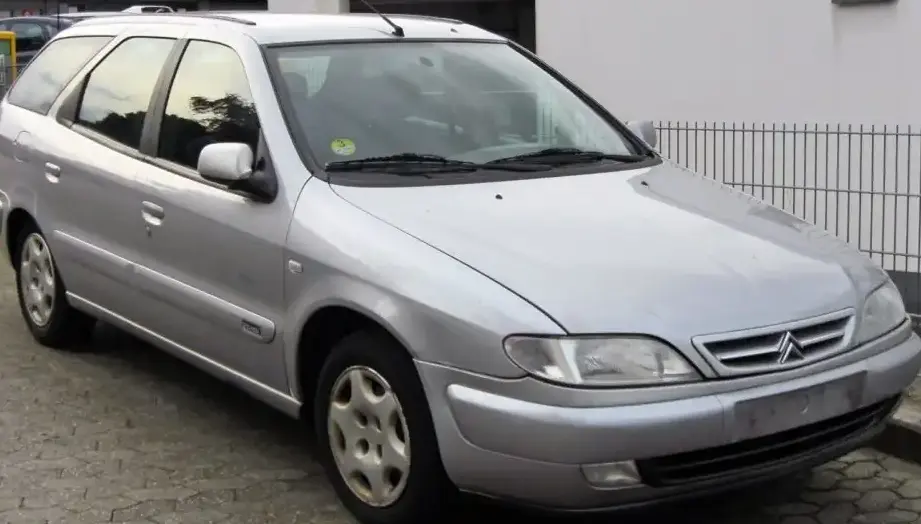
Technical Specifications
| Brand | Citroen |
| Model | Xsara |
| Generation | Xsara Break (N2, Phase I) |
| Type (Engine) | 2.0 16V (135 Hp) Automatic |
| Start of production | 1998 |
| End of production | 2000 |
| Powertrain Architecture | Internal Combustion engine |
| Body type | Station wagon (estate) |
| Seats | 5 |
| Doors | 5 |
| Fuel consumption (urban) | 13.7 l/100 km (17.2 US mpg, 20.6 UK mpg, 7.3 km/l) |
| Fuel consumption (extra urban) | 7.2 l/100 km (32.7 US mpg, 39.2 UK mpg, 13.9 km/l) |
| Fuel consumption (combined) | 9.6 l/100 km (24.5 US mpg, 29.4 UK mpg, 10.4 km/l) |
| CO2 emissions | 232 g/km |
| Fuel Type | Petrol (Gasoline) |
| Maximum speed | 201 km/h (124.9 mph) |
| Weight-to-power ratio | 9 kg/Hp, 110.9 Hp/tonne |
| Weight-to-torque ratio | 6.8 kg/Nm, 147.9 Nm/tonne |
| Power | 135 Hp @ 5500 rpm |
| Power per litre | 67.6 Hp/l |
| Torque | 180 Nm @ 4200 rpm (132.76 lb.-ft. @ 4200 rpm) |
| Engine layout | Front, Transverse |
| Engine Model/Code | RFV XU10J4R |
| Engine displacement | 1998 cm3 (121.93 cu. in.) |
| Number of cylinders | 4 |
| Engine configuration | Inline |
| Cylinder Bore | 86 mm (3.39 in.) |
| Piston Stroke | 86 mm (3.39 in.) |
| Compression ratio | 10.4:1 |
| Number of valves per cylinder | 4 |
| Fuel injection system | Multi-port manifold injection |
| Engine aspiration | Naturally aspirated engine |
| Valvetrain | DOHC |
| Engine oil capacity | 4.25 l (4.49 US qt | 3.74 UK qt) |
| Coolant | 7 l (7.4 US qt | 6.16 UK qt) |
| Kerb Weight | 1217 kg (2683.03 lbs.) |
| Max. weight | 1730 kg (3814 lbs.) |
| Max load | 513 kg (1130.97 lbs.) |
| Trunk (boot) space – minimum | 517 l (18.26 cu. ft.) |
| Trunk (boot) space – maximum | 1512 l (53.4 cu. ft.) |
| Fuel tank capacity | 54 l (14.27 US gal | 11.88 UK gal) |
| Max. roof load | 100 kg (220.46 lbs.) |
| Permitted trailer load with brakes (12%) | 1100 kg (2425.08 lbs.) |
| Permitted trailer load without brakes | 645 kg (1421.98 lbs.) |
| Permitted towbar download | 70 kg (154.32 lbs.) |
| Length | 4354 mm (171.42 in.) |
| Width | 1698 mm (66.85 in.) |
| Width including mirrors | 1994 mm (78.5 in.) |
| Height | 1426 mm (56.14 in.) |
| Wheelbase | 2540 mm (100 in.) |
| Front track | 1423 mm (56.02 in.) |
| Rear (Back) track | 1430 mm (56.3 in.) |
| Front overhang | 868 mm (34.17 in.) |
| Rear overhang | 946 mm (37.24 in.) |
| Minimum turning circle (turning diameter) | 11.5 m (37.73 ft.) |
| Drivetrain Architecture | The Internal combustion engine (ICE) drives the front wheels of the vehicle. |
| Drive wheel | Front wheel drive |
| Number of gears and type of gearbox | 4 gears, automatic transmission |
| Front suspension | Independent, type McPherson with coil spring and anti-roll bar |
| Rear suspension | Torsion |
| Front brakes | Ventilated discs |
| Rear brakes | Disc |
| Assisting systems | ABS (Anti-lock braking system) |
| Steering type | Steering rack and pinion |
| Power steering | Hydraulic Steering |
| Tires size | 195/55 R15 |
The Citroën Xsara Break 2.0 16V Automatic, produced between 1998 and 2000, represents a compelling blend of practicality and performance within the first phase (N2) of the Xsara Break model range. Positioned as a mid-to-upper trim level, this variant offered a more refined driving experience compared to the base models, while remaining a more accessible option than the later, more performance-focused iterations. The Xsara Break, as a whole, was Citroën’s entry in the competitive European compact estate car segment, designed to appeal to families and those requiring versatile cargo space. This particular configuration aimed to provide comfortable long-distance cruising with the convenience of an automatic transmission.
Powertrain & Engine Architecture
The Xsara Break 2.0 16V Automatic is powered by the RFV XU10J4R engine, a 1998cc inline-four cylinder petrol engine. This engine belongs to the PSA Group’s XU series, renowned for its durability and straightforward design. It boasts a double overhead camshaft (DOHC) valvetrain with four valves per cylinder, contributing to its respectable power output. Fuel delivery is handled by a multi-port fuel injection system, optimizing combustion efficiency. The engine generates 135 horsepower at 5500 rpm and 180 Nm (132.76 lb-ft) of torque at 4200 rpm. The four-speed automatic transmission, while not cutting-edge by modern standards, delivers smooth and convenient gear changes. Its gear ratios are tuned for comfortable cruising rather than aggressive acceleration.
Driving Characteristics
Driving the Xsara Break 2.0 16V Automatic is a comfortable and effortless experience. The automatic transmission eliminates the need for manual gear shifts, making it well-suited for city driving and extended highway journeys. While the 135 hp engine doesn’t provide exhilarating acceleration, it offers enough power for overtaking and maintaining comfortable speeds. Compared to the manual transmission versions of the same engine, the automatic variant feels slightly less responsive due to the torque converter’s inherent losses. However, the convenience and smoothness of the automatic transmission compensate for this performance difference for many drivers. The gear ratios are optimized for fuel efficiency and relaxed cruising, prioritizing comfort over rapid acceleration.
Equipment & Trim Levels
The 2.0 16V Automatic trim typically included features such as power steering, central locking, electric front windows, and an RDS radio. Higher-specification models could be equipped with optional extras like air conditioning, alloy wheels, and a sunroof. The interior upholstery was generally cloth, featuring a functional and durable design. The dashboard layout was characteristic of Citroëns from that era, emphasizing ergonomics and ease of use. Additional optional features included upgraded audio systems, rear electric windows, and metallic paint finishes.
Chassis & Braking
The Xsara Break 2.0 16V Automatic utilizes an independent McPherson strut suspension system at the front, providing a comfortable ride and good handling. The rear suspension employs a torsion beam, a cost-effective and space-saving solution. Braking is provided by ventilated discs at the front and solid discs at the rear. An Anti-lock Braking System (ABS) was standard, enhancing safety by preventing wheel lock-up during hard braking. The steering system is rack and pinion, offering precise and responsive control.
Market Reception & Comparison
The Citroën Xsara Break 2.0 16V Automatic was generally well-received by automotive critics as a practical and comfortable estate car. It was praised for its spacious interior, comfortable ride, and the convenience of the automatic transmission. Some reviewers noted that the automatic transmission slightly diminished the engine’s performance compared to the manual version. Compared to other estate cars in its class, such as the Ford Focus Estate and the Vauxhall/Opel Astra Estate, the Xsara Break offered a distinctive French design and a comfortable ride. Fuel economy was reasonable for the time, though not exceptional compared to diesel-powered alternatives.
Legacy
The RFV XU10J4R engine, found in the Xsara Break 2.0 16V Automatic, is known for its reliability and durability when properly maintained. The automatic transmission, while not as advanced as modern units, is also generally reliable. Today, these cars are relatively affordable on the used car market, making them an appealing option for those seeking a practical and comfortable estate car. However, potential buyers should be aware of the age-related issues common to vehicles of this era, such as corrosion and wear and tear on suspension components. Parts availability is generally good, thanks to the engine’s widespread use in other PSA Group vehicles.
