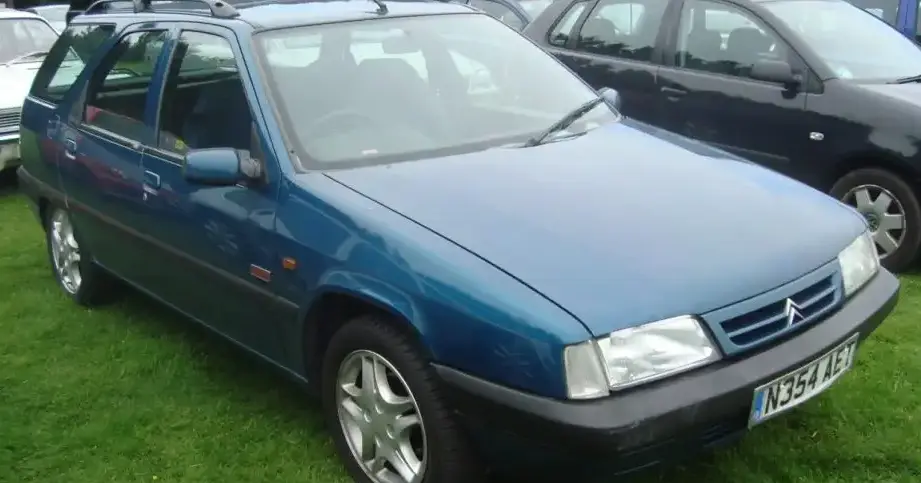
The Citroen ZX Break 1.9 D Automatic, produced between November 1993 and 1994, represents a specific configuration within the broader ZX Break (N2, Phase I) range. Positioned as an economy-focused variant, it combined the practicality of the ZX estate body style with a diesel engine and the convenience of an automatic transmission. This model aimed to provide a comfortable and fuel-efficient option for families and those requiring a spacious vehicle, though it sacrificed performance compared to petrol-powered versions. It was part of the first phase of the ZX Break, built on the Citroen Xantia/Peugeot 405 platform.
Technical Specifications
| Brand | Citroen |
| Model | ZX |
| Generation | ZX Break (N2, Phase I) |
| Type (Engine) | 1.9 D (71 Hp) Automatic |
| Start of production | November, 1993 |
| End of production | 1994 |
| Powertrain Architecture | Internal Combustion engine |
| Body type | Station wagon (estate) |
| Seats | 5 |
| Doors | 5 |
| Fuel consumption (urban) | 7.2 l/100 km (32.7 US mpg, 39.2 UK mpg, 13.9 km/l) |
| Fuel consumption (extra urban) | 4.8 l/100 km (49 US mpg, 58.9 UK mpg, 20.8 km/l) |
| Fuel Type | Diesel |
| Acceleration 0 – 100 km/h | 19.2 sec |
| Acceleration 0 – 62 mph | 19.2 sec |
| Acceleration 0 – 60 mph | 18.2 sec |
| Maximum speed | 151 km/h (93.83 mph) |
| Weight-to-power ratio | 15.4 kg/Hp, 65.1 Hp/tonne |
| Weight-to-torque ratio | 8.7 kg/Nm, 114.7 Nm/tonne |
| Power | 71 Hp @ 4600 rpm |
| Power per litre | 37.3 Hp/l |
| Torque | 125 Nm @ 2000 rpm (92.2 lb.-ft. @ 2000 rpm) |
| Engine layout | Front, Transverse |
| Engine Model/Code | D9B XUD9A/L |
| Engine displacement | 1905 cm3 (116.25 cu. in.) |
| Number of cylinders | 4 |
| Engine configuration | Inline |
| Cylinder Bore | 83 mm (3.27 in.) |
| Piston Stroke | 88 mm (3.46 in.) |
| Compression ratio | 23:1 |
| Number of valves per cylinder | 2 |
| Fuel injection system | Precombustion chamber injection |
| Engine aspiration | Naturally aspirated engine |
| Engine oil capacity | 4.3 l (4.54 US qt | 3.78 UK qt) |
| Coolant | 5 l (5.28 US qt | 4.4 UK qt) |
| Kerb Weight | 1090 kg (2403.04 lbs.) |
| Max. weight | 1630 kg (3593.53 lbs.) |
| Max load | 540 kg (1190.5 lbs.) |
| Trunk (boot) space – minimum | 488 l (17.23 cu. ft.) |
| Trunk (boot) space – maximum | 1580 l (55.8 cu. ft.) |
| Fuel tank capacity | 65 l (17.17 US gal | 14.3 UK gal) |
| Max. roof load | 100 kg (220.46 lbs.) |
| Permitted trailer load with brakes (12%) | 1000 kg (2204.62 lbs.) |
| Permitted trailer load without brakes | 545 kg (1201.52 lbs.) |
| Permitted towbar download | 40 kg (88.18 lbs.) |
| Length | 4260 mm (167.72 in.) |
| Width | 1702 mm (67.01 in.) |
| Height | 1451 mm (57.13 in.) |
| Wheelbase | 2540 mm (100 in.) |
| Front track | 1422 mm (55.98 in.) |
| Rear (Back) track | 1415 mm (55.71 in.) |
| Front overhang | 849 mm (33.43 in.) |
| Rear overhang | 871 mm (34.29 in.) |
| Minimum turning circle | 11.5 m (37.73 ft.) |
| Drivetrain Architecture | The Internal combustion engine (ICE) drives the front wheels of the vehicle. |
| Drive wheel | Front wheel drive |
| Number of gears and type of gearbox | 4 gears, automatic transmission |
| Front suspension | Independent type McPherson, Wishbone |
| Rear suspension | Hydro-pneumatic element, Trailing arm |
| Front brakes | Ventilated discs |
| Rear brakes | Drum |
| Steering type | Steering rack and pinion |
| Power steering | Hydraulic Steering |
| Tires size | 175/65 R14 |
| Wheel rims size | 5.5J x 14 |
INTRODUCTION
The Citroen ZX Break 1.9 D Automatic, produced from late 1993 to 1994, was a variant of the ZX Break (N2) estate car. The ZX, launched in 1992, was Citroen’s replacement for the BX, aiming to offer a more modern and refined driving experience. The Break, or estate version, provided increased practicality and cargo space. This particular model, equipped with the 1.9-liter diesel engine and a four-speed automatic transmission, was positioned as a budget-friendly option within the ZX Break lineup, appealing to buyers prioritizing fuel economy and ease of use over outright performance. It was built on the shared platform with the Peugeot 405 and Xantia.
Powertrain & Engine Architecture
The heart of the ZX Break 1.9 D Automatic is the D9B XUD9A/L engine, a 1905cc inline-four cylinder diesel. This engine is a naturally aspirated unit utilizing precombustion chamber injection. This system, common in older diesel engines, involves injecting fuel into a precombustion chamber connected to the main cylinder, promoting more complete combustion. The engine produces 71 horsepower at 4600 rpm and 125 Nm (92.2 lb-ft) of torque at 2000 rpm. The four-speed automatic transmission, while offering convenience, was not known for its responsiveness or efficiency compared to manual counterparts. It was a relatively simple, hydraulically controlled unit. The engine’s design prioritized durability and fuel efficiency over high output, making it a reliable, if somewhat unrefined, powerplant.
Driving Characteristics
The driving experience in the ZX Break 1.9 D Automatic is best described as relaxed and unhurried. The 71 hp output and the characteristics of the automatic transmission result in leisurely acceleration – 0-60 mph takes around 18.2 seconds. The automatic transmission’s gear ratios are geared towards fuel economy, meaning the engine often operates at lower RPMs. This contributes to good fuel consumption (7.2 l/100km urban, 4.8 l/100km extra-urban) but can feel sluggish when overtaking or climbing hills. Compared to the 2.0i petrol versions or even the later 1.9 TDI diesel, the 1.9 D Automatic lacks significant punch. However, the hydropneumatic suspension provides a comfortable ride, absorbing bumps and imperfections in the road effectively.
Equipment & Trim Levels
The 1.9 D Automatic trim level typically included basic equipment as standard. This generally consisted of central locking, power steering, and cloth upholstery. Air conditioning and electric windows were often optional extras. The interior design was functional and straightforward, reflecting the car’s economy-focused positioning. Dashboard materials were durable but not luxurious. The Break’s estate body style provided a generous 488-liter boot space (expanding to 1580 liters with the rear seats folded), making it a practical choice for families or those needing to carry large loads.
Chassis & Braking
The ZX Break featured independent McPherson strut front suspension and a hydro-pneumatic trailing arm rear suspension. The hydro-pneumatic system, a Citroen hallmark, provided a uniquely smooth and self-leveling ride. The front brakes were ventilated discs, offering adequate stopping power, while the rear brakes were drums. This combination was typical for vehicles in this class and weight category (1090 kg / 2403 lbs). The steering was a rack and pinion system with hydraulic assistance, providing reasonable precision and ease of use.
Market Reception & Comparison
The ZX Break 1.9 D Automatic was generally viewed as a sensible and practical choice, particularly for those prioritizing fuel economy and low running costs. Critics acknowledged its comfortable ride and spacious interior but noted its lack of performance compared to petrol-powered alternatives. Compared to the 1.9 TDI version (introduced later), the 1.9 D Automatic offered lower initial cost but significantly less power and torque. The TDI also benefited from more modern direct injection technology, resulting in improved fuel efficiency and refinement. The petrol versions, while offering more performance, were less fuel-efficient and generally more expensive to maintain.
Legacy
The D9B XUD9A/L engine, while not known for being particularly sophisticated, proved to be remarkably durable and reliable. ZX Break 1.9 D Automatic models, if well-maintained, can still be found on the road today, testament to the engine’s longevity. However, age-related issues such as corrosion and wear on suspension components are common. In the used car market, these models are typically valued for their affordability and simplicity. They appeal to those seeking a classic French car with a reputation for reliability, but potential buyers should be aware of the engine’s limited performance and the potential for maintenance on the aging hydropneumatic suspension system.