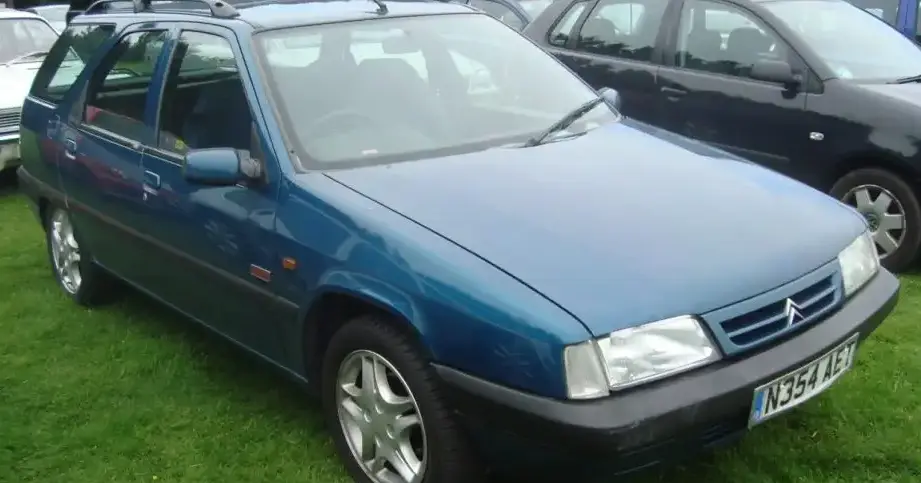
The Citroën ZX Break (N2, Phase II) 1.4 i, producing 75 horsepower, was a mainstay of the ZX estate range from July 1994 until 1997. Positioned as the entry-level engine option within the Break (estate) body style, it offered a practical and affordable family vehicle. The ZX, overall, represented Citroën’s attempt to move towards more conventional designs while retaining its commitment to comfort and innovative technology, built upon the shared Peugeot 306 platform (though mechanically distinct). The Phase II update brought subtle styling revisions and improvements to interior trim and equipment levels.
Technical Specifications
| Brand | Citroën |
| Model | ZX |
| Generation | ZX Break (N2, Phase II) |
| Type (Engine) | 1.4 i (75 Hp) |
| Start of production | July, 1994 |
| End of production | 1997 |
| Powertrain Architecture | Internal Combustion engine |
| Body type | Station wagon (estate) |
| Seats | 5 |
| Doors | 5 |
| Fuel consumption (urban) | 8.5 l/100 km (27.7 US mpg, 33.2 UK mpg, 11.8 km/l) |
| Fuel consumption (extra urban) | 5.5 l/100 km (42.8 US mpg, 51.4 UK mpg, 18.2 km/l) |
| Fuel consumption (combined) | 7 l/100 km (33.6 US mpg, 40.4 UK mpg, 14.3 km/l) |
| Fuel Type | Petrol (Gasoline) |
| Acceleration 0 – 100 km/h | 15.8 sec |
| Acceleration 0 – 62 mph | 15.8 sec |
| Acceleration 0 – 60 mph | 15 sec |
| Maximum speed | 165 km/h (102.53 mph) |
| Weight-to-power ratio | 13.5 kg/Hp, 73.9 Hp/tonne |
| Weight-to-torque ratio | 9 kg/Nm, 111.3 Nm/tonne |
| Power | 75 Hp @ 5500 rpm |
| Power per litre | 55.1 Hp/l |
| Torque | 113 Nm @ 3400 rpm (83.34 lb.-ft. @ 3400 rpm) |
| Engine layout | Front, Transverse |
| Engine Model/Code | KFX TU3JP L3 |
| Engine displacement | 1360 cm3 (82.99 cu. in.) |
| Number of cylinders | 4 |
| Engine configuration | Inline |
| Cylinder Bore | 75 mm (2.95 in.) |
| Piston Stroke | 77 mm (3.03 in.) |
| Compression ratio | 10.2:1 |
| Number of valves per cylinder | 2 |
| Fuel injection system | Multi-port manifold injection |
| Engine aspiration | Naturally aspirated engine |
| Valvetrain | OHC |
| Engine oil capacity | 3.5 l (3.7 US qt | 3.08 UK qt) |
| Coolant | 6.5 l (6.87 US qt | 5.72 UK qt) |
| Kerb Weight | 1015 kg (2237.69 lbs.) |
| Max. weight | 1550 kg (3417.17 lbs.) |
| Max load | 535 kg (1179.47 lbs.) |
| Trunk (boot) space – minimum | 488 l (17.23 cu. ft.) |
| Trunk (boot) space – maximum | 1580 l (55.8 cu. ft.) |
| Fuel tank capacity | 54 l (14.27 US gal | 11.88 UK gal) |
| Max. roof load | 100 kg (220.46 lbs.) |
| Permitted trailer load with brakes (12%) | 1000 kg (2204.62 lbs.) |
| Permitted trailer load without brakes | 500 kg (1102.31 lbs.) |
| Permitted towbar download | 40 kg (88.18 lbs.) |
| Length | 4260 mm (167.72 in.) |
| Width | 1705 mm (67.13 in.) |
| Height | 1457 mm (57.36 in.) |
| Wheelbase | 2540 mm (100 in.) |
| Front track | 1422 mm (55.98 in.) |
| Rear (Back) track | 1415 mm (55.71 in.) |
| Front overhang | 849 mm (33.43 in.) |
| Rear overhang | 871 mm (34.29 in.) |
| Minimum turning circle | 11.3 m (37.07 ft.) |
| Drivetrain Architecture | The Internal combustion engine (ICE) drives the front wheels of the vehicle. |
| Drive wheel | Front wheel drive |
| Number of gears and type of gearbox | 5 gears, manual transmission |
| Front suspension | Independent type McPherson, Wishbone |
| Rear suspension | Hydro-pneumatic element, Trailing arm |
| Front brakes | Disc |
| Rear brakes | Drum |
| Assisting systems | ABS (Anti-lock braking system) |
| Steering type | Steering rack and pinion |
| Power steering | Hydraulic Steering |
| Tires size | 175/65 R14 |
| Wheel rims size | 5.5J x 14 |
Powertrain & Engine Architecture
The 1.4-liter inline-four engine, designated KFX and utilizing the TU3JP code, was a relatively simple and robust unit. It featured a single overhead camshaft (OHC) operating two valves per cylinder. Fuel delivery was handled by a multi-port fuel injection system, a significant upgrade over earlier carbureted Citroën engines. This engine produced 75 horsepower at 5500 rpm and 113 Nm (83.34 lb-ft) of torque at 3400 rpm. The engine’s design prioritized fuel efficiency and reliability over outright performance. The 5-speed manual transmission was the standard offering, chosen for its cost-effectiveness and suitability for the engine’s power output. The transmission featured a relatively long gearing, emphasizing fuel economy and smooth cruising.
Driving Characteristics
The ZX Break 1.4 i offered a comfortable, if unhurried, driving experience. Acceleration from 0-60 mph took around 15 seconds, and top speed was approximately 102.53 mph. The long gearing of the manual transmission meant that the engine rarely felt strained at highway speeds, but overtaking required careful planning. Compared to the more powerful 1.6L and 2.0L variants, the 1.4L felt noticeably slower, particularly when fully loaded. However, the suspension, a hallmark of Citroën design, provided a remarkably smooth and compliant ride, even on rough surfaces. The hydraulic power steering was light and precise, making maneuvering in urban environments easy.
Equipment & Trim Levels
The 1.4 i Break typically came with a modest level of standard equipment. This included central locking, power steering, and a basic stereo system. Interior upholstery was typically cloth, with a durable and practical finish. Optional extras included air conditioning, electric windows, and an upgraded stereo system. The Phase II models benefited from minor interior trim upgrades, offering a slightly more refined cabin ambiance. The dashboard layout was functional and driver-focused, with clearly labeled controls.
Chassis & Braking
The ZX Break featured an independent McPherson strut front suspension and a hydro-pneumatic rear suspension system – a Citroën signature. The hydro-pneumatic suspension provided exceptional ride comfort and self-leveling capabilities, maintaining a consistent ride height regardless of load. Front brakes were discs, while rear brakes were drums. ABS (Anti-lock Braking System) was standard, enhancing safety and stability during emergency braking. The chassis was designed to prioritize comfort and handling balance, rather than outright sportiness.
Market Reception & Comparison
The ZX Break 1.4 i was generally well-received as a practical and affordable family estate car. Critics praised its comfortable ride, spacious interior, and fuel efficiency. However, its relatively low power output was often cited as a drawback, particularly for those who frequently carried passengers or luggage. Compared to the 1.6L and 2.0L variants, the 1.4 i offered significantly lower running costs but at the expense of performance. The 1.9 TDI diesel version provided superior fuel economy and torque, appealing to drivers who prioritized economy over outright speed.
Legacy
The Citroën ZX Break 1.4 i, while not the most powerful or exciting variant in the range, proved to be a reliable and durable vehicle. The TU3 engine is known for its longevity, and many examples are still on the road today. In the used car market, these models are often sought after by those looking for an affordable and practical estate car with a comfortable ride. While parts availability can be a concern due to the vehicle’s age, the relatively simple mechanical design makes it a viable option for DIY mechanics. The ZX Break 1.4 i represents a practical and well-engineered example of Citroën’s commitment to comfort and innovation.