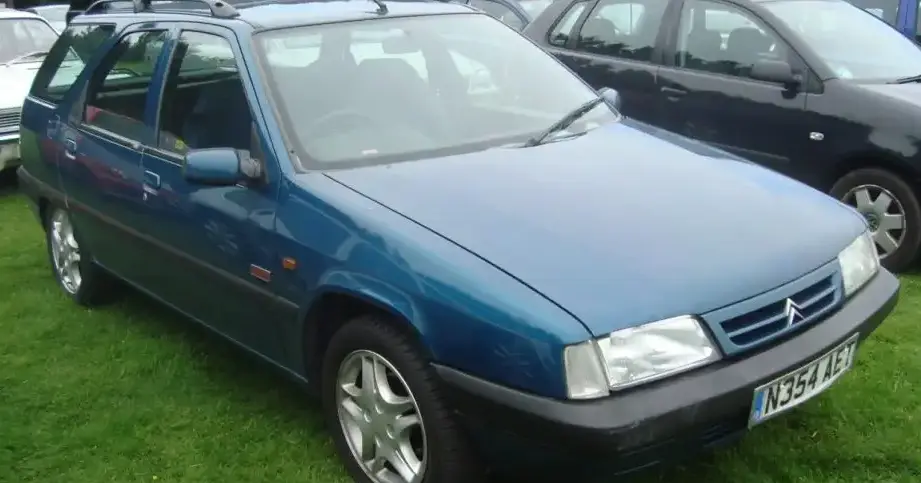
The Citroën ZX 1.1, produced between 1992 and 1994, represented the entry point into the ZX range, Citroën’s replacement for the popular BX. This 3-door hatchback, designated as the N2 Phase I, was aimed at budget-conscious buyers seeking a practical and economical family car. It played a significant role in Citroën’s efforts to modernize its lineup and compete in the increasingly competitive European compact car segment. While not known for outright performance, the 1.1-liter variant offered a blend of affordability, reasonable fuel economy, and Citroën’s signature comfortable ride. It was positioned as the base model, below the 1.6 and 1.9-liter options, and served as a stepping stone for customers looking for a more refined driving experience.
Technical Specifications
| Brand | Citroen |
| Model | ZX |
| Generation | ZX (N2, Phase I) 3-door |
| Type (Engine) | 1.1 (60 Hp) |
| Start of production | 1992 |
| End of production | 1994 |
| Powertrain Architecture | Internal Combustion engine |
| Body type | Hatchback |
| Seats | 5 |
| Doors | 3 |
| Fuel Type | Petrol (Gasoline) |
| Weight-to-power ratio | 15.5 kg/Hp, 64.5 Hp/tonne |
| Weight-to-torque ratio | 11.8 kg/Nm, 84.9 Nm/tonne |
| Power | 60 Hp @ 5800 rpm |
| Power per litre | 53.4 Hp/l |
| Torque | 79 Nm @ 3200 rpm, 58.27 lb.-ft. @ 3200 rpm |
| Engine layout | Front, Transverse |
| Engine Model/Code | H1A TU1 K |
| Engine displacement | 1124 cm3, 68.59 cu. in. |
| Number of cylinders | 4 |
| Engine configuration | Inline |
| Cylinder Bore | 72 mm, 2.83 in. |
| Piston Stroke | 69 mm, 2.72 in. |
| Compression ratio | 9.4:1 |
| Number of valves per cylinder | 2 |
| Fuel injection system | Carburettor |
| Engine aspiration | Naturally aspirated engine |
| Valvetrain | OHC |
| Engine oil capacity | 3.5 l, 3.7 US qt | 3.08 UK qt |
| Coolant | 6.5 l, 6.87 US qt | 5.72 UK qt |
| Kerb Weight | 930 kg, 2050.3 lbs. |
| Max. weight | 1465 kg, 3229.77 lbs. |
| Max load | 535 kg, 1179.47 lbs. |
| Trunk (boot) space – minimum | 324 l, 11.44 cu. ft. |
| Trunk (boot) space – maximum | 1146 l, 40.47 cu. ft. |
| Fuel tank capacity | 56 l, 14.79 US gal | 12.32 UK gal |
| Max. roof load | 75 kg, 165.35 lbs. |
| Permitted trailer load with brakes (12%) | 900 kg, 1984.16 lbs. |
| Permitted trailer load without brakes | 465 kg, 1025.15 lbs. |
| Permitted towbar download | 70 kg, 154.32 lbs. |
| Length | 4071 mm, 160.28 in. |
| Width | 1688 mm, 66.46 in. |
| Height | 1397 mm, 55 in. |
| Wheelbase | 2540 mm, 100 in. |
| Front track | 1414 mm, 55.67 in. |
| Rear (Back) track | 1407 mm, 55.39 in. |
| Front overhang | 849 mm, 33.43 in. |
| Rear overhang | 682 mm, 26.85 in. |
| Ride height (ground clearance) | 114 mm, 4.49 in. |
| Drag coefficient (Cd) | 0.32 |
| Minimum turning circle (turning diameter) | 11.1 m, 36.42 ft. |
| Drivetrain Architecture | The Internal combustion engine (ICE) drives the front wheels of the vehicle. |
| Drive wheel | Front wheel drive |
| Number of gears and type of gearbox | 5 gears, manual transmission |
| Front suspension | Independent type McPherson, Wishbone |
| Rear suspension | Hydro-pneumatic element, Trailing arm |
| Front brakes | Disc |
| Rear brakes | Drum |
| Assisting systems | ABS (Anti-lock braking system) |
| Steering type | Steering rack and pinion |
| Power steering | Hydraulic Steering |
| Tires size | 165/70 R13 |
Powertrain & Engine Architecture
The Citroën ZX 1.1 was powered by the H1A TU1 K engine, a 1.1-liter inline-four cylinder petrol engine. This engine, a mainstay of Citroën and Peugeot vehicles of the era, was known for its simplicity and reliability. The TU1 engine featured a single overhead camshaft (OHC) operating two valves per cylinder. Crucially, this base model ZX utilized a carburetor for fuel delivery, rather than the fuel injection systems found in higher-spec models. This contributed to its lower cost but also resulted in slightly reduced performance and increased emissions. The engine produced 60 horsepower at 5800 rpm and 79 Nm (58.27 lb-ft) of torque at 3200 rpm. The engine was transversely mounted, driving the front wheels. The transmission was a standard five-speed manual gearbox, optimized for fuel efficiency rather than sporty acceleration.
Driving Characteristics
The driving experience in the ZX 1.1 was characterized by its modest performance. With only 60 horsepower propelling a vehicle weighing around 930 kg (2050 lbs), acceleration was leisurely. The 0-60 mph time was estimated to be around 14-15 seconds. The carburetor-fed engine delivered power in a relatively linear fashion, but lacked the responsiveness of fuel-injected counterparts. The five-speed gearbox was well-matched to the engine’s characteristics, allowing drivers to keep the engine in its optimal power band. However, overtaking maneuvers required careful planning. The ZX’s strength lay in its comfortable ride, thanks to Citroën’s renowned hydropneumatic suspension on the rear axle. This system provided a smooth and compliant ride, even on uneven surfaces, a hallmark of the Citroën brand.
Equipment & Trim Levels
The ZX 1.1 was the entry-level trim, and as such, it came with a relatively basic level of equipment. Standard features typically included cloth upholstery, a basic dashboard layout, and manual windows and door locks. Power steering was often included, but air conditioning and central locking were usually optional extras. The interior was functional and durable, prioritizing practicality over luxury. Optional extras could include a radio/cassette player, upgraded seat fabrics, and a sunroof. The exterior styling was understated, with steel wheels and black plastic trim.
Chassis & Braking
The ZX 1.1 featured an independent McPherson strut front suspension and a hydro-pneumatic trailing arm rear suspension. The hydro-pneumatic system, a Citroën innovation, provided self-leveling and adjustable ride height, contributing to the car’s exceptional comfort. The braking system consisted of disc brakes on the front wheels and drum brakes on the rear. ABS (Anti-lock Braking System) was available as an option, enhancing safety. The steering was a rack and pinion system with hydraulic power assistance, providing light and precise steering feel. Tire size was typically 165/70 R13.
Market Reception & Comparison
The Citroën ZX 1.1 was generally well-received as an affordable and practical family car. Critics praised its comfortable ride and spacious interior, but noted its lack of performance. Compared to the higher-spec ZX models, such as the 1.6 and 1.9, the 1.1 offered significantly less power and refinement. However, it was more fuel-efficient and cheaper to purchase and maintain. It competed with other compact hatchbacks of the era, such as the Ford Escort, Volkswagen Golf, and Opel Astra. The ZX 1.1 often represented a better value proposition than some of its rivals, offering a unique blend of comfort and affordability.
Legacy
The Citroën ZX 1.1, while not a performance icon, remains a fondly remembered car for its practicality and comfort. The TU1 engine proved to be remarkably durable, and many examples are still on the road today. However, the carburetor-equipped models can require more frequent maintenance than fuel-injected versions. In the used car market, the ZX 1.1 is typically very affordable, making it an attractive option for budget-conscious buyers or those seeking a classic French car experience. Its hydropneumatic suspension, while requiring occasional maintenance, continues to provide a uniquely comfortable ride, setting it apart from many modern vehicles.