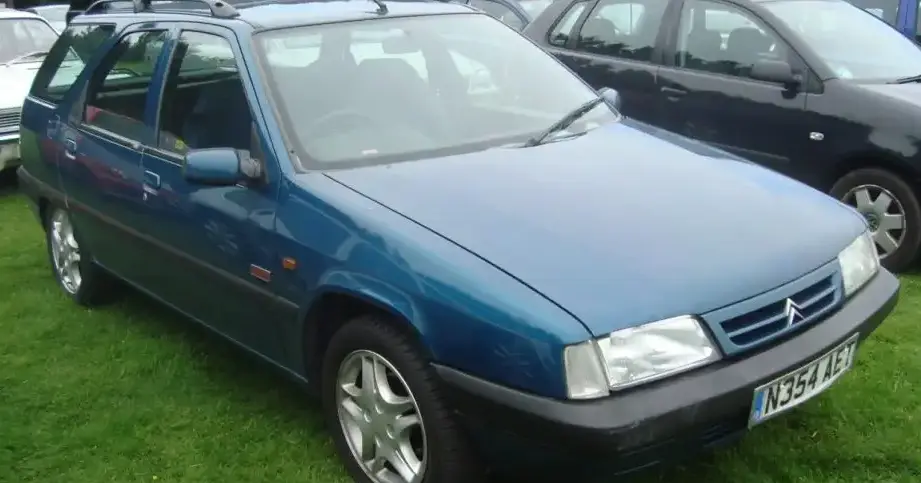
The Citroën ZX 1.4, produced between 1992 and 1993, represented the entry point into the ZX range, Citroën’s replacement for the popular BX. This 3-door hatchback variant, powered by a 1.4-liter engine producing 75 horsepower, was aimed at buyers seeking affordable and practical transportation. It was part of the initial N2 series, representing the first phase of the ZX’s production run. The ZX, built on Citroën’s platform, aimed to offer a blend of comfort, practicality, and modern styling, a formula that proved successful in the European market.
Technical Specifications
| Brand | Citroën |
| Model | ZX |
| Generation | ZX (N2, Phase I) 3-door |
| Type (Engine) | 1.4 (75 Hp) |
| Start of production | 1992 |
| End of production | 1993 |
| Powertrain Architecture | Internal Combustion engine |
| Body type | Hatchback |
| Seats | 5 |
| Doors | 3 |
| Fuel Type | Petrol (Gasoline) |
| Weight-to-power ratio | 12.5 kg/Hp, 80.2 Hp/tonne |
| Weight-to-torque ratio | 8.1 kg/Nm, 124.1 Nm/tonne |
| Power | 75 Hp @ 5800 rpm |
| Power per litre | 55.1 Hp/l |
| Torque | 116 Nm @ 3800 rpm (85.56 lb.-ft. @ 3800 rpm) |
| Engine layout | Front, Transverse |
| Engine Model/Code | K2D TU3 2K |
| Engine displacement | 1360 cm3 (82.99 cu. in.) |
| Number of cylinders | 4 |
| Engine configuration | Inline |
| Cylinder Bore | 75 mm (2.95 in.) |
| Piston Stroke | 77 mm (3.03 in.) |
| Compression ratio | 9.3:1 |
| Number of valves per cylinder | 2 |
| Fuel injection system | Carburettor |
| Engine aspiration | Naturally aspirated engine |
| Engine oil capacity | 3.5 l (3.7 US qt | 3.08 UK qt) |
| Coolant | 6.5 l (6.87 US qt | 5.72 UK qt) |
| Kerb Weight | 935 kg (2061.32 lbs.) |
| Max. weight | 1420 kg (3130.56 lbs.) |
| Max load | 485 kg (1069.24 lbs.) |
| Trunk (boot) space – minimum | 324 l (11.44 cu. ft.) |
| Trunk (boot) space – maximum | 1146 l (40.47 cu. ft.) |
| Fuel tank capacity | 56 l (14.79 US gal | 12.32 UK gal) |
| Max. roof load | 75 kg (165.35 lbs.) |
| Permitted trailer load with brakes (12%) | 1000 kg (2204.62 lbs.) |
| Permitted trailer load without brakes | 465 kg (1025.15 lbs.) |
| Permitted towbar download | 70 kg (154.32 lbs.) |
| Length | 4071 mm (160.28 in.) |
| Width | 1688 mm (66.46 in.) |
| Height | 1399 mm (55.08 in.) |
| Wheelbase | 2540 mm (100 in.) |
| Front track | 1414 mm (55.67 in.) |
| Rear (Back) track | 1407 mm (55.39 in.) |
| Front overhang | 849 mm (33.43 in.) |
| Rear overhang | 682 mm (26.85 in.) |
| Ride height (ground clearance) | 121 mm (4.76 in.) |
| Minimum turning circle (turning diameter) | 11.1 m (36.42 ft.) |
| Drivetrain Architecture | The Internal combustion engine (ICE) drives the front wheels of the vehicle. |
| Drive wheel | Front wheel drive |
| Number of gears and type of gearbox | 5 gears, manual transmission |
| Front suspension | Independent type McPherson, Wishbone |
| Rear suspension | Hydraulic elements, Trailing arm |
| Front brakes | Disc |
| Rear brakes | Drum |
| Assisting systems | ABS (Anti-lock braking system) |
| Steering type | Steering rack and pinion |
| Power steering | Hydraulic Steering |
| Tires size | 165/70 R13 |
Powertrain & Engine Architecture
The Citroën ZX 1.4 utilized the K2D (TU3) engine, a 1360cc inline-four cylinder unit. This engine was a mainstay in many Peugeot and Citroën vehicles of the era. The ‘TU’ series engines were known for their simplicity and durability, though not for outright performance. This particular version employed a single carburetor for fuel delivery, a relatively archaic system by the early 1990s, but one that contributed to its affordability. The engine featured a two-valve per cylinder configuration and a compression ratio of 9.3:1. The engine’s transverse mounting and front-wheel drive configuration were typical for European hatchbacks of the time. The 5-speed manual transmission was the only gearbox option available with this engine, providing a relatively long-legged feel suited to cruising rather than rapid acceleration.
Driving Characteristics
The 75 horsepower and 116 Nm (85.56 lb-ft) of torque produced by the 1.4-liter engine resulted in modest performance. Acceleration was leisurely, and overtaking required careful planning. The 5-speed gearbox helped to keep engine speeds reasonable on the highway, but the engine lacked the punch of larger displacement variants. The gear ratios were geared towards economy, prioritizing fuel efficiency over spirited driving. Compared to the later 1.6 and 2.0-liter versions, or even the diesel options, the 1.4 felt noticeably underpowered. However, the light weight of the ZX (around 935 kg or 2061 lbs) helped to mitigate some of the engine’s shortcomings. The hydraulic power steering provided a light and easy driving experience, while the suspension offered a comfortable ride, typical of Citroën’s emphasis on comfort.
Equipment & Trim Levels
The 1.4-liter ZX was generally considered the base model. Standard equipment included basic cloth upholstery, a simple dashboard layout, and manual windows and door locks. ABS (Anti-lock Braking System) was often included as standard, a notable safety feature for the time. Optional extras included a sunroof, upgraded audio systems, and central locking. The interior was functional and durable, prioritizing practicality over luxury. Trim levels were relatively limited on the base 1.4 model, with most options being standalone additions.
Chassis & Braking
The ZX featured an independent McPherson strut front suspension and a trailing arm rear suspension. This setup provided a good balance of ride comfort and handling. The front brakes were discs, while the rear brakes were drums, a common configuration for vehicles in this price range. The steering utilized a rack and pinion system with hydraulic power assistance. The relatively narrow 165/70 R13 tires were chosen for fuel efficiency and ride comfort rather than outright grip.
Market Reception & Comparison
The Citroën ZX 1.4 was generally well-received as an affordable and practical hatchback. Critics praised its comfortable ride and spacious interior, but noted its lack of performance. Compared to rivals like the Volkswagen Golf and Ford Escort, the ZX offered a distinctive French flair and a focus on comfort. The 1.4-liter engine provided reasonable fuel economy, making it an attractive option for budget-conscious buyers. However, the carbureted engine and relatively basic equipment level meant it wasn’t a particularly exciting car to drive. The 1.6-liter version offered a noticeable performance improvement, while the diesel models provided superior fuel economy.
Legacy
The Citroën ZX 1.4, while not the most powerful or exciting variant, proved to be a reliable and durable vehicle. The TU3 engine is known for its longevity, and many examples are still on the road today. In the used car market, the 1.4-liter ZX represents an affordable entry point into classic Citroën ownership. Its simplicity and relatively low maintenance costs make it an appealing option for those seeking a practical and reliable classic hatchback. While not a collector’s item, it remains a testament to Citroën’s commitment to comfortable and affordable transportation.