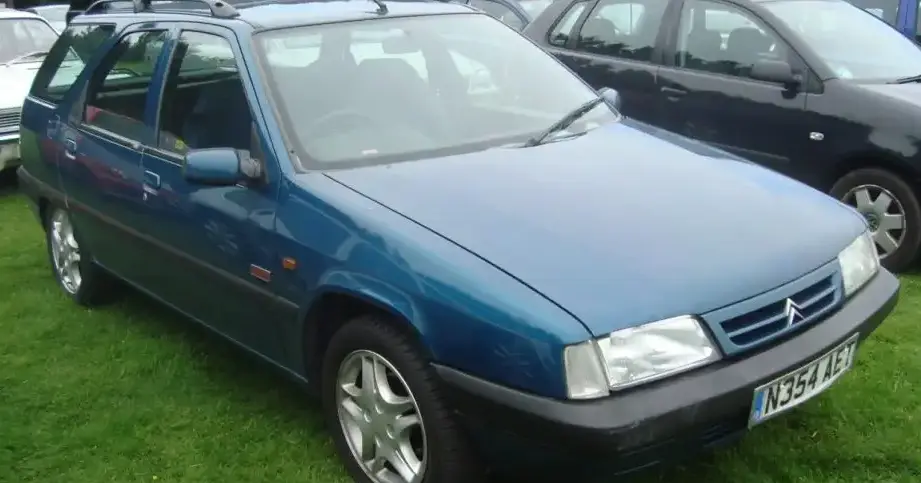
The Citroën ZX 1.6i, produced between 1992 and 1994, represented a key entry point into the ZX range, Citroën’s replacement for the popular BX. This 3-door hatchback variant, powered by an 88 horsepower 1.6-liter engine and typically paired with a manual transmission (though an automatic was available), aimed to offer a blend of practicality, affordability, and Citroën’s signature comfort. It was part of the N2 Phase I generation, built on the shared Peugeot 306 and Renault 19 platform, and served as a crucial volume seller in European markets. This specific configuration occupied the lower-mid range of the ZX lineup, positioned above the base 1.4-liter models but below the more powerful 1.9-liter and 2.0-liter 16V options.
Technical Specifications
| Brand | Citroen |
| Model | ZX |
| Generation | ZX (N2, Phase I) 3-door |
| Type (Engine) | 1.6 i (88 Hp) |
| Start of production | 1992 |
| End of production | 1994 |
| Powertrain Architecture | Internal Combustion engine |
| Body type | Hatchback |
| Seats | 5 |
| Doors | 3 |
| Fuel Type | Petrol (Gasoline) |
| Weight-to-power ratio | 11.5 kg/Hp, 86.7 Hp/tonne |
| Weight-to-torque ratio | 7.9 kg/Nm, 126.1 Nm/tonne |
| Power | 88 Hp @ 6400 rpm |
| Power per litre | 55.7 Hp/l |
| Torque | 128 Nm @ 3000 rpm (94.41 lb.-ft. @ 3000 rpm) |
| Engine layout | Front, Transverse |
| Engine Model/Code | BDY XU5M3 L/Z |
| Engine displacement | 1580 cm3 (96.42 cu. in.) |
| Number of cylinders | 4 |
| Engine configuration | Inline |
| Cylinder Bore | 83 mm (3.27 in.) |
| Piston Stroke | 73 mm (2.87 in.) |
| Compression ratio | 8.95:1 |
| Number of valves per cylinder | 2 |
| Fuel injection system | Single-point injection |
| Engine aspiration | Naturally aspirated engine |
| Valvetrain | OHC |
| Engine oil capacity | 4.75 l (5.02 US qt | 4.18 UK qt) |
| Coolant | 7.5 l (7.93 US qt | 6.6 UK qt) |
| Kerb Weight | 1015 kg (2237.69 lbs.) |
| Max. weight | 1540 kg (3395.12 lbs.) |
| Max load | 525 kg (1157.43 lbs.) |
| Trunk (boot) space – minimum | 324 l (11.44 cu. ft.) |
| Trunk (boot) space – maximum | 1146 l (40.47 cu. ft.) |
| Fuel tank capacity | 56 l (14.79 US gal | 12.32 UK gal) |
| Max. roof load | 75 kg (165.35 lbs.) |
| Permitted trailer load with brakes (12%) | 1000 kg (2204.62 lbs.) |
| Permitted trailer load without brakes | 505 kg (1113.33 lbs.) |
| Permitted towbar download | 70 kg (154.32 lbs.) |
| Length | 4071 mm (160.28 in.) |
| Width | 1688 mm (66.46 in.) |
| Height | 1404 mm (55.28 in.) |
| Wheelbase | 2540 mm (100 in.) |
| Front track | 1422 mm (55.98 in.) |
| Rear (Back) track | 1415 mm (55.71 in.) |
| Front overhang | 849 mm (33.43 in.) |
| Rear overhang | 682 mm (26.85 in.) |
| Ride height (ground clearance) | 127 mm (5 in.) |
| Minimum turning circle (turning diameter) | 11.1 m (36.42 ft.) |
| Drivetrain Architecture | The Internal combustion engine (ICE) drives the front wheels of the vehicle. |
| Drive wheel | Front wheel drive |
| Number of gears and type of gearbox | 5 gears, manual transmission |
| Front suspension | Independent type McPherson, Wishbone |
| Rear suspension | Hydro-pneumatic element, Trailing arm |
| Front brakes | Ventilated discs |
| Rear brakes | Drum |
| Steering type | Steering rack and pinion |
| Power steering | Hydraulic Steering |
| Tires size | 175/65 R14 |
| Wheel rims size | 5.5J x 14 |
Powertrain & Engine Architecture
The heart of the ZX 1.6i was the XU5M3 engine, a naturally aspirated, inline-four cylinder unit displacing 1580cc. This engine, also found in various Peugeot and Citroën models of the era, utilized a single-point fuel injection system, a relatively simple setup compared to the multi-point injection systems becoming more common at the time. The engine featured an overhead camshaft (OHC) valvetrain with two valves per cylinder. The BDY engine code specifically denotes this configuration. While not a powerhouse, the XU5M3 was known for its durability and relatively low maintenance costs. The 5-speed manual transmission was the most common pairing, offering a decent spread of gears for everyday driving. A 4-speed automatic transmission was also available, though it impacted performance and fuel economy.
Driving Characteristics
The 1.6i ZX offered a comfortable, if not particularly exciting, driving experience. With 88 horsepower, acceleration was adequate for typical urban and highway driving, but it lacked the punch of the higher-spec models. The automatic transmission, while providing convenience, further dulled performance, resulting in slower acceleration and a less engaging driving feel. The gear ratios were optimized for fuel efficiency rather than outright speed. Compared to the 1.9-liter diesel, the 1.6i offered more responsive acceleration but significantly lower fuel economy. Against the more powerful 2.0-liter 16V, the 1.6i was noticeably slower, but it provided a smoother, more forgiving ride due to the softer suspension setup.
Equipment & Trim Levels
The ZX 1.6i typically came with a reasonable level of standard equipment. This included central locking, power steering, and a basic stereo system. Interior upholstery was typically cloth, with a relatively simple dashboard layout. Optional extras included electric windows, a sunroof, and upgraded audio systems. The trim level varied slightly depending on the market, but generally, the 1.6i represented a mid-range offering, bridging the gap between the basic entry-level models and the more luxurious trims.
Chassis & Braking
The ZX featured an independent McPherson strut front suspension and a unique hydro-pneumatic rear suspension system, a hallmark of Citroën engineering. This rear suspension provided a remarkably smooth and comfortable ride, absorbing bumps and imperfections in the road with ease. The front brakes were ventilated discs, providing adequate stopping power, while the rear brakes were drums, a cost-saving measure for this trim level. Stabilizer bars were fitted to both the front and rear axles to reduce body roll during cornering.
Market Reception & Comparison
The Citroën ZX 1.6i was generally well-received by automotive critics as a practical and comfortable family car. However, the 1.6-liter engine was often criticized for being underpowered, particularly when paired with the automatic transmission. Fuel economy was considered average for the time, and reliability was generally good, although the complex hydro-pneumatic suspension system required periodic maintenance. Compared to rivals like the Renault 19 and Peugeot 306, the ZX offered a unique blend of comfort and handling, thanks to its innovative suspension.
Legacy
The XU5M3 engine proved to be a durable and reliable unit, and many ZX 1.6i models remain on the road today. While not a particularly sought-after variant, the 1.6i offers an affordable entry point into ZX ownership. The hydro-pneumatic suspension, while requiring maintenance, is still highly regarded for its ride quality. In the used car market, the ZX 1.6i represents a classic example of 1990s French automotive engineering, offering a unique and comfortable driving experience.