
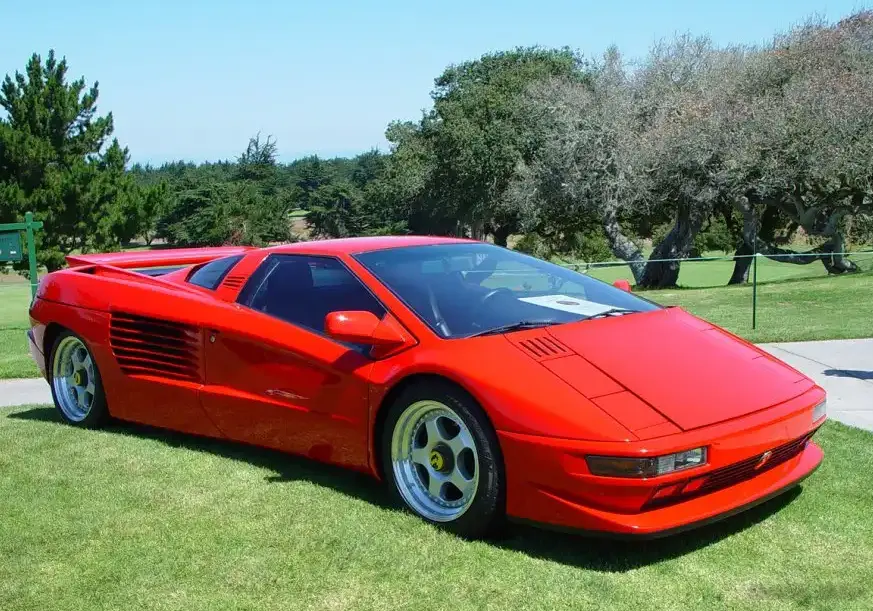
The Cizeta V16t was a low-volume Italian sports car produced between 1989 and 1993. Conceived by Claudio Zampolli, a former Lamborghini engineer, the V16t aimed to recapture the spirit of the classic Lamborghini Countach, offering a similarly dramatic design and a powerful, naturally aspirated V16 engine. Production was extremely limited, with only a handful of cars completed, making it a highly exclusive and sought-after vehicle among collectors. The “t” in V16t stands for “Twin,” referencing the dual turbochargers originally planned for the engine, though the production models were naturally aspirated.
Technical Specifications
| Brand | Cizeta |
| Model | V16t |
| Generation | V16t |
| Type (Engine) | 6.0 i V16 64V (520 Hp) |
| Start of production | 1989 |
| End of production | 1993 |
| Powertrain Architecture | Internal Combustion engine |
| Body type | Coupe |
| Seats | 2 |
| Doors | 2 |
| Fuel consumption (urban) | 24 l/100 km (9.8 US mpg, 11.8 UK mpg, 4.2 km/l) |
| Fuel consumption (extra urban) | 9.6 l/100 km (24.5 US mpg, 29.4 UK mpg, 10.4 km/l) |
| Fuel consumption (combined) | 11.3 l/100 km (20.8 US mpg, 25 UK mpg, 8.8 km/l) |
| Fuel Type | Petrol (Gasoline) |
| Acceleration 0 – 100 km/h | 4.5 sec |
| Acceleration 0 – 62 mph | 4.5 sec |
| Acceleration 0 – 60 mph | 4.3 sec |
| Maximum speed | 299 km/h (185.79 mph) |
| Power | 520 Hp @ 7000 rpm |
| Power per litre | 86.7 Hp/l |
| Torque | 540 Nm @ 4500 rpm (398.28 lb.-ft. @ 4500 rpm) |
| Engine displacement | 5995 cm3 (365.84 cu. in.) |
| Number of cylinders | 16 |
| Engine configuration | V-engine |
| Cylinder Bore | 86 mm (3.39 in.) |
| Piston Stroke | 64.5 mm (2.54 in.) |
| Compression ratio | 9.5:1 |
| Number of valves per cylinder | 4 |
| Fuel injection system | Multi-port manifold injection |
| Engine aspiration | Naturally aspirated engine |
| Max. weight | 1700 kg (3747.86 lbs.) |
| Trunk (boot) space – minimum | 250 l (8.83 cu. ft.) |
| Trunk (boot) space – maximum | 350 l (12.36 cu. ft.) |
| Fuel tank capacity | 136 l (35.93 US gal | 29.92 UK gal) |
| Length | 4440 mm (174.8 in.) |
| Width | 2050 mm (80.71 in.) |
| Height | 1240 mm (48.82 in.) |
| Wheelbase | 2690 mm (105.91 in.) |
| Front track | 1610 mm (63.39 in.) |
| Rear (Back) track | 1665 mm (65.55 in.) |
| Drivetrain Architecture | The Internal combustion engine (ICE) drives the rear wheels of the vehicle. |
| Drive wheel | Rear wheel drive |
| Number of gears and type of gearbox | 5 gears, manual transmission |
| Front suspension | Coil spring |
| Rear suspension | Coil spring |
| Front brakes | Ventilated discs |
| Rear brakes | Disc |
| Assisting systems | ABS (Anti-lock braking system), Hydraulic Steering |
| Tires size | 245/40 ZR17 |
Powertrain & Engine Architecture
The heart of the Cizeta V16t is its 6.0-liter, naturally aspirated V16 engine. This engine, designated as a 64V due to its four valves per cylinder, was a remarkable feat of engineering. It was built by a team that included former Lamborghini engineers, and its design was heavily influenced by the Lamborghini V12. The engine utilizes a 90-degree V-angle, contributing to a smoother power delivery. Fuel is delivered via a multi-port fuel injection system, carefully tuned to maximize performance. The engine produces 520 horsepower at 7000 rpm and 540 Nm (398 lb-ft) of torque at 4500 rpm. The engine is paired with a 5-speed manual transmission, sending power to the rear wheels. While turbocharging was initially considered, the production models opted for a naturally aspirated setup, prioritizing a more linear and predictable power curve.
Driving Characteristics
The Cizeta V16t delivers a unique driving experience. The large-displacement V16 provides substantial power throughout the rev range, resulting in impressive acceleration – 0 to 60 mph in approximately 4.3 seconds and a top speed of 185.79 mph. The 5-speed manual transmission requires a skilled driver to fully exploit the engine’s potential. The car’s weight of 1700 kg (3747.86 lbs) is noticeable, but the powerful engine overcomes this to provide exhilarating performance. Compared to potential turbocharged variants, the naturally aspirated engine offers a more immediate throttle response and a less peaky power delivery. The driving experience is raw and engaging, reminiscent of the classic Italian supercars of the era.
Equipment & Trim Levels
Given the limited production run, the Cizeta V16t was largely built to order, with a high degree of customization available. Standard features included leather upholstery, air conditioning, and power windows. The interior design, while luxurious, was relatively minimalist, focusing on functionality and driver engagement. Optional extras included upgraded audio systems, custom paint colors, and bespoke interior trim options. The dashboard layout was clean and straightforward, with a focus on essential driving information. The car featured a unique steering wheel design and a prominent central console housing the gear lever and various controls.
Chassis & Braking
The Cizeta V16t utilizes a steel tube chassis, providing a rigid and lightweight foundation for the vehicle. Suspension is handled by coil springs all around, offering a balance between comfort and handling. The car is equipped with ventilated disc brakes at the front and solid disc brakes at the rear, providing adequate stopping power for its performance capabilities. An anti-lock braking system (ABS) was included as standard, enhancing safety. The steering is hydraulically assisted, providing a responsive and precise feel. Tire size is 245/40 ZR17, chosen to provide optimal grip and handling characteristics.
Market Reception & Comparison
The Cizeta V16t received mixed reviews upon its release. Critics praised the car’s stunning design, powerful engine, and unique character. However, the high price tag and limited production run made it inaccessible to most enthusiasts. Fuel economy was predictably poor, with combined consumption of 11.3 l/100 km (20.8 US mpg). Compared to contemporaries like the Lamborghini Countach and Ferrari Testarossa, the V16t offered a different flavor of Italian exotic, prioritizing a more raw and visceral driving experience. Its rarity and unique engineering have made it a highly collectible vehicle.
Legacy
The Cizeta V16t remains a fascinating and highly collectible automobile. Its unique V16 engine and striking design have cemented its place in automotive history. While production numbers were low, the car has gained a devoted following among enthusiasts who appreciate its rarity and engineering excellence. The powertrain, while complex, has proven to be relatively reliable when properly maintained. Today, the Cizeta V16t commands a significant premium on the used car market, reflecting its exclusivity and historical significance. It represents a bold and ambitious attempt to create a modern interpretation of the classic Italian supercar, and its legacy continues to inspire automotive enthusiasts worldwide.
