
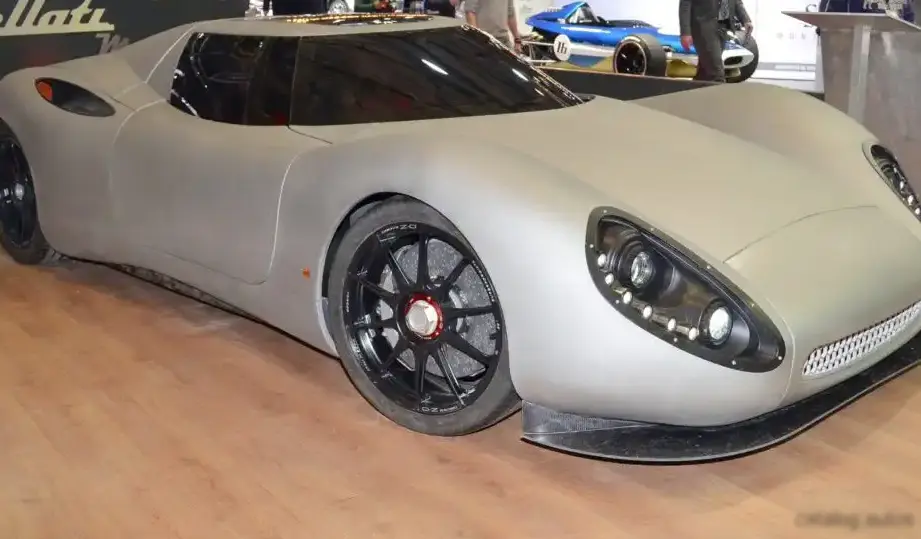
The Corbellati Missile, a striking Italian hypercar concept, debuted in 2018, representing an ambitious attempt to create an ultra-high-performance vehicle focused on raw power and speed. Produced as a single concept vehicle by Corbellati S.p.A., a small Italian automotive firm, the Missile aimed to challenge established hypercar manufacturers with its massive 9.0-liter twin-turbocharged V8 engine. Production was limited to the single concept shown, making it a rare and noteworthy vehicle in automotive history. The Missile was intended to showcase Corbellati’s engineering capabilities and design philosophy, prioritizing extreme performance above all else.
Technical Specifications
| Brand | Corbellati |
| Model | Missile |
| Generation | Missile (Concept) |
| Type (Engine) | 9.0 V8 (1800 Hp) |
| Start of production | 2018 |
| End of production | 2018 |
| Powertrain Architecture | Internal Combustion engine |
| Body type | Coupe |
| Seats | 2 |
| Doors | 2 |
| Fuel Type | Petrol (Gasoline) |
| Acceleration 0 – 60 mph | 2.0 sec |
| Maximum speed | 500 km/h (310.69 mph) |
| Power | 1800 Hp |
| Torque | 2350 Nm (1733.27 lb.-ft.) |
| Number of cylinders | 8 |
| Engine configuration | V-engine |
| Number of valves per cylinder | 4 |
| Fuel injection system | Direct injection |
| Engine aspiration | Twin-Turbo, Intercooler |
| Length | 4670 mm (183.86 in.) |
| Width | 2040 mm (80.31 in.) |
| Height | 1170 mm (46.06 in.) |
| Wheelbase | 2850 mm (112.2 in.) |
| Ride height (ground clearance) | 120 mm (4.72 in.) |
| Drivetrain Architecture | The Internal combustion engine (ICE) drives the rear wheels of the vehicle. |
| Drive wheel | Rear wheel drive |
| Number of gears and type of gearbox | 6 gears, manual transmission |
| Front suspension | Double wishbone |
| Rear suspension | Double wishbone |
| Front brakes | Ventilated discs |
| Rear brakes | Ventilated discs |
| Steering type | Steering rack and pinion |
| Tires size | Front wheel tires: 265/35 R20 Rear wheel tires: 345/30 R20 |
| Wheel rims size | 20 |
Powertrain & Engine Architecture
The heart of the Corbellati Missile is its massive 9.0-liter V8 engine. This engine, reportedly based on a heavily modified American V8 block, utilizes direct fuel injection and twin turbochargers with intercooling to produce a staggering 1800 horsepower and 2350 Nm (1733.27 lb.-ft.) of torque. The engine’s architecture is a traditional 90-degree V8 configuration with four valves per cylinder. The turbocharging system is crucial to achieving such high output, providing significant boost to overcome the inherent limitations of a naturally aspirated engine of this size. The concept car was paired with a 6-speed manual transmission, a deliberate choice to provide the driver with maximum control over the immense power. Details regarding the specific engine management system and turbocharger specifications remain limited, given the concept nature of the vehicle.
Driving Characteristics
Given that only a single concept vehicle was produced, extensive real-world driving data is scarce. However, the Missile’s specifications suggest an absolutely brutal driving experience. The 1800 horsepower output, coupled with the rear-wheel-drive configuration, would result in immense acceleration – a claimed 0-60 mph time of just 2.0 seconds and a top speed exceeding 310 mph. The 6-speed manual transmission would require significant skill to manage, demanding precise gear changes to harness the engine’s power effectively. The power delivery would likely be characterized by significant turbo lag at lower RPMs, followed by an explosive surge of power as the turbos spooled up. Controlling such a powerful vehicle would necessitate a sophisticated traction control system, although details of such a system in the concept car are not widely available. The car’s relatively low ride height and stiff suspension (double wishbone front and rear) would prioritize handling at high speeds, potentially at the expense of ride comfort.
Equipment & Trim Levels
As a one-off concept car, the Corbellati Missile was not offered with trim levels or optional extras in the traditional sense. The interior was designed to be minimalist and driver-focused, featuring two racing-style seats and a simple dashboard layout. The interior materials appeared to be high-quality, with extensive use of carbon fiber and leather. The instrument cluster was primarily digital, displaying essential vehicle information. The car featured ventilated disc brakes on all four wheels, essential for managing the heat generated during high-speed braking. Other features included a steering rack and pinion system for precise steering control and large 20-inch wheels fitted with high-performance tires (265/35 R20 front, 345/30 R20 rear).
Chassis & Braking
The Corbellati Missile’s chassis was constructed primarily from lightweight materials, including carbon fiber, to minimize weight and maximize performance. The double wishbone suspension system, both front and rear, was designed to provide precise handling and stability at high speeds. The ventilated disc brakes, located on all four wheels, were crucial for dissipating heat generated during aggressive braking maneuvers. The car’s relatively short wheelbase (2850 mm / 112.2 in.) contributed to its agility, while the wide track width (2040 mm / 80.31 in.) enhanced stability. The low ride height (120 mm / 4.72 in.) further improved aerodynamics and handling.
Market Reception & Comparison
The Corbellati Missile received significant attention from the automotive press upon its unveiling in 2018. Critics praised its audacious design and the sheer ambition of its powertrain. However, the concept nature of the vehicle and the lack of concrete production plans tempered enthusiasm. Compared to established hypercar rivals such as the Bugatti Chiron, Koenigsegg Agera, and Pagani Huayra, the Missile lacked the pedigree and proven track record of those manufacturers. Its reliance on a heavily modified American V8 engine, rather than a bespoke powerplant, also drew some criticism. Fuel economy and long-term reliability were not primary concerns given the vehicle’s intended purpose, but these factors would have been significant challenges for a production version.
Legacy
The Corbellati Missile remains a unique and intriguing concept car. While it never progressed beyond the prototype stage, it served as a bold statement of intent from a small Italian manufacturer. The Missile demonstrated Corbellati’s engineering capabilities and its willingness to push the boundaries of automotive performance. Its legacy lies in its audacious design and its uncompromising focus on raw power. The single concept vehicle is occasionally displayed at automotive events, continuing to captivate enthusiasts and serve as a reminder of the potential for extreme performance in the hypercar segment. Its long-term impact on the automotive industry is limited by its non-production status, but it remains a noteworthy example of Italian automotive creativity.
