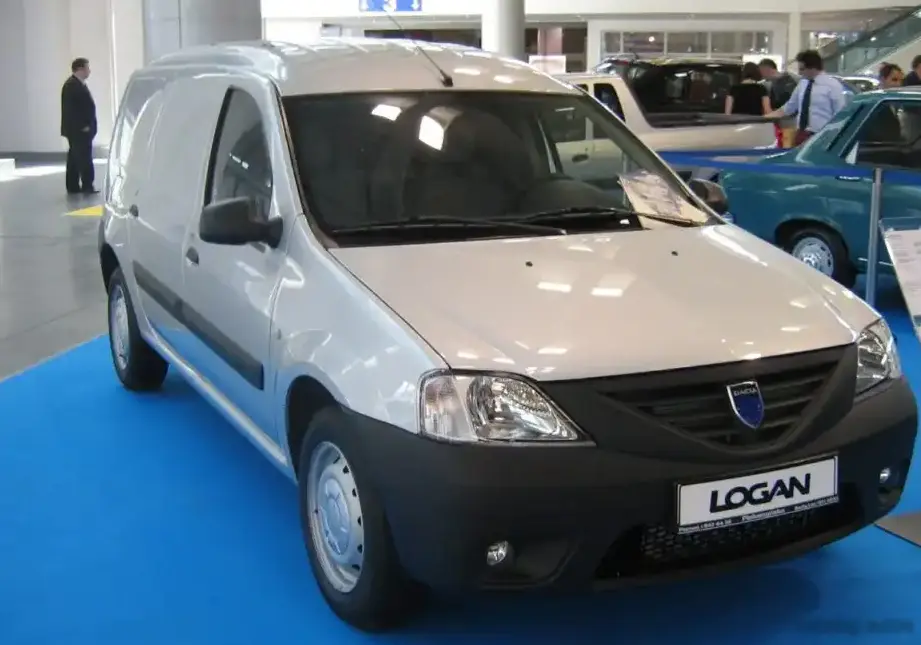
The Dacia Logan I Van 1.6 16V, produced from January 2007 to August 2012, represents a practical and affordable commercial vehicle option within the first generation Logan range. Based on the MCV (Multi-Capacity Vehicle) body style – essentially a station wagon – this variant was primarily aimed at small businesses and tradespeople requiring a spacious and economical load carrier. It occupied a mid-range position in the Logan Van lineup, offering a balance between payload capacity and running costs. The Logan I Van, and this 1.6L engine specifically, was a key component in Dacia’s strategy of providing no-frills transportation to price-sensitive markets, particularly in Eastern Europe and developing countries, but also gaining traction in Western Europe as a budget-friendly alternative.
Technical Specifications
| Brand | Dacia |
| Model | Logan |
| Generation | Logan I Van |
| Type (Engine) | 1.6 16V (105 Hp) |
| Start of production | January, 2007 |
| End of production | August, 2012 |
| Powertrain Architecture | Internal Combustion engine |
| Body type | Station wagon (estate) |
| Doors | 5 |
| Fuel consumption (urban) | 9.8 l/100 km (24 US mpg, 28.8 UK mpg, 10.2 km/l) |
| Fuel consumption (extra urban) | 6.3 l/100 km (37.3 US mpg, 44.8 UK mpg, 15.9 km/l) |
| Fuel consumption (combined) | 7.5 l/100 km (31.4 US mpg, 37.7 UK mpg, 13.3 km/l) |
| Fuel Type | Petrol (Gasoline) |
| Acceleration 0 – 100 km/h | 11.8 sec |
| Acceleration 0 – 62 mph | 11.8 sec |
| Acceleration 0 – 60 mph | 11.2 sec |
| Maximum speed | 174 km/h (108.12 mph) |
| Emission standard | Euro 4 |
| Weight-to-power ratio | 12.1 kg/Hp, 82.7 Hp/tonne |
| Weight-to-torque ratio | 8.6 kg/Nm, 116.5 Nm/tonne |
| Power | 105 Hp @ 5750 rpm |
| Power per litre | 65.7 Hp/l |
| Torque | 148 Nm @ 3750 rpm (109.16 lb.-ft. @ 3750 rpm) |
| Engine layout | Front, Transverse |
| Engine Model/Code | K4M 690 |
| Engine displacement | 1598 cm3 (97.52 cu. in.) |
| Number of cylinders | 4 |
| Engine configuration | Inline |
| Cylinder Bore | 79.5 mm (3.13 in.) |
| Piston Stroke | 80.5 mm (3.17 in.) |
| Compression ratio | 9.5:1 |
| Number of valves per cylinder | 4 |
| Fuel injection system | Multi-port manifold injection |
| Engine aspiration | Naturally aspirated engine |
| Engine oil capacity | 4.8 l (5.07 US qt | 4.22 UK qt) |
| Coolant capacity | 4.5 l (4.76 US qt | 3.96 UK qt) |
| Kerb Weight | 1270 kg (2799.87 lbs.) |
| Max. weight | 1770 kg (3902.18 lbs.) |
| Max load | 500 kg (1102.31 lbs.) |
| Trunk (boot) space – minimum | 700 l (24.72 cu. ft.) |
| Trunk (boot) space – maximum | 2350 l (82.99 cu. ft.) |
| Fuel tank capacity | 50 l (13.21 US gal | 11 UK gal) |
| Length | 4450 mm (175.2 in.) |
| Width | 1740 mm (68.5 in.) |
| Height | 1636 mm (64.41 in.) |
| Wheelbase | 2900 mm (114.17 in.) |
| Drivetrain Architecture | The Internal combustion engine (ICE) drives the front wheels of the vehicle. |
| Drive wheel | Front wheel drive |
| Number of gears and type of gearbox | 5 gears, manual transmission |
| Front brakes | Disc |
| Rear brakes | Drum |
| Assisting systems | ABS (Anti-lock braking system) |
| Tires size | 185/65 R15 |
Powertrain & Engine Architecture
The Dacia Logan I Van 1.6 16V utilizes the K4M 690 engine, a 1.6-liter inline-four cylinder gasoline engine developed by Renault. This engine, widely used across various Renault and Dacia models, is known for its simplicity and robustness. The ‘16V’ designation indicates a four-valve-per-cylinder configuration, enhancing breathing and contributing to improved power output compared to older two-valve designs. Fuel delivery is managed by a multi-point fuel injection system, providing precise fuel metering for optimal combustion. The engine’s 9.5:1 compression ratio strikes a balance between efficiency and performance. The engine is transversely mounted at the front of the vehicle, driving the front wheels. The five-speed manual transmission, a standard feature, is a relatively simple unit designed for durability and ease of maintenance. It features conventional synchromesh gears and a cable-operated shift linkage.
Driving Characteristics
The 105 horsepower and 109 lb-ft of torque produced by the 1.6L engine provide adequate, though not exhilarating, performance for the Logan I Van. Acceleration from 0-60 mph takes around 11.2 seconds, and top speed is approximately 108 mph. The engine feels relatively strained when fully loaded, particularly on inclines. The five-speed manual transmission is well-matched to the engine’s characteristics, with gear ratios optimized for fuel economy and usability. The gearshift action is generally precise, but can feel somewhat notchy. Compared to potential higher-output versions (which weren’t offered in the Van configuration), this setup prioritizes fuel efficiency and lower running costs over outright performance. The driving experience is best described as functional and utilitarian, focusing on practicality rather than driver engagement.
Equipment & Trim Levels
The Logan I Van 1.6 16V was typically equipped with a basic level of standard features, reflecting its commercial vehicle focus. Interior appointments were spartan, with durable plastic trim and cloth upholstery. Standard equipment generally included power steering, central locking, and an adjustable steering column. Air conditioning and a radio/CD player were often optional extras. The van’s interior prioritized practicality, with a large, flat load floor and minimal distractions. Trim levels were limited, with most vans being equipped to a single, functional specification. Options were typically limited to upgrades like improved sound systems or additional security features.
Chassis & Braking
The Logan I Van utilizes a relatively simple chassis design, featuring a MacPherson strut front suspension and a torsion beam rear axle. This setup provides a comfortable ride quality, particularly when unladen, but can feel somewhat wallowy when carrying a heavy load. Front brakes are ventilated discs, providing adequate stopping power, while rear brakes are drums. ABS (Anti-lock Braking System) was standard, enhancing safety in emergency braking situations. The suspension is tuned for durability and load-carrying capacity, rather than sporty handling. Stabilizer bars were fitted to both the front and rear axles to reduce body roll.
Market Reception & Comparison
The Dacia Logan I Van 1.6 16V was generally well-received by critics as a value-for-money commercial vehicle. Its spacious cargo area, low purchase price, and relatively good fuel economy were key selling points. However, it was often criticized for its basic interior, lack of refinement, and somewhat underwhelming performance. Compared to other vans in its class, such as the Fiat Doblo or Renault Kangoo, the Logan Van offered a more affordable entry point, but at the expense of features and driving experience. Fuel economy figures of around 31.4 US mpg combined were competitive for its class. Reliability was generally good, with the K4M engine proving to be a durable and dependable unit.
Legacy
The Dacia Logan I Van 1.6 16V has established a reputation as a reliable and affordable workhorse in the used car market. The K4M engine is known for its longevity, and parts availability remains good. While not a particularly desirable vehicle for enthusiasts, it continues to be a popular choice for small businesses and tradespeople seeking a practical and economical van. Its simple construction and robust design make it relatively easy and inexpensive to maintain. Today, well-maintained examples can still be found in service, testament to the Logan Van’s enduring practicality and value.