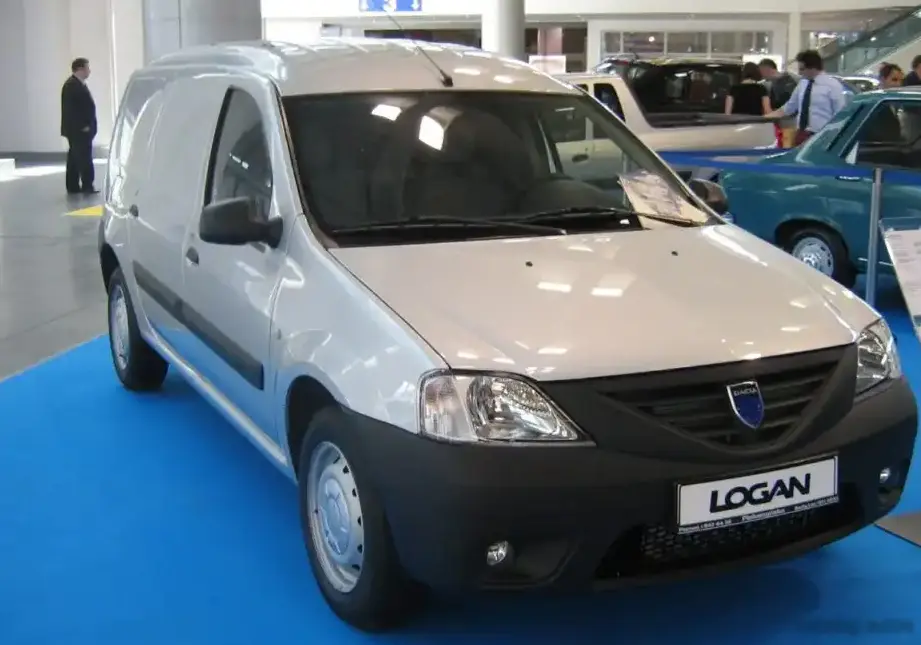
The Dacia Logan I Van 1.6, producing 87 horsepower, was a practical and affordable commercial vehicle offered by the Romanian manufacturer Dacia between January 2007 and August 2012. Positioned as a budget-friendly workhorse, the Van variant of the first-generation Logan (based on the X90 platform) prioritized cargo capacity and low running costs over outright performance or luxury. It was primarily aimed at small businesses, tradespeople, and those needing a versatile vehicle for light commercial duties within European markets. This specific 1.6-liter engine and five-speed manual transmission combination represented a core offering in the Logan Van lineup, balancing usability with economy.
Technical Specifications
| Brand | Dacia |
| Model | Logan |
| Generation | Logan I Van |
| Type (Engine) | 1.6 (87 Hp) |
| Start of production | January, 2007 |
| End of production | August, 2012 |
| Powertrain Architecture | Internal Combustion engine |
| Body type | Station wagon (estate) |
| Doors | 5 |
| Fuel consumption (urban) | 10.4 l/100 km (22.6 US mpg, 27.2 UK mpg, 9.6 km/l) |
| Fuel consumption (extra urban) | 6.3 l/100 km (37.3 US mpg, 44.8 UK mpg, 15.9 km/l) |
| Fuel consumption (combined) | 7.8 l/100 km (30.2 US mpg, 36.2 UK mpg, 12.8 km/l) |
| Fuel Type | Petrol (Gasoline) |
| Acceleration 0 – 100 km/h | 13.4 sec |
| Acceleration 0 – 62 mph | 13.4 sec |
| Acceleration 0 – 60 mph | 12.7 sec |
| Maximum speed | 167 km/h (103.77 mph) |
| Emission standard | Euro 4 |
| Weight-to-power ratio | 14.3 kg/Hp, 70.2 Hp/tonne |
| Weight-to-torque ratio | 9.7 kg/Nm, 103.2 Nm/tonne |
| Power | 87 Hp @ 5500 rpm |
| Power per litre | 54.4 Hp/l |
| Torque | 128 Nm @ 3000 rpm (94.41 lb.-ft. @ 3000 rpm) |
| Engine layout | Front, Transverse |
| Engine Model/Code | K7M 710 |
| Engine displacement | 1598 cm3 (97.52 cu. in.) |
| Number of cylinders | 4 |
| Engine configuration | Inline |
| Cylinder Bore | 79.5 mm (3.13 in.) |
| Piston Stroke | 80.5 mm (3.17 in.) |
| Compression ratio | 9.5:1 |
| Number of valves per cylinder | 2 |
| Fuel injection system | Multi-port manifold injection |
| Engine aspiration | Naturally aspirated engine |
| Engine oil capacity | 3.3 l (3.49 US qt | 2.9 UK qt) |
| Coolant capacity | 4.5 l (4.76 US qt | 3.96 UK qt) |
| Kerb Weight | 1240 kg (2733.73 lbs.) |
| Max. weight | 1740 kg (3836.04 lbs.) |
| Max load | 500 kg (1102.31 lbs.) |
| Trunk (boot) space – maximum | 2350 l (82.99 cu. ft.) |
| Fuel tank capacity | 50 l (13.21 US gal | 11 UK gal) |
| Length | 4450 mm (175.2 in.) |
| Width | 1740 mm (68.5 in.) |
| Height | 1636 mm (64.41 in.) |
| Wheelbase | 2900 mm (114.17 in.) |
| Drivetrain Architecture | The Internal combustion engine (ICE) drives the front wheels of the vehicle. |
| Drive wheel | Front wheel drive |
| Number of gears and type of gearbox | 5 gears, manual transmission |
| Front brakes | Disc |
| Rear brakes | Drum |
| Assisting systems | ABS (Anti-lock braking system) |
| Tires size | 185/65 R15 |
Powertrain & Engine Architecture
The Dacia Logan I Van 1.6 was powered by the K7M 710 engine, a 1.6-liter inline-four cylinder gasoline engine. This engine, originating from Renault, was known for its simplicity and robustness. It featured a single overhead camshaft (SOHC) valvetrain with two valves per cylinder. Fuel delivery was handled by a multi-point fuel injection system, providing adequate, though not particularly sophisticated, control over the air-fuel mixture. The engine produced 87 horsepower at 5500 rpm and 128 Nm (94.41 lb-ft) of torque at 3000 rpm. The five-speed manual transmission was a standard offering, chosen for its cost-effectiveness and suitability for commercial applications. The transmission’s gear ratios were geared towards maximizing fuel efficiency and providing sufficient torque for carrying loads, rather than sporty acceleration.
Driving Characteristics
The 1.6-liter engine in the Logan Van, paired with the five-speed manual transmission, delivered modest performance. Acceleration from 0-60 mph took approximately 12.7 seconds, and the top speed was around 103.77 mph. The focus was clearly on utility rather than speed. The engine felt somewhat strained when fully loaded, requiring frequent downshifts to maintain momentum on inclines. Compared to potential higher-output variants (had they been offered in the Van configuration), this setup prioritized fuel economy and reduced maintenance costs. The gear ratios were relatively long, contributing to better fuel efficiency on the highway but limiting responsiveness in city driving. The suspension, tuned for carrying loads, provided a comfortable ride when unladen but could become somewhat bouncy with a full cargo bay.
Equipment & Trim Levels
The Logan I Van 1.6 was typically offered with a basic level of equipment, reflecting its commercial focus. Standard features generally included power steering, central locking, and an adjustable steering column. The interior was functional and durable, with hard-wearing plastic trim and cloth upholstery. Air conditioning and a radio/CD player were often optional extras. The Van’s defining feature was its large cargo area, accessible through rear doors. The rear seats were typically absent or could be folded away to maximize space. Trim levels were minimal, with most variations stemming from optional equipment packages.
Chassis & Braking
The Logan Van utilized a relatively simple chassis design. The front suspension consisted of MacPherson struts, while the rear suspension employed a torsion beam axle. This setup provided a good balance between ride comfort and load-carrying capacity. Braking was handled by disc brakes on the front wheels and drum brakes on the rear. Anti-lock Braking System (ABS) was standard, enhancing safety during emergency braking situations. The tires were typically 185/65 R15, chosen for their durability and affordability.
Market Reception & Comparison
The Dacia Logan I Van 1.6 was well-received in its target market as a no-frills, affordable commercial vehicle. Critics praised its spacious cargo area, low running costs, and robust construction. However, the engine was often criticized for being underpowered, particularly when the van was fully loaded. Compared to other small vans available at the time, such as the Fiat Doblo or Renault Kangoo, the Logan Van offered a more basic package but at a significantly lower price point. Its fuel economy was competitive, averaging around 30.2 US mpg in combined driving conditions. Reliability was generally good, thanks to the simplicity of the engine and drivetrain.
Legacy
The Dacia Logan I Van 1.6 remains a popular choice in the used commercial vehicle market, particularly in Eastern Europe and other regions where affordability is a key consideration. The K7M engine is known for its durability and relatively low maintenance costs, making it a reliable option for small businesses and tradespeople. While not offering the refinement or performance of more modern vans, the Logan Van continues to provide a practical and cost-effective solution for light commercial duties. Its simple design and readily available parts contribute to its ongoing appeal and ease of repair.