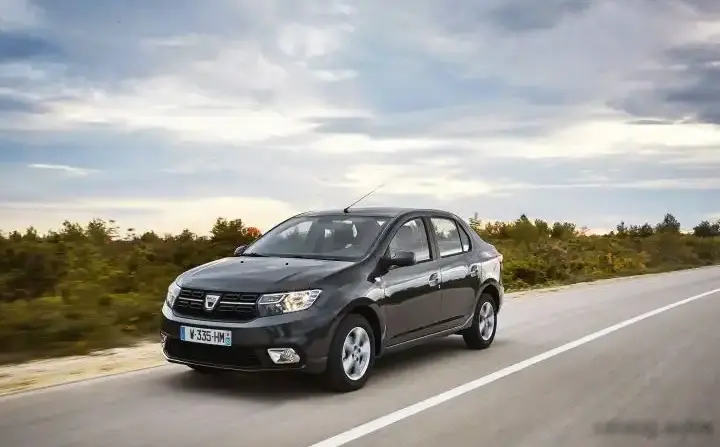
The Dacia Logan II (facelift 2016) 0.9 TCe 90 hp variant was a key offering in Dacia’s lineup from 2019 until September 2020. Positioned as an entry-level to mid-range option, it provided a more fuel-efficient alternative to the larger-displacement engines available in the Logan II range. This model represented Dacia’s commitment to providing affordable transportation, particularly within European markets, where the Logan II found significant success as a budget-friendly sedan. The facelifted Logan II, built on the 1HX0/A3 platform, aimed to refine the original’s practicality with updated styling and improved equipment levels.
Technical Specifications
| Brand | Dacia |
| Model | Logan |
| Generation | Logan II (facelift 2016) |
| Type (Engine) | 0.9 TCe (90 Hp) |
| Start of production | 2019 |
| End of production | September, 2020 |
| Powertrain Architecture | Internal Combustion engine |
| Body type | Sedan |
| Seats | 5 |
| Doors | 4 |
| Combined fuel consumption (WLTP) | 5.9-6.6 l/100 km (39.9 – 35.6 US mpg, 47.9 – 42.8 UK mpg, 16.9 – 15.2 km/l) |
| CO2 emissions (WLTP) | 133-150 g/km |
| Fuel consumption (economy) – urban (NEDC) | 6.3 l/100 km (37.3 US mpg, 44.8 UK mpg, 15.9 km/l) |
| Fuel consumption (economy) – extra urban (NEDC) | 4.6 l/100 km (51.1 US mpg, 61.4 UK mpg, 21.7 km/l) |
| Fuel consumption (economy) – combined (NEDC) | 5.3 l/100 km (44.4 US mpg, 53.3 UK mpg, 18.9 km/l) |
| CO2 emissions (NEDC) | 120 g/km |
| Fuel Type | Petrol (Gasoline) |
| Acceleration 0 – 100 km/h | 11.1 sec |
| Acceleration 0 – 62 mph | 11.1 sec |
| Acceleration 0 – 60 mph | 10.5 sec |
| Maximum speed | 175 km/h (108.74 mph) |
| Emission standard | Euro 6d-TEMP |
| Weight-to-power ratio | 12.1 kg/Hp, 82.7 Hp/tonne |
| Weight-to-torque ratio | 7.8 kg/Nm, 128.7 Nm/tonne |
| Power | 90 Hp @ 5000 rpm |
| Power per litre | 100.2 Hp/l |
| Torque | 140 Nm @ 2250 rpm (103.26 lb.-ft. @ 2250 rpm) |
| Engine layout | Front, Transverse |
| Engine Model/Code | H4B 408 |
| Engine displacement | 898 cm3 (54.8 cu. in.) |
| Number of cylinders | 3 |
| Engine configuration | Inline |
| Number of valves per cylinder | 4 |
| Fuel injection system | Multi-port manifold injection |
| Engine aspiration | Turbocharger, Intercooler |
| Engine oil capacity | 4.1 l (4.33 US qt | 3.61 UK qt) |
| Coolant | 4.5 l (4.76 US qt | 3.96 UK qt) |
| Kerb Weight | 1088 kg (2398.63 lbs.) |
| Max. weight | 1533 kg (3379.69 lbs.) |
| Max load | 445 kg (981.06 lbs.) |
| Trunk (boot) space – minimum | 510 l (18.01 cu. ft.) |
| Trunk (boot) space – maximum | 1257 l (44.39 cu. ft.) |
| Fuel tank capacity | 50 l (13.21 US gal | 11 UK gal) |
| Permitted trailer load with brakes (12%) | 1090 kg (2403.04 lbs.) |
| Permitted trailer load without brakes | 540 kg (1190.5 lbs.) |
| Length | 4346 mm (171.1 in.) |
| Width | 1733 mm (68.23 in.) |
| Width including mirrors | 1994 mm (78.5 in.) |
| Height | 1517 mm (59.72 in.) |
| Wheelbase | 2634 mm (103.7 in.) |
| Front track | 1497 mm (58.94 in.) |
| Rear (Back) track | 1486 mm (58.5 in.) |
| Front overhang | 827 mm (32.56 in.) |
| Rear overhang | 885 mm (34.84 in.) |
| Ride height (ground clearance) | 130 mm (5.12 in.) |
| Minimum turning circle (turning diameter) | 10.8 m (35.43 ft.) |
| Drivetrain Architecture | The Internal combustion engine (ICE) drives the front wheels of the vehicle. |
| Drive wheel | Front wheel drive |
| Number of gears and type of gearbox | 5 gears, manual transmission |
| Front brakes | Ventilated discs, 258×22 mm |
| Rear brakes | Drum |
| Assisting systems | ABS (Anti-lock braking system) |
| Steering type | Steering rack and pinion |
| Power steering | Hydraulic Steering |
| Tires size | 185/65 R15 |
| Wheel rims size | 6J x 15 |
Powertrain & Engine Architecture
The heart of this Logan variant is the H4B 408, a 0.9-liter turbocharged three-cylinder engine. This engine is part of Renault’s TCe (Turbo Control efficiency) family and was designed to offer a balance of fuel economy and adequate performance. It utilizes a single-scroll turbocharger with an intercooler to boost power output. The engine employs multi-point fuel injection and features four valves per cylinder. The 0.9 TCe engine is known for its relatively smooth operation for a three-cylinder unit, thanks to careful engineering and balancing. The engine paired with a 5-speed manual transmission, delivering power to the front wheels. While an automated manual transmission (AMT) was available in some markets, the 5-speed manual was the most common pairing for this engine.
Driving Characteristics
The 90 hp 0.9 TCe engine in the Logan II provided adequate, though not exhilarating, performance. Acceleration from 0-60 mph took around 10.5 seconds, and top speed was approximately 108.74 mph. The turbocharger provides a noticeable boost in power at lower RPMs, helping with everyday driving situations like overtaking. However, the engine can feel strained when pushed hard, particularly when fully loaded. The 5-speed manual transmission is well-matched to the engine’s characteristics, offering a reasonable spread of gears. Compared to the 1.6-liter petrol engine available in the Logan II, the 0.9 TCe offered significantly better fuel economy but lacked the larger engine’s outright power and refinement. The manual transmission provided a more engaging driving experience than the optional AMT.
Equipment & Trim Levels
The 0.9 TCe 90 hp variant typically came equipped with a base level of features, reflecting its position as an entry-level model. Standard equipment generally included power steering, central locking, electric front windows, and an ABS braking system. Higher trim levels added features such as air conditioning, a radio with USB connectivity, and alloy wheels. Interior upholstery was typically cloth, with a functional and durable design. Optional extras included a navigation system, rear parking sensors, and cruise control.
Chassis & Braking
The Logan II featured a conventional front-wheel-drive chassis with MacPherson strut suspension at the front and a torsion beam axle at the rear. The braking system consisted of ventilated discs on the front wheels and drum brakes on the rear. This configuration was chosen to keep costs down while providing adequate stopping power for the vehicle’s weight class. The suspension setup prioritized ride comfort over sporty handling, providing a reasonably comfortable ride on most road surfaces. Stabilizer bars were included to reduce body roll during cornering.
Market Reception & Comparison
The Dacia Logan II 0.9 TCe 90 hp was generally well-received by critics for its affordability and fuel efficiency. It was praised as a practical and sensible choice for budget-conscious buyers. However, some reviewers noted the engine’s lack of refinement and limited power. Compared to other trims in the Logan II lineup, the 0.9 TCe offered the best fuel economy but the slowest acceleration. It was often compared to similar budget-oriented sedans from other manufacturers, such as the Skoda Rapid and the Hyundai Accent.
Legacy
The 0.9 TCe engine proved to be a relatively reliable unit, although some owners have reported issues with the turbocharger and fuel injectors. The Logan II, in general, has a reputation for being a durable and low-maintenance vehicle. On the used car market, the 0.9 TCe variant remains an attractive option for buyers seeking an affordable and fuel-efficient sedan. Its simplicity and relatively low running costs make it a practical choice for everyday transportation. While not a performance car, the Logan II 0.9 TCe 90 hp represents a significant step forward in terms of fuel efficiency and refinement for Dacia’s budget-friendly lineup.