Technical Specifications
| Brand | Dacia |
| Model | Logan |
| Generation | Logan II (facelift 2016) |
| Type (Engine) | 1.5 Blue dCi (95 Hp) |
| Start of production | 2018 |
| End of production | September, 2020 |
| Powertrain Architecture | Internal Combustion engine |
| Body type | Sedan |
| Seats | 5 |
| Doors | 4 |
| Combined fuel consumption (WLTP) | 4.4-4.8 l/100 km (53.5 – 49 US mpg, 64.2 – 58.9 UK mpg, 22.7 – 20.8 km/l) |
| CO2 emissions (WLTP) | 115-125 g/km |
| Fuel consumption (economy) – urban (NEDC) | 4.3 l/100 km (54.7 US mpg, 65.7 UK mpg, 23.3 km/l) |
| Fuel consumption (economy) – extra urban (NEDC) | 3.2 l/100 km (73.5 US mpg, 88.3 UK mpg, 31.3 km/l) |
| Fuel consumption (economy) – combined (NEDC) | 3.6 l/100 km (65.3 US mpg, 78.5 UK mpg, 27.8 km/l) |
| CO2 emissions (NEDC) | 96 g/km |
| Fuel Type | Diesel |
| Acceleration 0 – 100 km/h | 11.9 sec |
| Acceleration 0 – 62 mph | 11.9 sec |
| Acceleration 0 – 60 mph | 11.3 sec |
| Maximum speed | 179 km/h (111.23 mph) |
| Emission standard | Euro 6d-TEMP |
| Weight-to-power ratio | 12.6 kg/Hp, 79.4 Hp/tonne |
| Weight-to-torque ratio | 5.4 kg/Nm, 183.9 Nm/tonne |
| Power | 95 Hp @ 3750 rpm |
| Power per litre | 65 Hp/l |
| Torque | 220 Nm @ 1750 rpm (162.26 lb.-ft. @ 1750 rpm) |
| Engine layout | Front, Transverse |
| Engine Model/Code | K9K 872 |
| Engine displacement | 1461 cm3 (89.16 cu. in.) |
| Number of cylinders | 4 |
| Engine configuration | Inline |
| Number of valves per cylinder | 2 |
| Fuel injection system | Diesel Commonrail |
| Engine aspiration | Turbocharger, Intercooler |
| Engine oil capacity | 5.7 l (6.02 US qt | 5.02 UK qt) |
| Coolant | 4.5 l (4.76 US qt | 3.96 UK qt) |
| Kerb Weight | 1196 kg (2636.73 lbs.) |
| Max. weight | 1635 kg (3604.56 lbs.) |
| Max load | 439 kg (967.83 lbs.) |
| Trunk (boot) space – minimum | 510 l (18.01 cu. ft.) |
| Trunk (boot) space – maximum | 1257 l (44.39 cu. ft.) |
| Fuel tank capacity | 50 l (13.21 US gal | 11 UK gal) |
| AdBlue tank | 14.4 l (3.8 US gal | 3.17 UK gal) |
| Permitted trailer load with brakes (12%) | 1090 kg (2403.04 lbs.) |
| Permitted trailer load without brakes | 595 kg (1311.75 lbs.) |
| Length | 4346 mm (171.1 in.) |
| Width | 1733 mm (68.23 in.) |
| Width including mirrors | 1994 mm (78.5 in.) |
| Height | 1517 mm (59.72 in.) |
| Wheelbase | 2634 mm (103.7 in.) |
| Front track | 1497 mm (58.94 in.) |
| Rear (Back) track | 1486 mm (58.5 in.) |
| Front overhang | 827 mm (32.56 in.) |
| Rear overhang | 885 mm (34.84 in.) |
| Ride height (ground clearance) | 130 mm (5.12 in.) |
| Minimum turning circle (turning diameter) | 10.8 m (35.43 ft.) |
| Drivetrain Architecture | The Internal combustion engine (ICE) drives the front wheels of the vehicle. |
| Drive wheel | Front wheel drive |
| Number of gears and type of gearbox | 5 gears, manual transmission |
| Front brakes | Ventilated discs, 258×22 mm |
| Rear brakes | Drum |
| Assisting systems | ABS (Anti-lock braking system) |
| Steering type | Steering rack and pinion |
| Power steering | Hydraulic Steering |
| Tires size | 185/65 R15 |
| Wheel rims size | 6J x 15 |
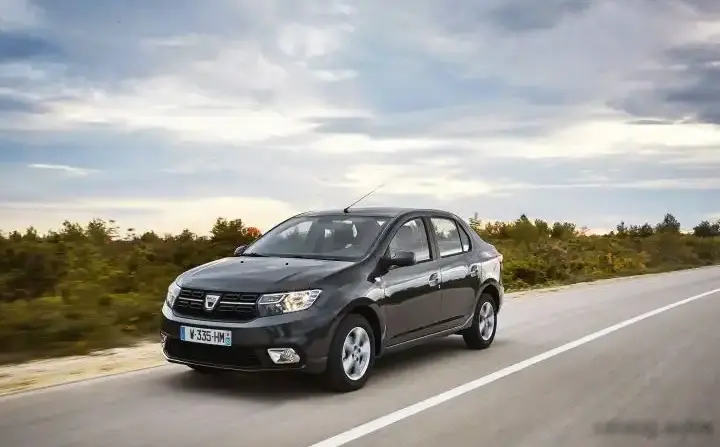
The Dacia Logan II (facelift 2016) 1.5 Blue dCi 95 Hp, produced from 2018 to September 2020, represents a significant variant within the second generation of Dacia’s popular Logan model. Positioned as a fuel-efficient and practical option, this version appealed to buyers seeking a cost-effective diesel sedan. It was part of the broader Logan II facelift range, built on the 1HX0/A3 platform shared with Renault. This specific trim aimed to balance affordability with reasonable performance and economy, making it a common sight in European markets where diesel engines were still widely used.
Powertrain & Engine Architecture
The engine powering this Logan variant is the Renault-sourced 1.5 Blue dCi, identified by the engine code K9K 872. This is a four-cylinder, inline diesel engine employing a common rail direct injection system. The ‘Blue dCi’ designation indicates the inclusion of emissions-reducing technologies, including a diesel particulate filter (DPF) and a selective catalytic reduction (SCR) system that requires AdBlue fluid. The engine utilizes a single overhead camshaft (SOHC) with two valves per cylinder. A turbocharger, working in conjunction with an intercooler, enhances power and torque delivery, particularly at lower engine speeds. The engine produces 95 horsepower at 3750 rpm, and a peak torque of 220 Nm (162 lb-ft) is available from 1750 rpm. This engine was known for its robust construction and fuel efficiency. A 5-speed manual transmission was the sole gearbox option, prioritizing cost-effectiveness over more advanced automatic options.
Driving Characteristics
The 1.5 Blue dCi 95 Hp Logan delivers a practical, though not particularly sporty, driving experience. The engine provides sufficient power for everyday driving, but acceleration is modest, taking approximately 11.9 seconds to reach 62 mph. The gear ratios in the 5-speed manual transmission are optimized for fuel economy, which can result in the engine feeling somewhat strained during quick acceleration or when climbing hills. Compared to higher-output Logan II models, or those equipped with an automatic transmission, this variant feels noticeably slower. However, the engine’s strong low-end torque makes it relatively easy to maneuver in urban environments. The focus is on efficiency and usability rather than dynamic performance.
Equipment & Trim Levels
The 1.5 Blue dCi 95 Hp trim typically included standard features such as power-assisted steering, central locking, electric front windows, and an anti-lock braking system (ABS). Interior upholstery was generally cloth, with a functional, if basic, dashboard layout. Air conditioning was often offered as an optional extra, along with features like alloy wheels, a radio/CD player, and rear electric windows. This trim level aimed to provide essential comfort and safety features at an affordable price point. It occupied a middle ground within the Logan II range, offering an upgrade from the very basic entry-level models while lacking the premium features found in higher-specification versions.
Chassis & Braking
The Logan II’s chassis is a relatively simple, yet effective, design. The front suspension utilizes MacPherson struts, while the rear employs a torsion beam setup. This configuration prioritizes cost-effectiveness and durability over sophisticated handling characteristics. The braking system features ventilated discs on the front wheels and drum brakes on the rear, a common setup for vehicles in this class and weight category. Hydraulic power steering provides adequate assistance, though it lacks the precision and feedback of more advanced systems. Stabilizer bars were included to minimize body roll, but the overall handling is geared towards comfort and stability rather than sporty dynamics.
Market Reception & Comparison
The Dacia Logan II 1.5 Blue dCi 95 Hp was generally well-received by automotive critics as a practical and affordable family car. Its fuel economy was a major selling point, particularly in Europe where diesel fuel was often competitively priced. Compared to other trims within the Logan II lineup, this variant offered a good balance between price, performance, and fuel efficiency. While the higher-output engines provided more power, they also came with a higher purchase price and slightly reduced fuel economy. The 1.5 dCi was often considered the ideal choice for buyers prioritizing practicality and running costs.
Legacy
The K9K engine family, including the 872 variant, has demonstrated relatively good long-term reliability when properly maintained. Regular servicing, including oil changes and DPF regeneration, is crucial to prevent potential issues. In the used car market, the Logan II 1.5 Blue dCi 95 Hp remains a popular choice for budget-conscious buyers. Its affordability, fuel efficiency, and relatively simple mechanicals make it an attractive option for those seeking a dependable and economical vehicle. However, prospective buyers should be aware of the potential costs associated with DPF maintenance and the ongoing need for AdBlue refills.