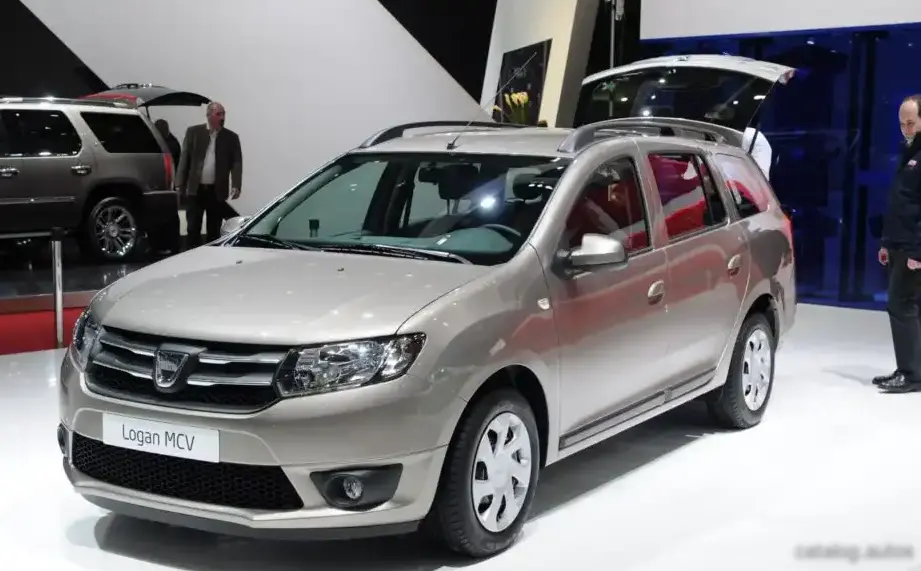
The Dacia Logan II MCV 0.9 TCe (90 hp) is a compact estate car produced by the Romanian manufacturer Dacia between 2013 and 2015. Positioned as an entry-level variant within the second generation Logan MCV (Multi-Capacity Vehicle) lineup, it offered a more economical and accessible option compared to higher-trim levels and larger-displacement engines. The Logan MCV, itself a practical and spacious vehicle, aimed to provide affordable family transport, particularly in European markets where the estate body style remains popular. This specific 0.9 TCe version represented Dacia’s move towards smaller, turbocharged engines to improve fuel efficiency and meet increasingly stringent emissions regulations.
Technical Specifications
| Brand | Dacia |
| Model | Logan |
| Generation | Logan II MCV |
| Type (Engine) | 0.9 TCe (90 Hp) |
| Start of production | 2013 |
| End of production | 2015 |
| Powertrain Architecture | Internal Combustion engine |
| Body type | Station wagon (estate) |
| Seats | 5 |
| Doors | 5 |
| Fuel consumption (urban) | 6.4 l/100 km (36.8 US mpg, 44.1 UK mpg, 15.6 km/l) |
| Fuel consumption (extra urban) | 4.4 l/100 km (53.5 US mpg, 64.2 UK mpg, 22.7 km/l) |
| Fuel consumption (combined) | 5.2 l/100 km (45.2 US mpg, 54.3 UK mpg, 19.2 km/l) |
| Fuel Type | Petrol (Gasoline) |
| Acceleration 0 – 100 km/h | 11.1 sec |
| Acceleration 0 – 62 mph | 11.1 sec |
| Acceleration 0 – 60 mph | 10.5 sec |
| Maximum speed | 175 km/h (108.74 mph) |
| Weight-to-power ratio | 11.5 kg/Hp, 86.7 Hp/tonne |
| Weight-to-torque ratio | 7.7 kg/Nm, 130.1 Nm/tonne |
| Power | 90 Hp @ 5250 rpm |
| Power per litre | 100.2 Hp/l |
| Torque | 135 Nm @ 2500 rpm (99.57 lb.-ft. @ 2500 rpm) |
| Engine layout | Front, Transverse |
| Engine Model/Code | H4B 400 |
| Engine displacement | 898 cm3 (54.8 cu. in.) |
| Number of cylinders | 3 |
| Engine configuration | Inline |
| Number of valves per cylinder | 4 |
| Fuel injection system | Multi-port manifold injection |
| Engine aspiration | Turbocharger, Intercooler |
| Engine oil capacity | 4.1 l (4.33 US qt | 3.61 UK qt) |
| Coolant capacity | 4.5 l (4.76 US qt | 3.96 UK qt) |
| Kerb Weight | 1038 kg (2288.4 lbs) |
| Max. weight | 1620 kg (3571.49 lbs) |
| Max load | 582 kg (1283.09 lbs) |
| Trunk (boot) space – minimum | 573 l (20.24 cu. ft.) |
| Trunk (boot) space – maximum | 1518 l (53.61 cu. ft.) |
| Fuel tank capacity | 50 l (13.21 US gal | 11 UK gal) |
| Length | 4492 mm (176.85 in) |
| Width | 1733 mm (68.23 in) |
| Height | 1539 mm (60.59 in) |
| Wheelbase | 2634 mm (103.7 in) |
| Drivetrain Architecture | The Internal combustion engine (ICE) drives the front wheels of the vehicle. |
| Drive wheel | Front wheel drive |
| Number of gears and type of gearbox | 5 gears, manual transmission |
| Front suspension | Independent, type McPherson with coil spring and anti-roll bar |
| Rear suspension | Torsion |
| Steering type | Steering rack and pinion |
| Power steering | Hydraulic Steering |
| Tires size | 185/65 R15 |
| Wheel rims size | 15 |
Powertrain & Engine Architecture
The heart of the Logan II MCV 0.9 TCe is the H4B 400 engine, a 898cc inline three-cylinder petrol engine. This engine is part of Dacia’s alliance with Renault, and shares technology with Renault’s own small-displacement turbocharged units. The H4B 400 utilizes a single-scroll turbocharger with an intercooler to boost power and efficiency. Fuel is delivered via multi-point fuel injection. The engine features four valves per cylinder, contributing to improved breathing and power output. The 90 horsepower and 135 Nm (99.57 lb-ft) of torque are relatively modest, but sufficient for everyday driving. The engine is paired with a five-speed manual transmission, as an automatic transmission was not offered with this engine configuration in the Logan MCV.
Driving Characteristics
The 0.9 TCe engine in the Logan II MCV provides adequate, though not exhilarating, performance. Acceleration from 0-60 mph takes around 10.5 seconds, and top speed is around 108.74 mph. The turbocharger provides a noticeable boost in power at lower RPMs, helping with everyday overtaking and hill climbing. However, the engine can feel strained when fully loaded or at higher speeds. The five-speed manual transmission is well-matched to the engine’s characteristics, with gear ratios designed to maximize fuel efficiency and provide reasonable acceleration. Compared to the 1.6-liter petrol engine offered in other Logan MCV trims, the 0.9 TCe prioritizes fuel economy over outright performance. The lighter engine weight also contributes to slightly improved handling.
Equipment & Trim Levels
The 0.9 TCe variant of the Logan II MCV typically came with a basic level of equipment, reflecting its position as an entry-level model. Standard features generally included power steering, central locking, electric front windows, and an adjustable steering column. Safety equipment included ABS brakes, front airbags, and seatbelt pretensioners. Higher trim levels offered options such as air conditioning, a radio with CD player, and alloy wheels. Interior upholstery was typically cloth, and the dashboard featured a functional, if somewhat basic, design. The focus was on practicality and durability rather than luxury.
Chassis & Braking
The Logan II MCV utilizes a McPherson strut front suspension and a torsion beam rear suspension. This setup provides a comfortable ride quality, although it’s not particularly sporty. The front brakes are disc brakes, while the rear brakes are typically drum brakes, a cost-saving measure common in this segment. Hydraulic power steering is standard. The 185/65 R15 tires provide adequate grip for everyday driving conditions. The chassis is designed to prioritize robustness and affordability, rather than dynamic handling.
Market Reception & Comparison
The Dacia Logan II MCV 0.9 TCe was generally well-received by critics for its affordability and fuel efficiency. It was praised as a practical and spacious family car, offering excellent value for money. However, some reviewers noted the engine’s lack of refinement and limited power. Compared to other trims in the Logan MCV lineup, the 0.9 TCe offered significantly better fuel economy, but at the expense of performance. It competed with other budget-oriented estate cars, such as the Skoda Fabia Estate and the Peugeot 308 SW, offering a compelling alternative for buyers prioritizing affordability and practicality.
Legacy
The H4B 400 engine, while not known for being a high-performance unit, has proven to be relatively reliable in the Logan II MCV. Common issues are generally minor and related to turbocharger wear or sensor failures. On the used car market, the 0.9 TCe variant remains an attractive option for buyers seeking an affordable and economical estate car. Its fuel efficiency and spacious interior continue to be key selling points. The Logan II MCV, in general, has established a reputation for being a durable and low-cost-to-maintain vehicle, making it a popular choice for budget-conscious buyers.